
So, you just stumbled upon a “NordVPN Premium Crack” file or similar pirated software promising lifetime access for free? Hold on a second. In the cybersecurity world, the old adage remains undefeated: If it sounds too good to be true, it usually is.
Let’s get real – hackers aren’t running charities. When they offer you a cracked VPN, the hidden price you pay is often far steeper than a mere $3 monthly subscription.
If you are tempted to download a cracked VPN, here are the critical facts you need to know before clicking “Install”:
- Is a cracked VPN safe?
→ No. Most contain malware, ransomware, or keyloggers that steal your data. - Do they actually work?
→ No. You cannot crack the server-side validation; you are likely just seeing a “Fake UI”. - What is the main risk?
→ Your PC could become a “zombie” in a botnet or be used for cryptojacking. - Is it worth the savings?
→ No. The cost of a hacked bank account or damaged PC is far higher than a $3 subscription. - What is the best alternative?
→ Use a legitimate free VPN (like Proton VPN) or a cheap premium service (like Surfshark).
In this guide, I will decode why these cracks are technically destined to fail. I will expose deadly risks like botnets and ransomware. Additionally, I will show you how to get legitimate premium protection for $0. Don’t let a $3 saving cost you thousands – read on.
1. What actually is a cracked VPN?
To understand the risk, you first need to understand the mechanics. A cracked VPN is essentially a pirated version of a premium application that has been modified to bypass the payment process. Hackers manipulate the activation code within the software so it “thinks” you have a valid subscription.
Some users try to use key generators to create fake serial numbers, but these tools rarely bypass modern server authentication. However, here is the technical knockout argument that most people miss: Cracking a VPN is not the same as cracking Photoshop.
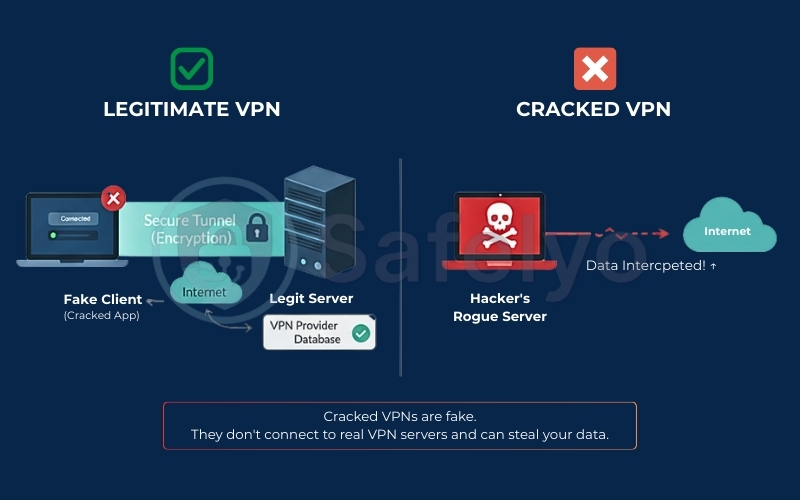
When you crack offline software like Adobe Photoshop or a single-player video game, you are modifying code that lives entirely on your hard drive. Once you break the digital lock on your computer, the software runs. But a Virtual Private Network is a service, not just a product. It relies on a constant, real-time connection between your device (the client) and the provider’s massive infrastructure (the servers).
You might be able to trick the app on your phone into showing a “Premium Active” badge (client-side), but you cannot trick the server-side validation. The moment your modified app tries to connect to a legitimate NordVPN or ExpressVPN server, the server checks your credentials against its central database. If you haven’t paid, the VPN server rejects the connection immediately. This is why users frequently report constant connection drops as the server repeatedly kicks them off.
So, what happens when that green “Connected” light turns on in a cracked app? You are likely looking at a fake UI designed to deceive you. Even worse, the traffic isn’t going to a secure premium server. It might be routed through a hacker’s rogue server, where they can intercept every password and credit card number you type.
2. The 5 deadly risks of using cracked VPNs
If the technical impossibility of “cracking a server” wasn’t enough to dissuade you, the security implications should be. Hackers frequently use social engineering tactics to convince users that these dangerous files are harmless tools. Downloading files from unknown third-party websites is like leaving your front door wide open in a bad neighborhood.
The dangers of installing pirated software go far beyond simple glitches; they compromise your entire digital life. Here are the five most significant consequences I frequently encounter in the cybersecurity field.
2.1. Malware, Adware, and Trojans
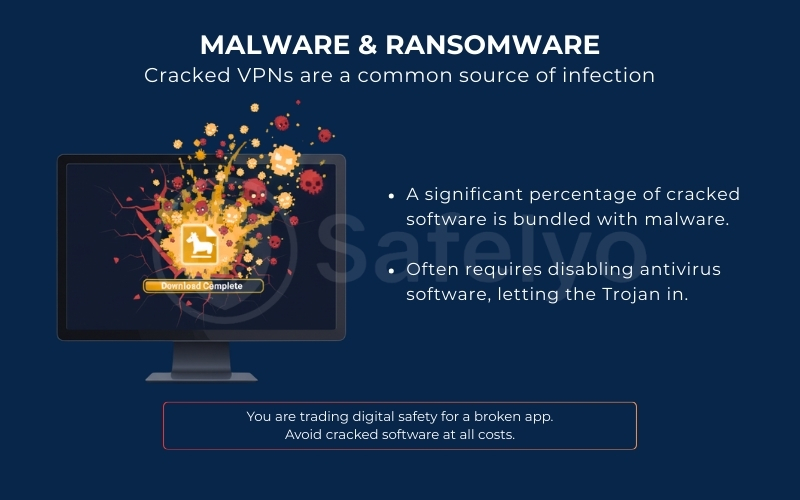
This is the most common payload. Research suggests that a significant percentage of cracked software, some estimates say up to 30-50%, comes bundled with malware (IDC White Paper – sponsored by Microsoft, 2013).
When you download that .exe file, you are often asked to disable your antivirus software to “install the patch”. That is the moment you let a dangerous Trojan infiltrate your operating system. Once inside, ransomware can lock your files and demand payment, or spyware can silently watch your every move. You might also be bombarded with aggressive adware that slows down your system and tracks your browsing habits. You are essentially trading your digital safety for a broken app.
2.2. Botnet: Turning your PC into a Zombie
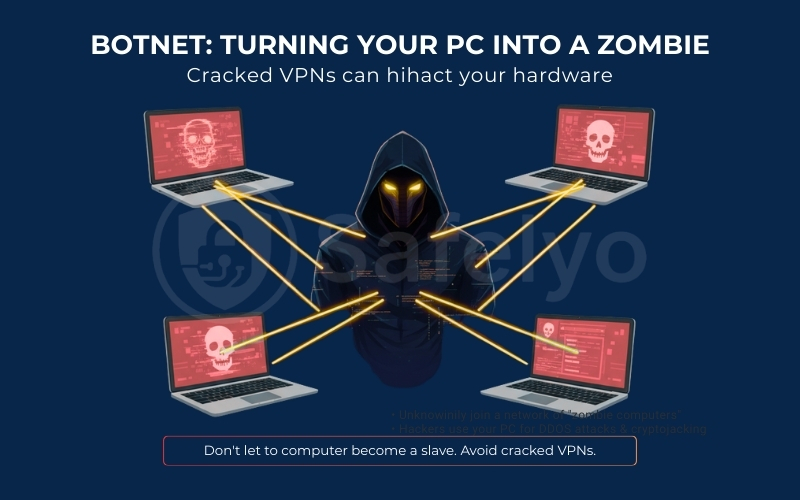
Hackers don’t just want your data; they want your hardware. By installing a cracked VPN, you might unknowingly join a botnet.
This turns your device into a “zombie computer” that hackers control remotely to launch DDoS attacks on other targets. Even worse, they might use your system resources for cryptojacking, mining cryptocurrency in the background.
If your fan is spinning like a jet engine and your PC is sluggish, you might already be mining cryptocurrency for a stranger. This background mining causes severe performance issues that can overheat and damage your hardware permanently.
2.3. Data theft (Keyloggers)
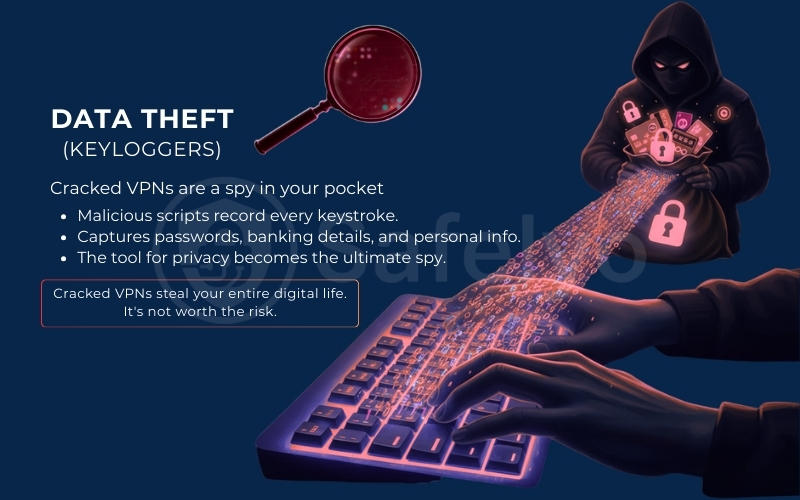
You use a VPN to protect your privacy, but a pirated version does the exact opposite. Many cracked versions come injected with keyloggers. Data theft is the primary motivation for hackers who distribute these infected files. These malicious scripts record every keystroke you make.
While you think you are browsing anonymously, the software is capturing your Facebook credentials, email passwords, and worst of all, your banking login details. Hackers then use this information for credential stuffing attacks to break into your other accounts.
It is the ultimate irony: The tool you downloaded for privacy is the spy in your pocket. Some fake interfaces even serve as sophisticated phishing scams designed to harvest your credit card details immediately.
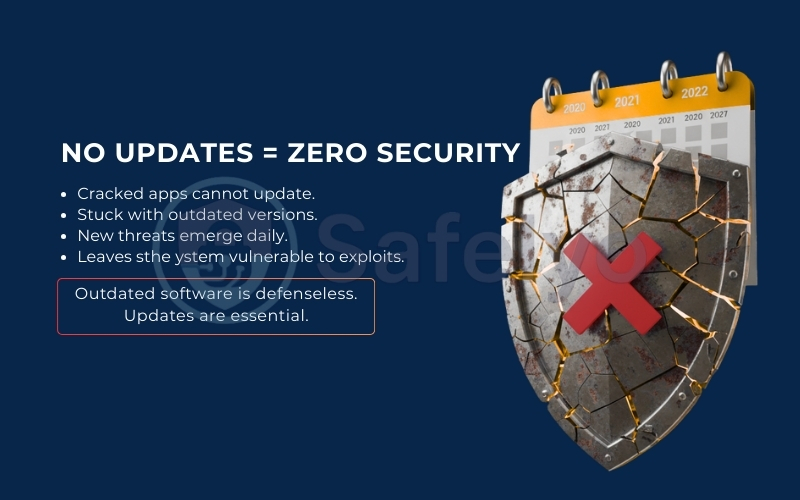
2.4. No updates = Zero security
Legitimate software receives regular security patches to fix vulnerabilities. A cracked app cuts the connection to the developer’s update server to prevent the license check. This means you are stuck with an outdated version forever.
As new threats emerge, your software remains defenseless, leaving gaping holes in your system’s security that hackers can exploit months or years down the line. This results in weak security that exposes your personal information to anyone who knows how to exploit these old vulnerabilities.
2.5. It simply won’t work
Finally, let’s go back to the reality check. Due to the server-side validation I mentioned earlier, most of these cracks fail to establish a connection. You risk malware, botnets, and copyright infringement for a piece of software that will likely just give you a “Connection Failed” error.
At best, you will experience severe lag and frequent connection drops that make streaming or gaming impossible. It is high risk for absolutely zero reward. Furthermore, when the app inevitably fails, there is no customer support to help you troubleshoot the issue.
3. The true cost: Cracked VPN vs. Legitimate free VPN
When you look at the price tag alone, both options seem equal: $0. But in the cybersecurity world, we don’t just pay with money. We pay with compromised data, loss of user privacy, and damaged system integrity. I always tell my readers to look at the true cost of ownership.
Here is the breakdown that makes the decision obvious:
| Feature | Cracked VPN | Legitimate Free VPN |
| Monetary Price | $0 | $0 |
| Malware Risk | Extremely High (Trojan/Spyware) | None (Verified Software) |
| Data Safety | No (Likely stolen or logged) | Yes (Encrypted & Protected) |
| Hidden Costs | PC repair, reinstalling Windows, and stolen funds | Data limits or fewer server locations |
| Legality | Illegal (Copyright Infringement) | 100% Legal |
| Peace of Mind | NO | YES |
The Verdict: It’s an Irrational Risk
Choosing a cracked VPN is, frankly, a risky decision. You are risking total system failure, identity theft, and legal trouble just to avoid a data cap or get a slightly faster server.
Think about it: A legitimate free VPN might restrict your speed or limit you to 10GB of data per month, but it will never infect your computer or steal your credit card info. The “hidden cost” of a cracked app, hours spent removing viruses or recovering hacked accounts, is infinitely higher than the minor inconvenience of a legit free plan. Why risk destroying your PC when safe, legal options exist?
4. What to do if you have already installed a cracked VPN
If you are reading this and realizing you have already installed a cracked VPN, don’t panic – but you need to act immediately. Here is your emergency step-by-step guide to cleaning your system and securing your identity.
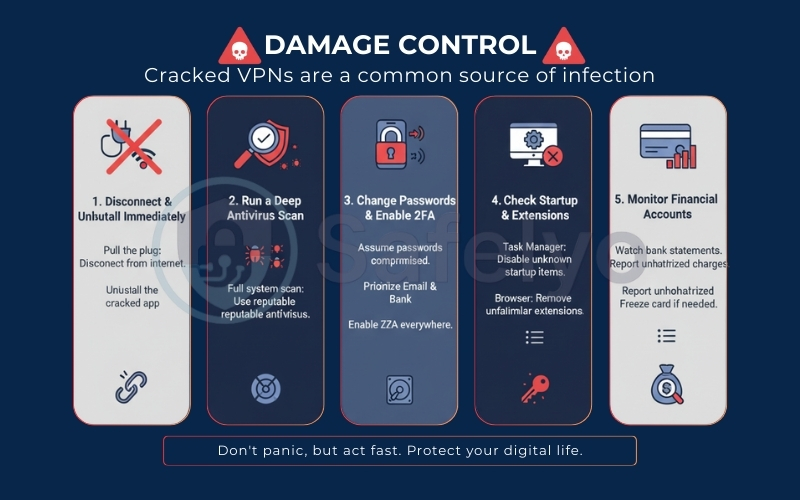
Step 1: Disconnect and Uninstall Immediately
Pull the plug. Disconnect your device from the internet (Wi-Fi and Ethernet) instantly. This severs the connection between your computer and the hacker’s command-and-control server, stopping any active data theft. Then, go to your settings and fully uninstall the cracked software.
Step 2: Run a Deep Antivirus Scan
Standard “Quick Scans” might miss hidden cryptominers. Run a full system scan using a reputable antivirus tool (like Malwarebytes or Norton). If the scan finds malware, quarantine and delete it immediately. Restart your computer and scan again to ensure it is gone.
>> Read more:
Step 3: Change passwords and enable 2FA
Assume your previous keystrokes were recorded. Using a different device (like your phone on 4G, not the infected PC), change your passwords. Prioritize your email and bank accounts first. Enable Two-Factor Authentication (2FA) everywhere so that even if hackers have your password, they cannot log in.
Step 4: Check startup items and browser extensions
Malware often hides in the background to reinstall itself after a reboot. Check your Task Manager (Startup tab) and your browser’s extension list. If you see any extension or program you don’t recognize or didn’t install, disable and remove it.
Step 5: Monitor your financial accounts
Keep a close watch on your bank statements and credit card transaction history for the next few weeks. If you see even a small unauthorized charge, contact your bank immediately to freeze your card.
5. Better alternatives: Safe ways to save money
Now that we have established that cracked VPNs are a digital minefield, let’s talk about the good news. You don’t need to break the law or risk your bank account to protect your privacy. There are legitimate ways to get premium-grade security for free (or for pennies). Instead of risking infection, you should take advantage of official free trials and refund policies. Here is how the pros do it.
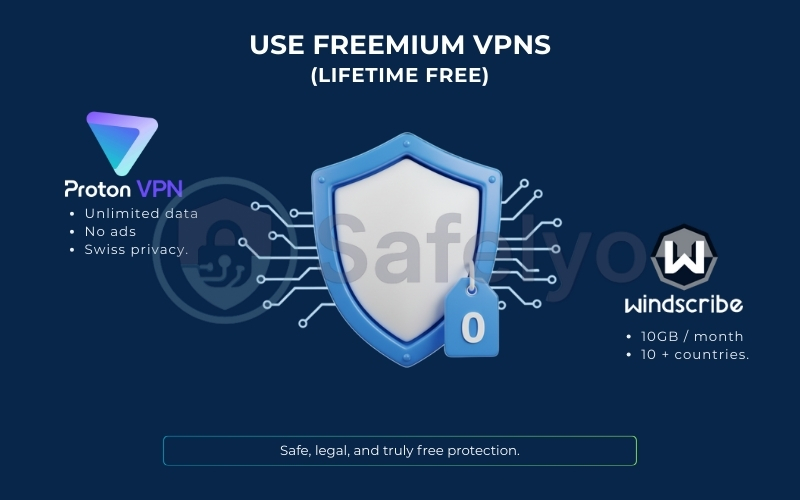
5.1. Use freemium VPNs (Lifetime Free)
The best alternative is what we call a “Freemium” VPN. These are legitimate services offered by reputable companies as a way to introduce you to their brand. They aren’t “free” because they sell your data; they are free because they hope you will eventually upgrade to a paid plan.
- Proton VPN: This is my top recommendation. It is one of the rare services that offers unlimited data on its free plan. Unlike most competitors that enforce strict data caps, Proton allows you to browse freely without worrying about hitting a limit. There are no ads, and it follows strict Swiss privacy laws. You get slower speeds than the paid version, but it is 100% safe and free forever.
- Windscribe: Another excellent option that offers a generous data cap (10GB/month if you verify your email) and access to servers in over 10 countries.
5.2. The money-back guarantee strategy
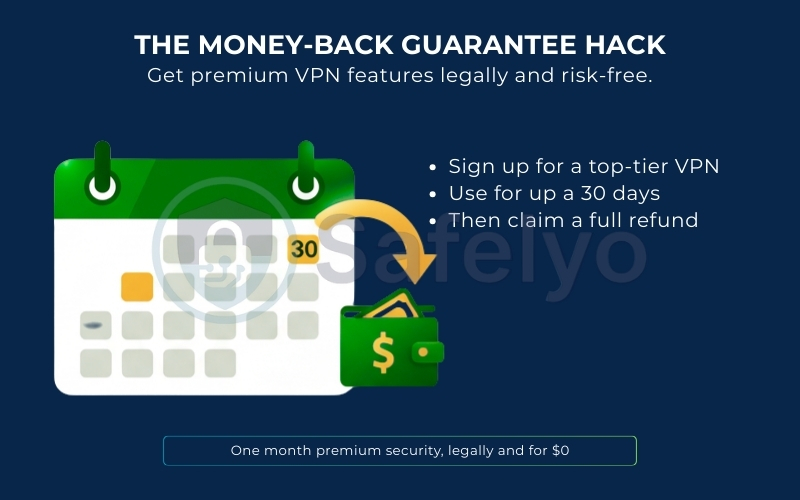
If you absolutely need the full speed and features of a top-tier service like NordVPN or ExpressVPN, you can take advantage of their “money-back guarantee” system. This is useful for a short trip or a specific project. Think of this method as an unofficial, extended free trial that grants you total access without the risk.
Almost all premium providers offer a 30-day money-back guarantee. You can sign up, pay the subscription fee, use the service for 29 days, and then request a refund via their 24/7 live chat. It is completely legal, and they honor these requests without hassle.
During this period, you also have access to premium 24/7 customer support if you face any technical difficulties. It effectively gives you one month of the world’s best cybersecurity for $0. Unlike standard 7-day free trials that limit features, this method allows you to test the full capability of the service.
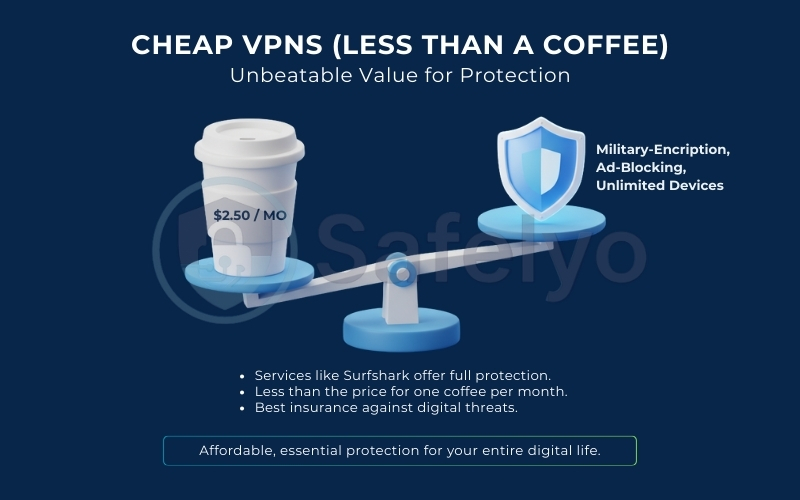
5.3. Cheap VPNs (Less than a coffee)
If you are tired of jumping through hoops and just want “set it and forget it” protection, consider a budget-friendly VPN.
Services like Surfshark often cost less than $2.50 per month – that is less than a single cup of coffee. A low-cost VPN is a small investment that guarantees your safety compared to the high risks of pirated apps. For that tiny investment, you get unlimited device connections, ad-blocking, and military-grade encryption protocols. When you compare that to the cost of repairing a virus-infected computer or recovering a stolen identity, it is the best insurance policy you can buy.
6. FAQs about cracked VPN
Is a NordVPN crack working in 2026?
No, it is not. Legitimate providers like NordVPN use strict server-side validation. This means that even if a crack successfully bypasses the payment screen on your computer, the actual VPN servers will still reject your connection. They do this because they don’t see a valid subscription in their database. Any “working” crack you find today is almost certainly a fake interface designed to hide malware.
Are modded APKs safe for Android?
They are extremely risky. Downloading files from untrustworthy sources bypasses the critical security checks found on the Google Play Store. Modded APKs are the primary vehicle for mobile malware. Unlike official apps, these modified files often contain spyware that runs in the background. They can silently track your GPS location, read your SMS messages (to steal 2FA codes), and access your photos. The risk of identity theft on a mobile device is significantly higher with these files.
Why do cracked VPNs look “real”?
It is a social engineering tactic. Hackers know that if the interface looks sketchy, you will delete it. So, they copy the legitimate software’s design (UI) pixel-for-pixel to build false trust. The goal is to make the “Fake UI” look so convincing that you feel safe typing in your admin password. It may also prompt you to disable your antivirus, allowing them to execute their malicious code.
Is there any 100% free VPN?
Yes, but you must be careful about the type of free. Legitimate “Freemium” services like Proton VPN or Windscribe are 100% free and safe because they are subsidized by paid users. However, be wary of “totally free” apps with no paid tier that promise unlimited data. If you aren’t paying for the product, you are the product – these services likely sell your browsing history to advertisers.
Can the FBI see through VPNs?
A reputable no-logs VPN can significantly limit what can be obtained from the VPN provider, because there’s little or no activity data to hand over. However, VPNs don’t make you invisible: your device, the websites you use, and other endpoints can still generate logs. In some cases, shady VPNs can be operated for surveillance purposes (or to harvest credentials), which is another reason to avoid cracked or unverified apps.
Is using a VPN legal in my country?
This is a common myth. Using a VPN is 100% legal in the vast majority of the world, including the US, UK, and Europe. It is a legitimate tool for privacy and security. VPNs are only restricted or banned in a few authoritarian countries (like China, Russia, or Iran). However, remember that committing crimes (like hacking or downloading pirated movies) is still illegal, even if you use a VPN.
Will Netflix ban me if I use a VPN?
Netflix typically won’t ban your account for using a VPN; they will simply block your connection. If they detect a proxy, you will see an error message and be unable to play videos. Note that cracked VPNs rarely work for Netflix because their IP addresses are usually blacklisted. You need a premium VPN with regularly updated IPs to bypass Netflix’s advanced detection systems.
7. Conclusion
Ultimately, the allure of a “Free Crack” is the most expensive trap in the digital world. It is simply not worth trading the safety of your bank details and personal identity just to save a few dollars. The technical reality is clear: Pirated VPNs don’t protect you; they expose you to malware, botnets, and theft. Beyond these technical dangers, you also expose yourself to potential legal repercussions associated with software piracy.
If you are on a tight budget, stick to a reliable zero-cost option like Proton VPN Free, or invest the price of a coffee in a premium service like Surfshark. Don’t wait until your data is compromised to make the right choice. Avoid the risk of credential stuffing and identity fraud by choosing legitimate software.
Start browsing safely today with our recommended best free VPN list here, and visit the VPN Guides category to be a smart user with Safelyo.