
Does Firefox have a VPN? Yes, Firefox offers two different VPN products.
This can be confusing, as one is a full, paid subscription called “Mozilla VPN”. The other is a newer, “free Firefox VPN” that is an upcoming feature launching on March 24. It is built directly into the browser.
This article will clarify the two distinct VPN products Mozilla offers and their key differences.
Key takeaways:
- Mozilla offers a paid, full-device “Mozilla VPN” for all your apps.
- Mozilla is also testing a “free Firefox VPN” that only protects your browser traffic.
- The paid version offers full features, while the free version is a basic tool.
1. Does Firefox have a VPN? The short answer
Yes, Mozilla, the company behind the Firefox browser, provides two distinct VPN services.
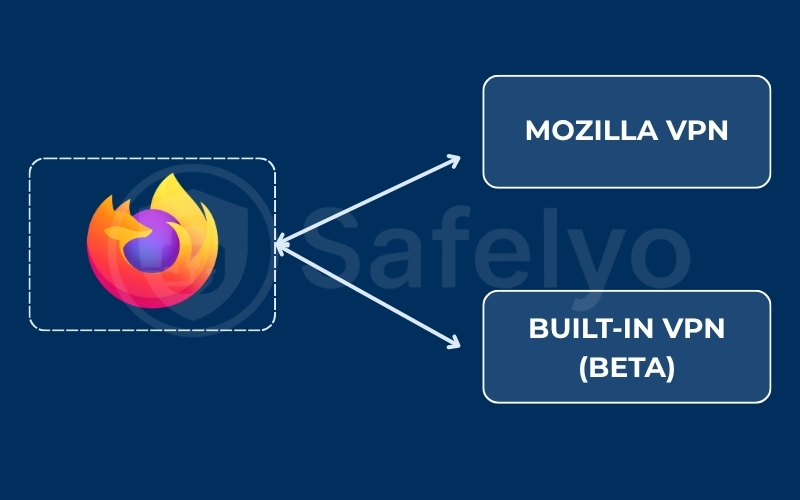
The first is Mozilla VPN. This is a premium, subscription-based service. It is a standalone application that protects your entire device, including all apps and browsers.
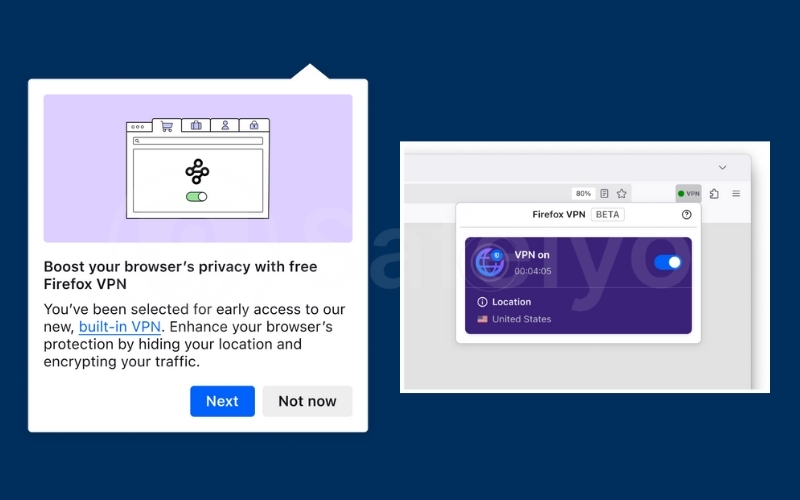
The second is the free Firefox VPN. This is a new, built-in browser feature. It is an upcoming tool for select users. This service only protects the traffic from your Firefox browser.
2. What is Mozilla VPN (The paid service)?
Let’s first explore Mozilla’s premium, standalone service: Mozilla VPN. This is their full-featured, subscription-based product designed for comprehensive security.
2.1. How it protects your entire device
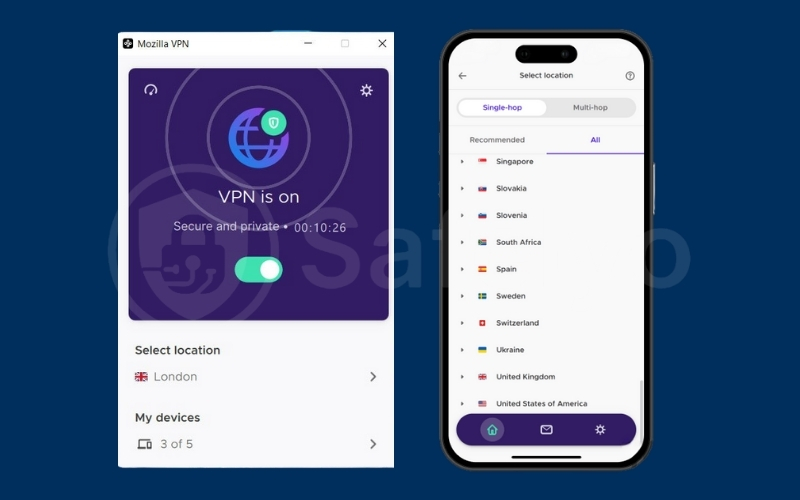
The main benefit of Mozilla VPN is its “full-device” protection. This means the app secures all internet traffic from your device, not just your browser.
When you connect, it creates an encrypted tunnel for everything. This includes other browsers like Chrome, your email app (like Outlook or Apple Mail), gaming clients, and even background system updates. This systemic approach secures your entire digital footprint.
2.2. What are the main features and costs?
The Mozilla VPN service has several key features. Technically, it is built using the WireGuard protocol. This is a modern and fast protocol widely used in the industry for its strong performance.
Regarding its privacy, Mozilla markets the service with a no-logs policy. This is the company’s stated promise that it does not track or store records of your online activity.
However, it is crucial to understand that Mozilla is based in the United States. The US is a core member of the Five Eyes (FVEY) intelligence-sharing alliance. This jurisdiction is a significant consideration for privacy advocates. While a company may have a no-logs policy, its location in a FVEY country means it operates under laws that could potentially compel it to provide user data to government agencies.
Other features include support for up to five devices on a single subscription. The Mozilla VPN cost depends on the plan you choose, offering both monthly and discounted annual payment options.
2.3. What devices does Mozilla VPN support?
As a standalone application, Mozilla VPN supports all major operating systems. You can install it on:
- Windows
- macOS
- Linux
- Android
- iOS
3. What is the free Firefox VPN (Browser-only)?
Now, let’s look at the second service, the free Firefox VPN. This is a much newer, browser-based tool. It will officially launch on March 24 alongside the Firefox 149 update. During this initial phase, the feature will only be available to users in the United States, France, Germany, and the United Kingdom.
3.1. What does “browser-only” protection mean?
The most important distinction is its “browser-only” scope. This service is designed to protect only the data you send and receive within the Firefox browser. It encrypts your activity from websites you visit in Firefox.
However, it leaves all other applications on your device unprotected. Your email client, cloud storage app, and other browsers will still use your regular, unencrypted connection.
3.2. What are the limitations of the free version?
This service has clear limitations. It is important to understand that it is not a replacement for a full VPN.
The free Firefox VPN provides 50 gigabytes of data per month. You must create and log into a free Mozilla account to use this feature. The infrastructure for this free version is hosted on Mozilla’s own servers around the world. This is a direct contrast to the paid Mozilla VPN, which relies on Mullvad’s network.
The service offers a limited selection of server locations. This means you will not have a large list of countries to connect to. It is a basic privacy feature for light browsing. It is not a robust security tool designed for heavy use.
3.3. How to check if you have the free Firefox VPN beta
This beta is not available to everyone. Mozilla is rolling it out slowly. To check if you have access:
- Ensure your Firefox browser is fully updated.
- Look for a new icon in the Firefox toolbar, often near the address bar. It may look like a shield or be labeled “VPN.”
- If you do not see this icon, your browser is not yet part of the limited beta test.
4. Key differences: Mozilla VPN vs. Free Firefox VPN
To help you decide which service is right for you, let’s look at the Mozilla VPN vs Firefox VPN comparison.
Here is a simple table showing their main differences:
| Feature | Mozilla VPN (Paid) | Free Firefox VPN |
| Cost | Paid subscription | Free |
| Scope | Full-Device (All apps) | Browser-Only (Firefox) |
| Features | Full-featured, server choice | Basic protection, limited servers |
| Security | Strong (WireGuard protocol) | Basic encryption |
| Data Limit | Unlimited | 50 GB/month |
5. Is the built-in Firefox VPN worth waiting for?
This depends entirely on your needs and your patience.
The service will officially release on March 24 with the Firefox 149 update. It will be restricted initially to users in the US, France, Germany, and the UK.
- Who should wait: You should only wait if your security needs are not urgent and you are simply curious about a free, browser-only tool for occasional use (like on public Wi-Fi).
- Who should not wait: If you need reliable, comprehensive security today, you should not wait. The built-in version (even when final) is unlikely to ever replace a full, paid VPN, as it is only designed to protect browser traffic. If you need protection for all your apps, you should opt for a full-featured paid service. This could be the paid Mozilla VPN or another established provider like NordVPN or Surfshark.
Read more:
6. What about other third-party VPN add-ons?
When you search the Firefox Add-on store, you will see hundreds of “VPNs.” You must be very careful with these third-party tools.
6.1. Are third-party VPN extensions safe?
Many third-party VPN extensions are not safe. A large number of them are not true VPNs. They are simple proxies that offer weak protection. Some are dangerous, logging your private data and selling it to advertisers.
6.2. How to spot a dangerous or fake VPN add-on
You can look for several clear warning signs to avoid a fake VPN add-on:
- It has a vague or non-existent privacy policy.
- It requests excessive permissions (like access to your history).
- There is no clear company or developer listed.
- It claims to be “100% free and unlimited” with no clear business model.
7. FAQs about does Firefox have a VPN
Here are quick answers to other common questions about Firefox’s VPN services.
Is the Firefox VPN a real VPN or just a proxy?
The paid Mozilla VPN is a real, full-featured VPN. It uses top security protocols like WireGuard. The free, browser-based beta functions more like a secure, encrypted proxy for your browser.
How much does the paid Mozilla VPN cost
The Mozilla VPN cost varies by plan. It typically offers a monthly subscription and a discounted annual subscription. Prices are subject to change, so check their official website.
Does Mozilla VPN keep logs?
No. The paid Mozilla VPN has a strict, independently audited no-logs policy. This means they do not track, collect, or store your browsing activity or connection data.
Can I use the Firefox VPN to unblock Netflix?
The paid Mozilla VPN may work for unblocking some streaming content. However, it is not optimized for streaming. The free Firefox VPN (beta) is highly unlikely to work for unblocking geo-restricted services like Netflix.
8. Conclusion
The answer to “Does Firefox have a VPN?” is a clear yes. Mozilla provides two very different tools for its users.
- Mozilla VPN is a paid, full-device solution designed for comprehensive security.
- The free Firefox VPN is a separate, limited, browser-only beta focused on basic privacy.
My personal experience highlights this difference. I have used the paid Mozilla VPN and found it to be a decent, straightforward service for general privacy.
Regarding the free Firefox VPN, the service will officially launch soon with a 50 GB monthly data limit. This update makes the tool highly relevant and useful for basic privacy needs at the present time.
For more in-depth guides on internet safety and privacy tools, explore the VPN Guides section at Safelyo.