

In the rapidly evolving world of internet security, protecting the data of internet users is paramount, and two names pop up constantly: Tor and VPN. Both promise to enhance your online privacy, which leads to a crucial question: Is Tor a VPN? And more importantly, which one is actually right for you?
Let’s get straight to the point: no, Tor is not a VPN. They are fundamentally different tools, built with separate philosophies for separate goals. In short, Tor is built for anonymity, while a VPN is built for privacy. Confusing the two can leave you with the wrong kind of protection when you need it most.
This guide will cut through the confusion. We’ll break down exactly how each technology works using simple, real-world analogies, compare their strengths and weaknesses side-by-side, and help you decide which tool is right for which job. Let’s dive into this critical distinction.
Confused about Tor and VPNs? They’re not the same. This quick summary breaks down the essential differences and tells you exactly which one you need.
- Is Tor a VPN? The answer is no; they are fundamentally different tools. A VPN focuses on online privacy by masking your IP address, whereas Tor emphasizes anonymity by concealing your digital identity.
- They work differently. A VPN sends your traffic through a single, private server (like a private car). Tor bounces your traffic through multiple volunteer-run relays (like a winding series of public buses), making your path much harder to trace due to the complex layers of encryption.
- A VPN is for everyday use. For 99% of your online activities, a fast and reliable VPN is the ideal tool. This includes tasks like securing public Wi-Fi, streaming geo-blocked content, and preventing your ISP from tracking you.
- Tor is for high-stakes situations. Tor is a specialized tool for when anonymity is absolutely critical, such as for journalists, activists, or anyone trying to bypass extreme censorship. Its slow speed makes it impractical for daily use.
1. So, is Tor a VPN? The short answer is no
Let’s address the main question head-on: no, Tor is not a VPN. While both are powerful tools designed to enhance your online privacy, they are fundamentally different technologies built for different purposes compared to basic proxy sites or alternate browsers.
The easiest way to understand the difference is to think about their primary goals:
- A VPN creates secure private networks primarily designed for online privacy. Its main job is to hide your IP address and online activity from your internet provider and secure your connection on public Wi-Fi.
- Tor is designed for anonymity. Its main job is to hide your identity, making it extremely difficult for anyone to trace your online activity back to you.
Think of it as the difference between drawing the curtains in your home (privacy) versus wearing a disguise in a crowd (anonymity). Both are forms of protection, but they work in completely different ways. The rest of this guide will explore these crucial differences in detail.
2. A quick recap
Before we can compare VPN vs Tor, let’s quickly refresh our memory on what a Virtual Private Network (VPN) is and how it functions.
2.1. What is a VPN?
A VPN creates a single VPN tunnel protected by robust encryption between your device (like your computer or phone) and a dedicated server operated by a single company.
To understand this, I often use the private car analogy. Using a VPN is like hiring a private, chauffeured car to get to your online destination.
You get in the car and tell the driver (the VPN server) where you want to go. The car (the encrypted tunnel) then takes you directly there in a private, secure ride. To anyone on the outside, they can only see the car passing by; they can’t see who is inside or where your specific destination is. This provides excellent online privacy from snoopers on public Wi-Fi and prevents your Internet Service Provider (ISP) from engaging in ISP throttling based on your activities.
However, there’s a key element of trust here: the driver knows your real IP address and where you’ve been. This is why the integrity of the VPN company, and especially their commitment to a strict no-logs policy, is the most important factor when choosing a VPN. You are trusting that one single entity to protect your data.
2.2. What is Tor? A journey through the onion network
Now, let’s look at the other side of the coin: Tor. The name stands for The Onion Router, which is a perfect description of how it works.
Tor is not a single company or service but a community-managed, open-source network of relays run by thousands of volunteers all over the world. Its goal is not just online privacy, but true anonymity, by routing your traffic through multiple layers of encryption across various relays within the Tor network.
To continue our travel analogy, if a VPN is a private car, then using the Tor network is like taking a long series of public buses. This route is winding and complicated, but it gets you to your destination.
You board the first bus (the initial entry relay in the Tor network), which is just the first step in a series of relays. The driver knows only where you boarded and drops you off at a random, undisclosed stop. From there, you get on a second bus (the middle relay) with a different driver, who takes you to yet another random IP address location.
This process repeats a third time. Each driver is aware only of the stop immediately before and after them. This ensures that even the final exit nodes have no knowledge of your original IP address or your entire journey.
This is the core of Tor’s design. The path is randomized and compartmentalized so that no single point in the network – not even the network itself – can link your online activity back to your real identity. Its purpose is to make you an anonymous face in a global crowd.

3. Tor vs. VPN: What are the differences?
Now that we understand the fundamental concepts and analogies, let’s put them side-by-side. The choice between Tor vs VPN, which is better, isn’t about one being definitively superior; it’s about recognizing they are different tools designed for different jobs. While a VPN is generally more user-friendly for accessing standard web services, Tor requires a different mindset.
From my experience as a privacy advocate, the most critical distinction lies in their primary goals: a VPN aims to protect what you do online (privacy), while Tor aims to hide who you are (anonymity).
This core difference leads to several other key distinctions, which are easiest to see in a direct comparison:
| Feature | Tor | VPN |
| Primary Goal | Anonymity (hiding who you are) | Privacy (hiding what you do) |
| Trust Model | Decentralized (trust is distributed across a volunteer network) | Centralized (trust is placed in a single VPN company) |
| Speed | Slow speed due to traffic bouncing through multiple relays and encryption layers. | Much faster, as traffic goes directly through one server |
| How it Works | Bounces traffic through multiple, random, volunteer-run nodes | Routes traffic through a single, professionally managed server |
| Ease of Use | Simple for basic use (download the Tor Browser) | Very simple (download a provider’s app and click “connect”) |
| Cost | Free (supported by donations and volunteers) | Usually, a paid subscription service |
| Key Vulnerability | Malicious exit nodes can potentially see traffic if data encryption (HTTPS) is not used. | A provider could potentially log user data (if they are untrustworthy) |
4. Can you use Tor and a VPN together?
Given that they both offer unique security benefits, a natural question arises: Can you combine them? The answer is yes, and doing so can provide an exceptionally high level of security. There are two primary ways to use a VPN with Tor, but for the vast majority of users, only one method is practical and recommended.
4.1. Tor over VPN (the recommended method)
This is the most common and straightforward way to combine the two technologies. The process is simple: you connect to your VPN server first, and then you open and use the Tor Browser.
Let’s revisit our travel analogy. This is like taking your private, chauffeured car (the VPN) to the first bus station (the Tor entry node). From there, you begin your anonymous, winding journey on a series of public buses (the Tor network).
The primary benefit of Tor over VPN is that your Internet Service Provider (ISP) cannot see that you are using Tor. All they can see is standard encryption traffic going to your VPN server, protecting any non-Tor traffic on your device as well. This adds a crucial layer of privacy, as simply using Tor can sometimes draw unwanted attention from ISPs or authorities in certain regions. In my opinion, this is one of the most secure privacy tools for anyone looking to maximize their online privacy while accessing Tor.
4.2. VPN over Tor (very complex and rare)
This method works in reverse: you connect to the Tor network first, and then link to your VPN through that network.
The main benefit is that your VPN provider will not see your real IP address, only the address of the Tor exit nodes. They will only see the IP address of the Tor exit node you are using. However, this configuration is extremely difficult to set up correctly, results in very low speed, and is not supported by most providers. It’s a highly specialized setup reserved for security experts with very specific, advanced threat models. For everyday use, it’s unnecessary and overly complicated.

5. When to use Tor? When to use a VPN?
Understanding the technical differences is one thing, but knowing which tool to use in a real-world situation is what truly matters. The choice is simpler than you might think and comes down to your specific goal.
As a security professional, my recommendation is clear: For 99% of individuals, 99% of the time, a reliable VPN is the appropriate solution. Tor is a specialized tool intended for high-stakes scenarios where anonymity is not just preferred but essential. It is vital for avoiding location tracking in hostile environments or ensuring identity protection.
Here’s a practical guide to help you decide:
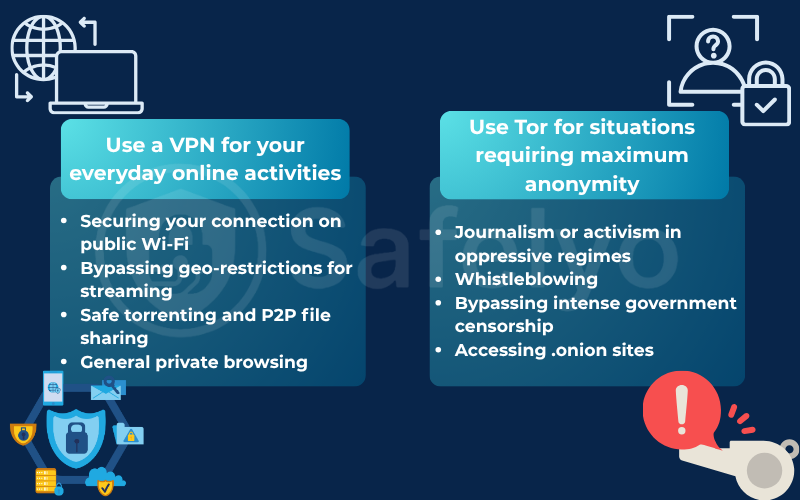
Use a VPN for your everyday online activities, such as:
- Securing your connection on public Wi-Fi: This is the most common and vital use case. A VPN protects your passwords and data from hackers at cafes, airports, and hotels.
- Bypassing geo-restrictions for streaming: Want to watch your home country’s Netflix library while traveling? By allowing you to swap your IP address, a VPN is a fast and effective tool for the job.
- Safe torrenting and P2P file sharing: A VPN hides your IP address from others, protecting your online privacy and allowing access to blocked content.
- General private browsing: To stop your ISP from tracking and logging your online activity.
Use Tor for situations requiring maximum anonymity, such as:
- Journalism or activism in oppressive regimes: For whistleblowers and individuals who face legal issues or censorship.
- Whistleblowing: When you need to share sensitive information without it being traced back to you.
- Bypassing intense government censorship: When you need to access information blocked by a national firewall.
- Accessing .onion sites: These are sites on the Tor network, often referred to as the dark web, which creates a space for anonymous browsing unavailable on the regular internet.
Consider it this way: you wouldn’t use a military-grade armored vehicle for a trip to the grocery store. For everyday travel, a dependable car is what you need. A VPN serves as your reliable daily driver for online privacy, while Tor is the armored vehicle saved for the most dangerous situations.
6. FAQs about Tor and VPN
Let’s clear up some of the most common questions about these two powerful but very different privacy tools.
Is Tor a VPN?
No, Tor is not a VPN. They are fundamentally different technologies. A VPN is a centralized service you trust for privacy (masking your activities), whereas Tor is a decentralized, open-source network aimed at providing anonymity (concealing your identity).
So, is Tor better than a VPN?
It’s not about one being “better,” but which is the right tool for the job. Tor is superior for achieving anonymity and fighting censorship, while a VPN is better for general online safety. A VPN is vastly superior for speed, ease of use, streaming, and everyday privacy protection.
Is it legal to use Tor?
Yes, in most of the world, using the Tor network is perfectly legal, despite its notorious association with the dark web. The technology was originally developed and funded by the U.S. government for secure communications. However, remember that performing illegal activities while using Tor is still illegal.
Is Tor safe?
The Tor network technology itself is safe, but using Tor without caution can lead to data leakage. The primary risk lies with the exit nodes – the last relays your traffic passes through. The owner of a malicious exit node could potentially monitor your activity if you are not visiting a secure HTTPS website. Always look for the padlock icon to ensure proper encryption and avoid exposing your IP address or data.
7. Conclusion
So, to put the question to rest once and for all: is Tor a VPN? The answer is a definitive no. They are two distinct, powerful security tools, but they are built for entirely different missions and operate on different principles of trust.
Ultimately, choosing between Tor and a VPN is about picking the right tool for the right job. You don’t need an armored tank for a trip to the grocery store. For the vast majority of online tasks, a reputable, paid VPN is the foundational tool for digital safety.
At Safelyo, we’re here to help you make that choice with confidence. Ready to secure your everyday privacy? Explore our expert rankings of the best VPN services to find the perfect ‘private car’ for your online journeys, and continue building your knowledge in our Privacy & Security Basics category.