
Enter the Decentralized VPN (dVPN). A decentralized VPN (dVPN) is a peer-to-peer bandwidth marketplace where your exit IP is provided by independent nodes rather than a single company’s servers. By leveraging blockchain technology and Peer-to-Peer (P2P) networks, dVPNs aim to remove the central server – and the middleman – entirely.
When you switch on a standard VPN to stay anonymous, you aren’t actually disappearing. You are simply shifting your trust from your Internet Service Provider (ISP) to a VPN company. But what happens if that company gets hacked, subpoenaed, or quietly decides to sell your logs? That is a classic single point of failure.
If you are curious whether a decentralized VPN is the ultimate privacy upgrade, here is the breakdown:
- What is a dVPN?
→ A peer-to-peer (P2P) network where you connect to other users’ devices, not a company server. - Is it better for streaming?
→ Yes for unblocking. dVPNs use “Residential IPs”, which are much harder for Netflix to detect than standard VPNs. - Is it faster than a normal VPN?
→ No. Commercial VPNs offer stable speeds for work; dVPNs are variable and often slower. - Is it completely safe?
→ It depends. There are no central logs, but the person running the node (Node Operator) could theoretically see your metadata. - What is the biggest risk?
→ Earning crypto by running a node. You become legally liable for any illegal traffic that passes through your internet connection.
At Safelyo, we don’t do hype. In this guide, I will honestly analyze how this tech works, compare it to traditional tools, and, most importantly, expose the security risks that few others talk about. Is it time to ditch your subscription? Let’s verify.
1. What actually is a Decentralized VPN (dVPN)?
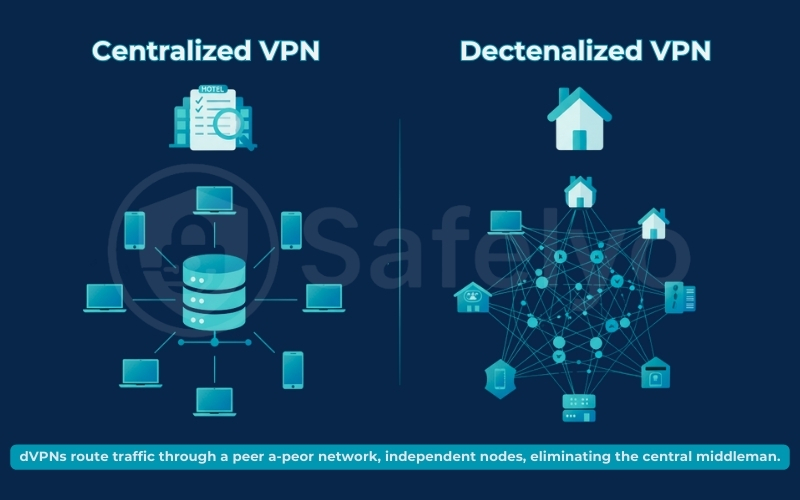
At its core, a Decentralized VPN (dVPN) is a “serverless” privacy solution. Unlike traditional services that route your traffic through massive data centers owned by a single corporation (think NordVPN or ExpressVPN), a dVPN routes your data through a distributed network of independent computers (called “nodes”) run by everyday people.
To really understand the dVPN vs VPN dynamic, let’s look at a simple analogy:
- Traditional VPNs are like Hotels: You check into a massive, branded building. The service is professional, the beds are made, and the Wi-Fi is fast. However, there is a central front desk with a guest list, and security cameras record everyone coming and going. It is a centralized target.
- dVPNs are like Airbnb: Instead of a hotel, you are staying in someone’s actual house in the suburbs. There is no central lobby, no single receptionist, and you blend in with the neighborhood. Because you are utilizing a Residential IP VPN connection (a real home internet address), streaming services like Netflix think you are just a local resident, making you much harder to detect or block.
However, just like a vacation rental, the experience isn’t always standardized. You gain privacy by blending in, but the quality of your stay depends entirely on the “host”.
2. How dVPN works: The power of Peer-to-Peer
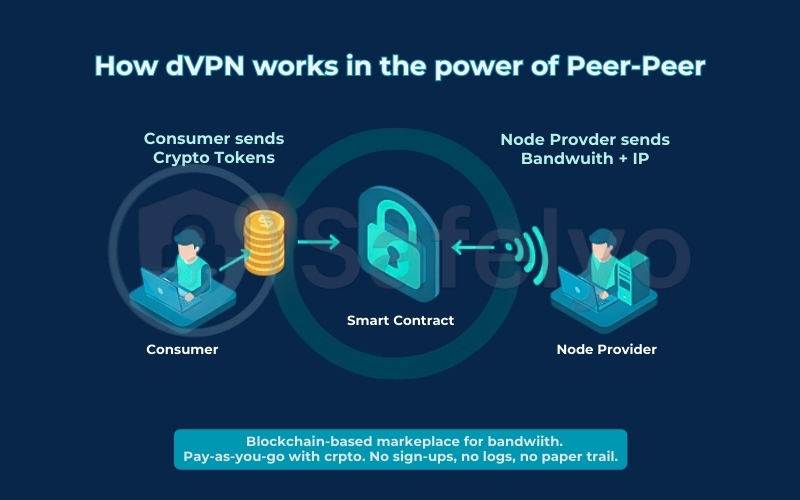
Think of a decentralized VPN not as a service you subscribe to, but as a global marketplace for bandwidth. It operates on a Peer-to-Peer (P2P) architecture (similar to how torrents work) but powered by an economic incentive model.
The ecosystem relies on two main players:
- Node Providers (the sellers): Anyone with a stable internet connection can become a provider. By installing dVPN software on a computer, server, or even a Raspberry Pi, users can rent out their unused bandwidth to the network. In return, they earn cryptocurrency tokens (like MYST or OXT). It is essentially passive income for your idle internet connection.
- Consumers (the buyers): When I use a dVPN to browse the web, I am technically renting a specific tunnel through one of these provider nodes. My traffic travels to the node and exits to the public internet through their device, effectively adopting their IP address.
This is where Blockchain and Smart Contracts become crucial. Traditional Virtual Private Networks usually require a monthly subscription linked to your credit card, creating a permanent paper trail of your identity. dVPNs flip this model with a pay-as-you-go system. You pay strictly for the gigabytes you consume, settling micropayments instantly on the blockchain. There are no sign-ups, no emails, and most importantly, no bank statements revealing that you paid for privacy tools.
3. The showdown: dVPN vs. Centralized VPN
This is the part where marketing hype usually collides with reality. If you are debating between renewing your NordVPN subscription or switching to a Web3 solution like Mysterium, you need to understand that these are two completely different beasts.
- A centralized VPN provides consistency through industrial-grade data centers.
- A dVPN sells you anonymity via the crowd.
Here is how they stack up:
| Feature | Centralized VPN | Decentralized VPN (dVPN) | Winner |
| Privacy Architecture | Trust-based. You must rely on the provider’s no-logs policy. | Trustless. No central authority capable of logging user activity. | dVPN |
| Reliability & Speed | High. Enterprise-grade servers in professional data centers. | Variable. Performance depends on individual node providers. | Centralized VPN |
| IP Quality | Datacenter IPs, often flagged or blocked by major websites. | Residential IPs. Appear as normal household traffic. | dVPN |
| Ease of Use | Plug-and-play. Simple apps with one-click connection. | Moderate complexity. May involve crypto wallets or manual setup. | Centralized VPN |
| Censorship Resistance | Good, but centralized IP ranges can be blocked. | Excellent. Difficult to block millions of distributed residential nodes. | dVPN |
When dVPNs Fail at Streaming
You might look at the table above and think: “Awesome, residential IPs mean Netflix will never block me again!”
Technically, you are right. Streaming services struggle to blacklist dVPNs because they can’t distinguish a dVPN user from a regular grandma in London. However, unblocking content is only half the battle – watching it is the other.
This is where dVPNs often struggle against their centralized rivals:
- The “neighbor” factor: Since you are routing traffic through someone else’s device, your connection stability relies on their internet. If the node provider decides to turn off their computer or download a large game file while you are watching a movie, your connection will drop or buffer instantly.
- No optimization: Centralized giants invest millions in SmartDNS technology and optimized routing specifically for 4K streaming. dVPNs are “raw” connections. They don’t care if you are buffering. They just tunnel data.
- Speed bottlenecks: Most home internet connections have fast download speeds but terrible upload speeds. Remember, the node provider has to upload data to you. This often results in the dreaded buffering wheel when trying to stream 4K content.
dVPN vs. residential proxy: What’s the difference?
Since dVPNs use residential IPs, many power users confuse them with Residential Proxies (often used for web scraping or sneaker bots). While they share the same infrastructure – routing traffic through home devices – their core function is completely different.
The difference lies in Encryption.
- Residential Proxies are often “dumb pipes.” They successfully change your location (IP spoofing), but they typically do not encrypt your data. If you use a basic HTTP proxy to watch Netflix, your ISP can still inspect your traffic packets and see exactly what you are doing.
- dVPNs are “secure tunnels.” They take that same residential IP connection but wrap it in a layer of military-grade encryption (protocols like WireGuard or OpenVPN). Most dVPN clients still establish an encrypted tunnel (often WireGuard/OpenVPN-based), but implementation details vary by project.
The bottom line:
- Use a Residential Proxy for high-volume tasks like market research, ad verification, or buying limited-edition sneakers.
- Use a dVPN for personal privacy, security, and bypassing censorship where encryption is mandatory to avoid detection by your ISP.
4. Is dVPN the same as Tor?
Many privacy enthusiasts confuse decentralized VPNs with The Onion Router (Tor) because both rely on community-run nodes rather than corporate servers. However, they serve two very different purposes.
Tor is built for extreme anonymity, often used by whistleblowers and activists. It bounces your traffic through three random layers of volunteer nodes (Guard, Middle, and Exit relays). While this makes you nearly impossible to trace, the trade-off is speed. Because it is free and relies on volunteers with varying hardware, Tor is notoriously slow and unsuited for streaming or heavy downloading. Furthermore, you cannot easily choose your exit location.
“A guard relay is the first relay (hop) in a Tor circuit. A middle relay is a relay that acts as the second hop in the Tor circuit.”
– Tor Project Community
dVPNs, on the other hand, are built for a balance of privacy and performance. Because the system is incentivized (you pay the node provider), the connection is typically much faster and more stable than Tor. Crucially, dVPNs allow for precise Geo-spoofing. You can specifically choose to exit via a node in Tokyo or New York to bypass regional blocks – something Tor isn’t designed to do efficiently.
“Exit nodes are the last hop before traffic leaves the Tor network and reaches its final destination… the exit node’s IP will be directly visible to the destination.”
– LowEndBox
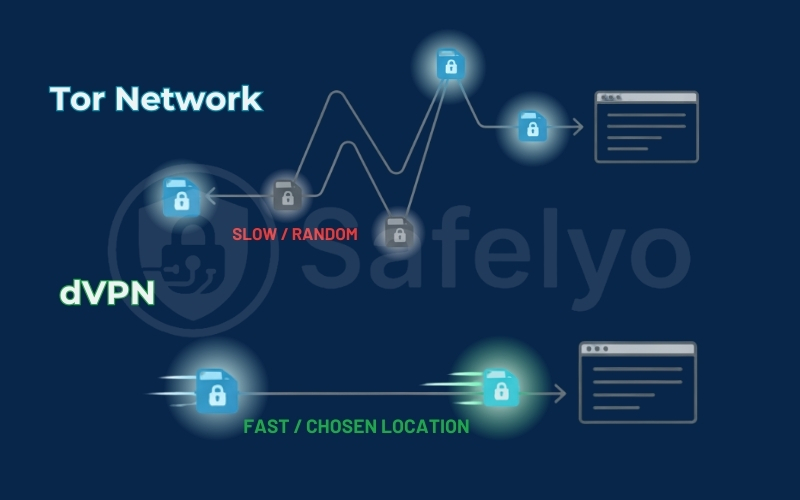
Here’s a quick head-to-head comparison:
| Feature | The Tor Network | Decentralized VPN (dVPN) |
| Cost Model | Free (Volunteer-based) | Paid (Pay-as-you-go via Crypto) |
| Speed | Very Slow | Faster (but variable) |
| Connection Path | Multi-layer (3 Hops) | Single Node |
| Primary Use Case | Extreme Anonymity | Geo-unblocking & Privacy |
| Location Choice | Random / Not user-controlled | User can select a specific country |
Think of a dVPN as the modern “hybrid” child of Tor and a commercial VPN: It offers the decentralized safety of Tor with the speed and usability of a paid service.
>> You may also be interested in:
5. The hidden risks & safety realities
Most articles will tell you that decentralized VPNs are the “Holy Grail” of privacy because they eliminate the middleman. At Safelyo, we value the truth over hype. While the technology is revolutionary, it introduces a unique set of risks that simply do not exist with corporate VPNs. Before you jump in, you need to understand the new rules of engagement.
5.1. Do decentralized VPNs keep logs?
The marketing pitch usually screams “No Central Logs!” and “Zero-Knowledge!” This is technically true – there is no central database held by a corporation that can be subpoenaed. However, that does not mean you are invisible.
The risk shifts from a company to an individual. The person running the node you are connected to (the Node Operator) could theoretically possess the technical skills to monitor the traffic passing through their router. While they cannot crack encrypted HTTPS traffic (which covers most of the modern web), they may be able to observe connection metadata (e.g., timing, destination indicators in some cases), especially if your traffic isn’t fully protected end-to-end.
“SNI is transmitted in cleartext and can be viewed and filtered.”
– Cisco Secure Essentials
ECH encrypts most of the ClientHello, thus closing the SNI metadata gap.
– Clouflare Blog

5.2. The “exit node” liability (legal risk)
This is a critical warning for anyone planning to earn crypto by turning their computer into a node provider.
When you let strangers route traffic through your home internet, your IP address becomes the “Exit Node”. This means to the outside world, their activity looks like your activity. If a cybercriminal uses your bandwidth to hack a bank, launch a DDoS attack, or download illegal child exploitation material, the digital footprint leads directly back to your residential IP address.
When the authorities investigate, they don’t look for the anonymous user on the blockchain – they come knocking on your door. This is a massive legal liability that few platforms warn you about effectively.

5.3. Legal status by country
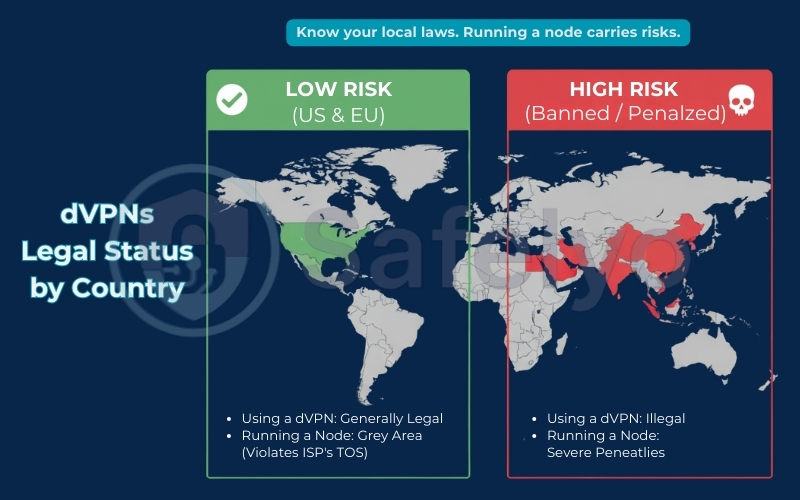
The legality of participating in a dVPN network varies wildly depending on your geography:
- US & EU: Using a dVPN is generally legal. However, running a node often falls into a “Grey Area”. While not strictly illegal, it almost certainly violates the Terms of Service (ToS) of your ISP (Internet Service Provider), which may ban you for commercializing their connection.
- China, Iran, & Russia: High risk. In these jurisdictions, running a node can be interpreted as operating an illegal telecommunications service or aiding in circumvention, carrying severe penalties.
“Internet freedom remained highly restricted in Iran … making access to the global internet more cumbersome and expensive, and drive users to a domestic version of the internet where authorities can more effectively control content and monitor users.”
– Freedom House
“Governments have also gone beyond explicit blocking orders, implementing new legal measures to stifle the use and promotion of VPNs … criminalized the use of ‘unauthorized’ VPNs.”
– Freedom House
According to a 2025 report, authorities in at least 21 countries have moved to block access to VPNs or censorship-circumvention tools, highlighting increasing global pressure on privacy technologies. (by Techradar)
“Anti-censorship tools have been blocked in at least 21 countries over the past 5 years…”
– European University Institute
6. Top 4 dVPN projects to watch in 2026
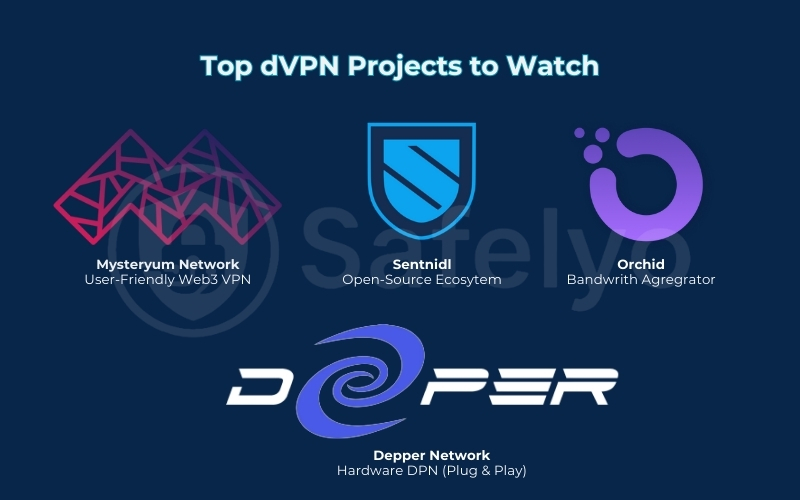
The decentralized privacy market is still young, but a few heavyweights have emerged as reliable leaders. Depending on your technical expertise and your patience, here are the projects defining the landscape in 2026.
- Mysterium network: Think of this as the “NordVPN of Web3”. It is arguably the most user-friendly option on this list. With a polished app that looks and feels like a standard VPN, it removes the complexity of blockchain for the average user. It has the largest residential IP network, making it a favorite for unblocking content.
- Orchid: Orchid is for the true “Web3 Native”. It is less of a service provider and more of a bandwidth aggregator, allowing you to “hop” between different providers using a multi-chain architecture. It offers incredible privacy, but the learning curve is steep – you will need a crypto wallet and some patience to get started.
- Deeper network: If you hate installing software, Deeper is your answer. They sell physical hardware devices (Decentralized Private Networks or DPNs) that you plug directly between your modem and router. It offers a “buy once, free forever” model with no monthly subscriptions, securing your entire home network at the hardware level.
- Sentinel: Sentinel is unique because it is an ecosystem, not just an app. Think of it as the “Android” of dVPNs – it provides the open-source infrastructure that other developers build VPN apps on top of. It is a robust, Cosmos-based network designed for censorship resistance.
7. Should you switch to a dVPN?
dVPNs are powerful, but they are still experimental technology in many ways. Deciding to switch from a polished service like ExpressVPN to a decentralized alternative isn’t just about privacy. It is about your tolerance for friction.
To help you decide, we have broken down the ideal user profiles.
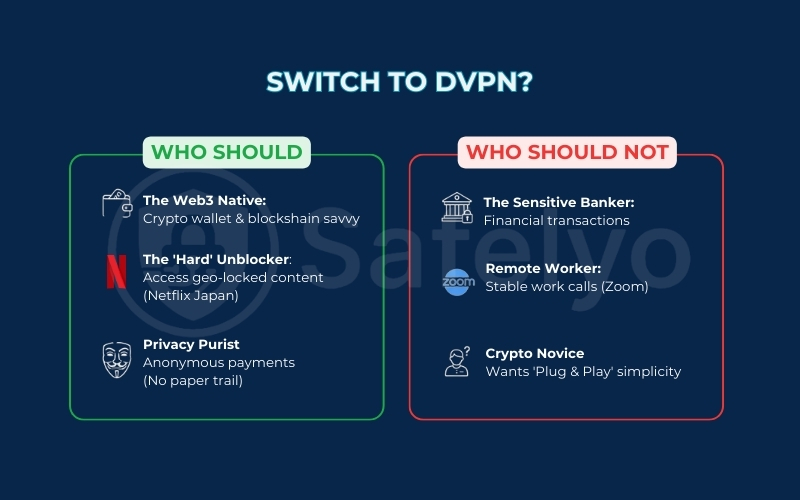
Who should use dVPN?
- The Web3 native: If you already have a crypto wallet and understand concepts like gas fees and private keys, you will appreciate the ethos of a trustless network.
- The “hard” unblocker: If you are trying to access stubborn geo-locked content (like Netflix Japan or localized banking portals) that constantly detects and bans standard VPN servers, the Residential IP feature of dVPNs is your best weapon.
- The privacy purist: If you refuse to leave a paper trail on a credit card statement, the ability to pay anonymously via Smart Contracts makes dVPNs the only logical choice.
Who should avoid dVPN?
- The crypto novice: If setting up a MetaMask wallet sounds like a nightmare to you, stick to a traditional VPN. The user experience (UX) of dVPNs has improved, but it is still far less intuitive than a standard “Login and Connect” app.
- The remote worker: Do not rely on a dVPN for critical Zoom calls or accessing corporate databases. The connection stability varies wildly depending on the node you connect to. You cannot risk your internet dropping out in the middle of a client meeting because the node operator turned off their PC.
- The Sensitive banker: Avoid logging into sensitive bank accounts via random dVPN nodes. While encrypted, routing your financial data through a stranger’s residential connection adds an unnecessary layer of risk compared to a secure, verified server.
Quick decision framework: Which tool fits your needs?
If you are still on the fence, use this cheat sheet to match your specific digital lifestyle with the right tool.
| Your Primary Goal | Recommended Tool | Why? |
| Stable Remote Work (Zoom, Slack) | Traditional VPN | You need guaranteed uptime and speed stability, which dVPNs cannot promise yet. |
| Bypassing Tough Blocks (Netflix, local news) | dVPN | Residential IPs are much harder for websites to detect than corporate server IPs. |
| User Friendliness (Plug & Play) | Traditional VPN | No wallets, no tokens, just one click. Ideal for non-techies. |
| Anonymous Payment | dVPN | Pay with crypto (no credit card trail) via smart contracts. |
| Speed & 4K Streaming | Traditional VPN | Optimized servers prevent buffering better than a random peer’s home connection. |
| Anti-Censorship (Strict Firewalls) | dVPN (Use with caution) | Residential IPs are harder to blacklist at scale, but success is not guaranteed. Significant legal risk applies in restrictive jurisdictions. |
Pro Tip: Many advanced privacy users employ a Hybrid Strategy. They keep a reliable traditional VPN (like NordVPN) for daily work and streaming, but keep a dVPN (like Mysterium) on hand specifically for unblocking stubborn websites or when they need “residential” cover.
8. FAQs about the decentralized VPN
What is a decentralized VPN?
A decentralized VPN (dVPN) is a peer-to-peer (P2P) network where users route their internet traffic through other users’ devices rather than through a central server owned by a single company. This eliminates the “single point of failure” and prevents data logging by a central authority.
Is a dVPN free?
Not entirely. While there are no monthly subscription contracts like with traditional VPNs, dVPNs operate on a pay-as-you-go model. You typically pay for the exact amount of bandwidth you consume using cryptocurrency. Some projects offer limited “free” modes, but these are often slow or require you to share your own bandwidth in exchange.
Is it safe to run a dVPN node at home?
Running a residential node can expose you to ISP bans and abuse complaints, as you are technically operating a server. Enabling “Whitelist” or “Restricted” modes reduces the risk of facilitating serious crimes, but it is not a legal shield. You should strictly review your ISP’s Terms of Service (which often prohibit commercial use) and understand your local liability laws before proceeding.
Can a dVPN replace my corporate VPN?
No. Businesses require centralized control, static IPs, and guaranteed stability – features that dVPNs fundamentally lack. A dVPN is a consumer privacy tool, not an enterprise security solution.
Can the police track a VPN?
With a centralized VPN, police can subpoena the company for logs (if they exist). With a dVPN, there is no central company to subpoena. However, sophisticated “timing attacks” or monitoring the ISP of the entry/exit nodes could theoretically correlate traffic, though this is extremely difficult and resource-intensive compared to traditional tracking.
Is NordVPN a decentralized VPN?
No. NordVPN is a classic Centralized VPN. They own (or rent) and manage the servers you connect to. You must trust NordVPN not to log your data. A dVPN like Mysterium does not own the servers; the community does.
9. Conclusion
Decentralized VPNs represent a fascinating evolution in the fight for digital privacy. By removing the middleman, they solve the “trust” issue that plagues even the best corporate VPNs. For users needing residential IPs to bypass strict censorship or those who demand anonymous crypto payments, dVPNs are a powerful tool.
However, let’s be realistic: the technology is still in its “Early Adopter” phase. The speeds can be inconsistent, and the legal risks for node runners are real.
Our Verdict? Don’t delete your NordVPN or ExpressVPN app just yet. Treat a dVPN as a specialized backup tool in your privacy toolkit- perfect for specific tasks where a residential IP is required, but perhaps not ready to be your daily driver for work and 4K streaming.
Ready to dip your toes into Web3 privacy? To learn how residential proxies work and how to use them safely, check out more step-by-step tutorials in the VPN Guides category on Safelyo.