
2025 VPN statistics mark a definitive turning point where the Virtual Private Network has evolved from a niche IT tool into a mainstream utility. Amid accelerating AI surveillance and an intensifying pace of data breaches, the latest global statistics confirm this massive shift for VPN users.
At Safelyo, I have compiled this comprehensive report by analyzing data from leading industry sources to provide you with a clear picture of the landscape. We will explore the VPN market size 2026 projections, shifting user demographics, and critical cybersecurity statistics 2025. Here are the numbers defining digital privacy right now.
Quick Summary for Researchers & Journalists:
- VPN Usage is Mainstream: Privacy tools have moved beyond tech circles to become essential household software.
- Mobile First Shift: Mobile VPN adoption is currently outpacing desktop usage by a significant margin.
- The “Free” Fall: Consumer trust in free VPN services has hit a record low following recent security scandals.
- Market Trajectory: The global VPN market projects sustained double-digit growth heading into 2030.
1. Editor’s choice: 10 VPN stats you need to know (2025)
If you are looking for a quick snapshot of the industry, these are the most critical numbers defining the landscape this year. Based on our analysis of validated VPN usage statistics 2025, here is the “TL;DR” for researchers and journalists:
| 23–25% of surveyed internet users report using a VPN (2025). |
“Around 23% of internet users worldwide use a VPN.”
– Security.org, 2025 VPN Usage Statistics
Why it matters: VPN adoption has stabilized at scale, signaling a mature, mainstream market rather than early-stage growth. This aligns with the broader normalization of remote and hybrid work.
| 1.6-1.75 billion people worldwide now use a VPN. |
“There are over 1.75 billion VPN users worldwide.”
– DemandSage, VPN Statistics 2025
Why it matters: At this scale, VPNs function as global digital infrastructure, not niche privacy tools.
| The global VPN market is projected to reach $75-80 billion by 2026. |
“The global VPN market size is projected to reach USD 77.1 billion by 2026.”
– ElectroIQ, VPN Market Statistics
Why it matters: Enterprise security, remote work, and regulatory pressure are driving sustained economic growth.
| 32% of U.S. adults used a VPN in 2025, down from 46% in 2024. |
“32% of U.S. adults used a VPN in 2025, down from 46% in 2024.”
– Security.org, VPN Usage Statistics
Why it matters: Post-pandemic normalization reduced business usage, but consumer demand remains strong.
| Public Wi-Fi security is the #1 reason people use VPNs. |
“Security when using public Wi-Fi is the most common reason people use a VPN.”
– AllAboutCookies, VPN Usage Survey 2025
Why it matters: VPNs are increasingly viewed as basic digital hygiene, not advanced privacy tools.
| Geo-restricted content access is among the top consumer VPN use cases. |
“Many people use VPNs to access streaming services and other geo-restricted content.”
– Security.org, Why People Use VPNs
Why it matters: Entertainment and streaming continue to drive mass-market VPN adoption.
| Approximately 66% of VPN users rely on VPNs on their smartphones. |
“Nearly two-thirds of VPN users use a VPN on their smartphone.”
– DemandSage, VPN Usage by Device
Why it matters: VPN usage is now mobile-first, reflecting broader shifts in internet consumption behavior. While mobile dominates, the usage frequency across other platforms like Windows and macOS remains high for heavy productivity tasks.
| 48% of VPN users still use free VPN services. |
“48% of VPN users say they use a free VPN service rather than a paid subscription.” – AllAboutCookies, VPN Usage Survey
Why it matters: A significant portion of users remains exposed to logging, tracking, and safety risks.
| Countries in APAC and the Middle East show the highest VPN adoption rates globally. |
“The Asia-Pacific region shows the highest growth in VPN usage, driven largely by censorship and content restrictions.”
– Cloudwards, VPN Statistics & Trends 2025
Why it matters: Internet censorship and content restrictions remain the strongest adoption drivers.
| VPN demand has surged by several hundred percent during censorship or political crises. |
“VPN demand has surged by several hundred percent following government censorship, protests, or new legislation.”
– Top10VPN, VPN Demand Statistics
Why it matters: VPN usage has become a reliable real-time indicator of digital freedom stress.
Bottom line: These VPN usage statistics in 2025 confirm that VPNs are no longer optional privacy add-ons. They are now a core component of how billions of people access and secure the internet worldwide.
2. Global VPN Market Size & Financial Forecast (2025-2030)
The Virtual Private Network industry has evolved from a niche cybersecurity sector into a global financial powerhouse. Current market analysis indicates that we are in the middle of a massive growth phase. This phase is driven not only by individual privacy concerns but also by systemic changes in how the world conducts business. Recurring headlines about major account breaches have forced users to take proactive control of their digital identity.
The Multi-Billion Dollar Surge
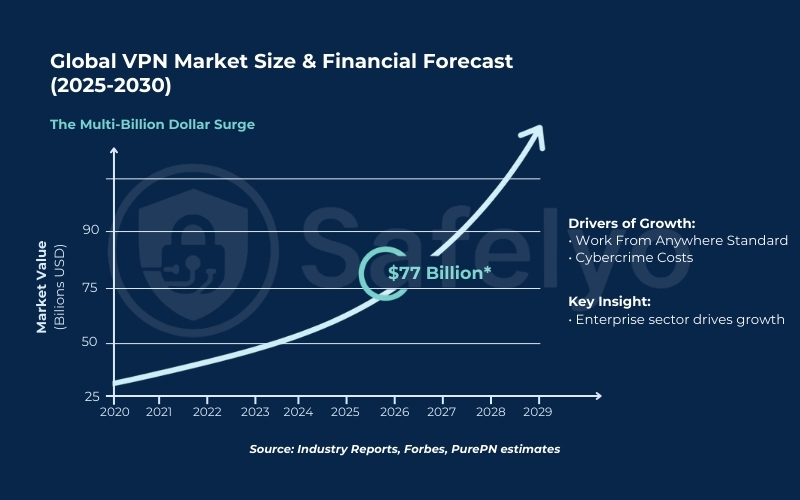
If you are analyzing the VPN market size in 2026 projections, the numbers are staggering. Industry reports, including data cited by Forbes, PureVPN, and other market analysts, estimate the global market is on track to reach approximately 77 billion by 2026. This represents a significant leap from the 45 billion valuation seen just a few years prior (2024), showcasing a rapid adoption rate that outpaces many other software sectors.
Drivers of Growth: Why the Boom?
What is fueling this double-digit Compound Annual Growth Rate (CAGR) heading toward 2030?
- The “work from anywhere” standard: The permanent shift to remote work models has forced enterprises to invest heavily in corporate usage policies and Zero Trust architectures. For companies, the VPN is no longer optional; it is the new digital perimeter.
- Rising cybercrime costs: As the cost of data breaches continues to climb, both SMEs and large corporations are expanding their cybersecurity budgets, with VPNs serving as the essential first line of defense.
While consumer subscriptions (B2C) for streaming and gaming remain popular, the real financial engine driving this market through 2030 is the enterprise sector’s need to secure a decentralized workforce.
3. VPN adoption growth over time (2019 – 2025)
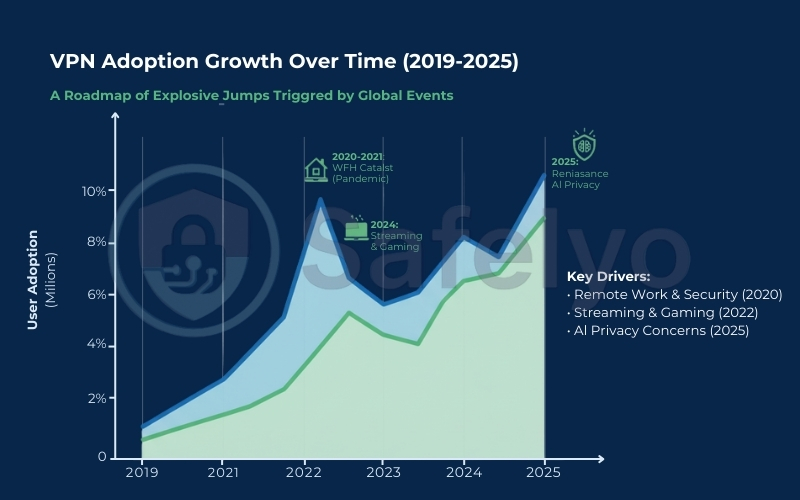
To understand the current market volume, we must look at the timeline. The trajectory of VPN adoption hasn’t been a gradual climb – it has been a series of explosive jumps triggered by global events. Based on historical search interest and download data, here is the roadmap of growth:
2019 (The Pre-Pandemic Baseline)
Before the world shut down, VPNs were largely considered “techie tools” or niche enterprise software. Usage was steady but confined mostly to IT professionals and privacy activists.
2020-2021 (The WFH Catalyst)
This was the tipping point. As COVID-19 lockdowns forced the global workforce into remote setups, demand skyrocketed. Organizations scrambled to secure home networks, and “VPN” became a household term overnight. Download trends during this period spiked to unprecedented levels as offices emptied and digital borders closed.
2022-2024 (The Streaming Era)
Post-pandemic, retention remained high, but the motivation shifted. Users began keeping their subscriptions not just for work, but for lifestyle reasons – specifically to bypass geo-restrictions on platforms like Netflix and to reduce latency in online gaming.
2025 (The AI Privacy Renaissance)
This year, we are seeing a “second wave” of privacy-focused adoption. With the rise of generative AI and aggressive data scraping, users are turning back to VPNs. They use these tools to reduce passive data collection and large-scale scraping.
4. Who uses VPNs? Demographics breakdown
Understanding the “typical” VPN user in 2025 requires looking beyond the stereotype of a tech-savvy enthusiast. The latest demographic data reveals a diverse, global user base driven by two distinct motivations: Necessity and privacy.
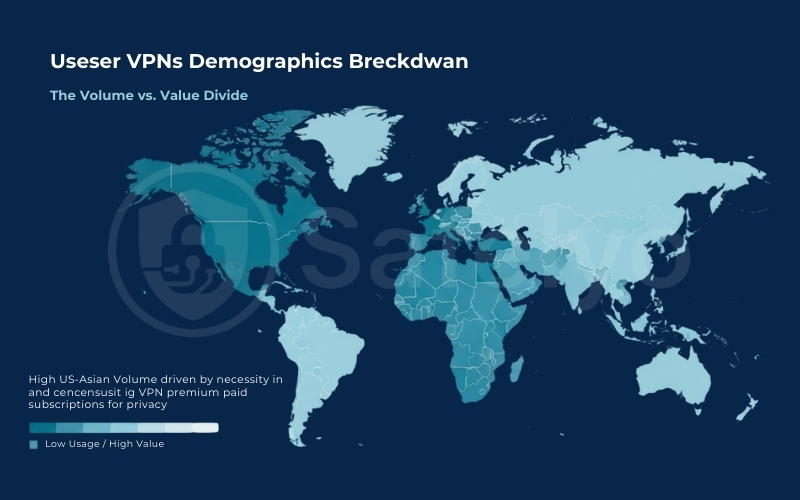
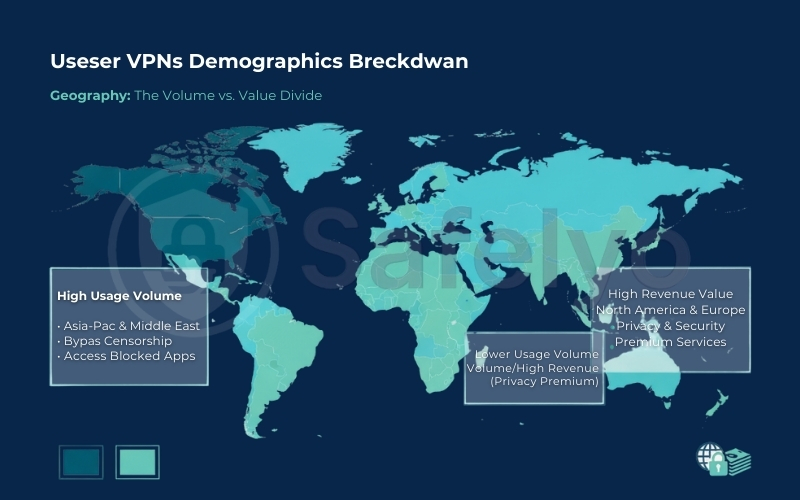
Geography: The Volume vs. Value Divide
When we analyze adoption rates (the percentage of the population using a VPN), the Asia-Pacific (APAC) and Middle East regions are the undisputed global leaders. Countries like Indonesia, India, and the UAE consistently show the highest market penetration. The reason is practical necessity: In these regions, users rely on VPNs to bypass strict government censorship or to access blocked communication apps (VoIP).
>> You may also be interested in: Best VPN for censorship bypass: 5 options that actually work
Conversely, while North America and Western Europe may have lower usage rates by sheer percentage compared to emerging markets, they dominate in revenue generation. Users in the US, UK, and Germany are far more likely to subscribe to premium, paid services. Here, the driver is not avoiding censorship, but preserving privacy against ISP tracking and targeted advertising.
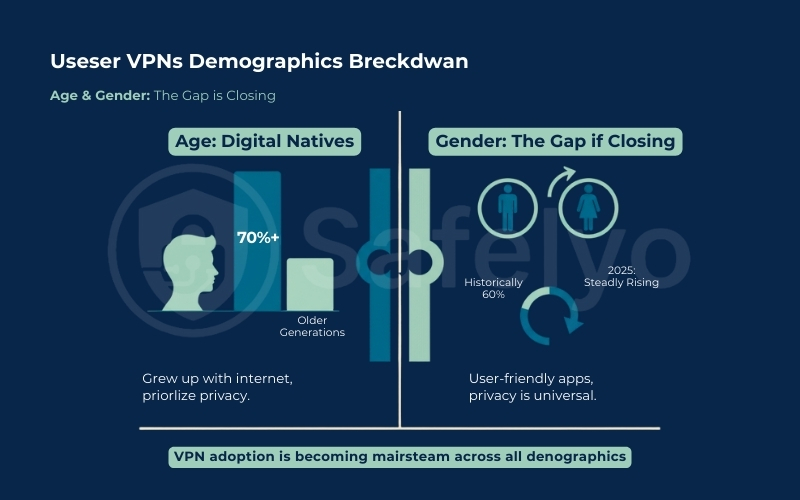
Age & Gender: The Gap is Closing
Unsurprisingly, age plays a massive role in adoption. Gen Z and Millennials make up the lion’s share of the global user base. These “digital natives” grew up with the internet and treat online privacy as a standard requirement, much like locking a front door.
Regarding gender, the landscape has historically been male-dominated (often cited around a 60/40 split). However, industry data suggests this gap is narrowing significantly in 2025. As VPN apps have evolved from complex network tools into user-friendly, “one-click” mobile applications, female adoption is steadily rising, making privacy a universal concern rather than a tech-niche interest.
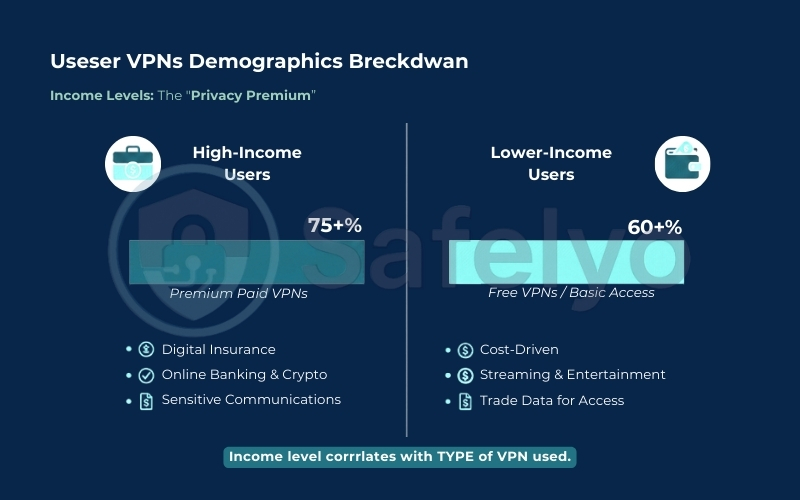
Income Levels: The "Privacy Premium"
There is a distinct correlation between income levels and the type of VPN used. High-income earners are significantly more likely to invest in paid subscriptions. This trend is largely driven by professionals who rely on secure connections for remote work and handling sensitive client data.
This demographic views VPNs as a form of digital insurance – protecting online banking, cryptocurrency portfolios, and sensitive business communications. Lower-income demographics, while active users, are more prone to relying on free alternatives to access entertainment, often trading their data privacy for zero-cost access.
5. Why do people use VPNs? (Motivations & Trust)
When we peel back the layers of user behavior, the motivation for downloading a VPN rarely stems from a single cause. In 2025, it is a complex mix of fear, entertainment, and the desire for information freedom. As cybersecurity awareness grows, privacy concerns and the need for genuine user trust are becoming the primary decision-making factors.
The "big three" motivators
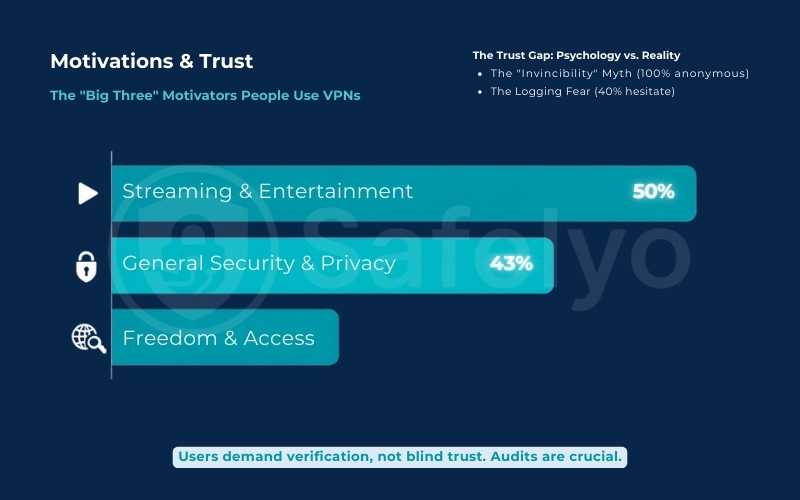
According to recent consumer reports, the primary drivers for adoption generally fall into three distinct buckets (respondents could select multiple reasons):
- General Security & Privacy (~43%): This remains the most cited reason in formal surveys. Users are increasingly aware of the dangers of “digital eavesdropping” on unsecured open Wi-Fi networks in airports and cafes. They want encryption to act as a tunnel for their sensitive data.
- Streaming & Entertainment (~50%): While security is the “official” reason, practical usage often tells a different story. Accessing geo-restricted content (such as unblocking foreign Netflix libraries or watching sports blackouts) is the leading practical use case for the average consumer.
- Freedom & Access: For users in restrictive regimes (as noted in the demographics section), the motivation is binary: Access or isolation. Here, VPNs are tools to bypass government firewalls and access the global internet. For millions of internet users living under digital censorship, these tools represent the only viable gateway to the outside world.
The trust gap: Psychology vs. Reality
However, adoption does not equal blind faith. A significant “Trust Gap” persists in the market.
- The “Invincibility” Myth: A worrying percentage of users still falsely believe that a VPN makes them “100% anonymous.” They think it makes them immune to all forms of cyberattacks, including phishing or malware, which a VPN cannot stop.
- The Logging Fear: Trust in providers is fragile. Surveys indicate that over 40% of users hesitate to use a VPN because they fear the provider itself might be logging and selling their browsing history.
From our perspective, the market is maturing. We are observing a sharp rise in user literacy regarding no-logs policies. Users in 2025 are no longer just looking for the fastest server. They are actively reading privacy audits and transparency reports before subscribing. The era of “blind trust” is over; users now demand verification.
6. VPN Usage and Government Restrictions (Legal Trends)
While VPNs are legal tools in the vast majority of the world, the global map of digital freedom is becoming increasingly fragmented. In 2025, we are witnessing the acceleration of the “Splinternet” – where national borders are increasingly applied to the digital realm, creating distinct, isolated versions of the internet.
The Legal Landscape: Bans and Barriers
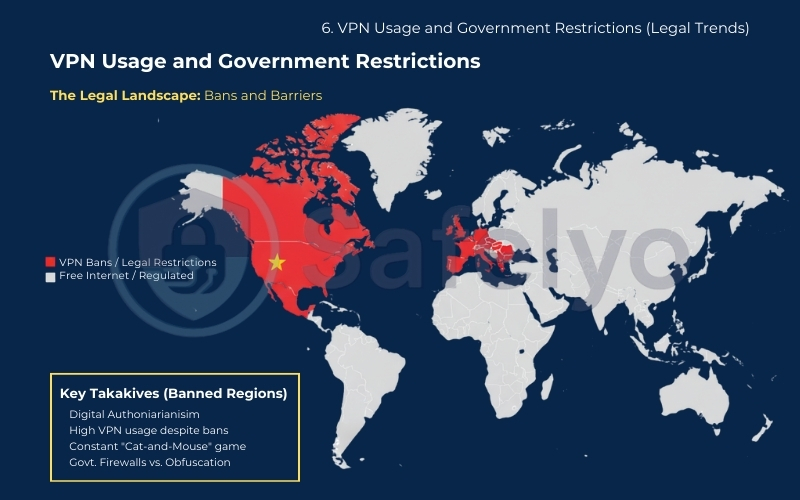
While VPNs are legal in most jurisdictions, a number of countries either ban VPNs outright or heavily regulate which services are permitted – particularly in regions with strict censorship regimes. According to global legality summaries compiled by Security.org and similar watchdogs, this list includes major economies like China and Russia, alongside Iran, North Korea, and several Middle Eastern states.
In these “digital authoritarian” regions, using a VPN is often a cat-and-mouse game between government censors updating firewalls and providers obfuscating traffic. Paradoxically, strict legal prohibitions often correlate with the highest per-capita download rates for VPNs, as citizens seek to bypass the “Digital Iron Curtain”.
Data retention & Jurisdiction hopping
For the rest of the world, the concern is not banning, but surveillance. The rise of aggressive Data Retention Laws in the US, UK, and parts of the EU has fundamentally changed user behavior.
- Jurisdiction Matters: Users are increasingly selecting VPN providers based on where the company is legally incorporated (e.g., Panama, British Virgin Islands, Switzerland) rather than just server speed.
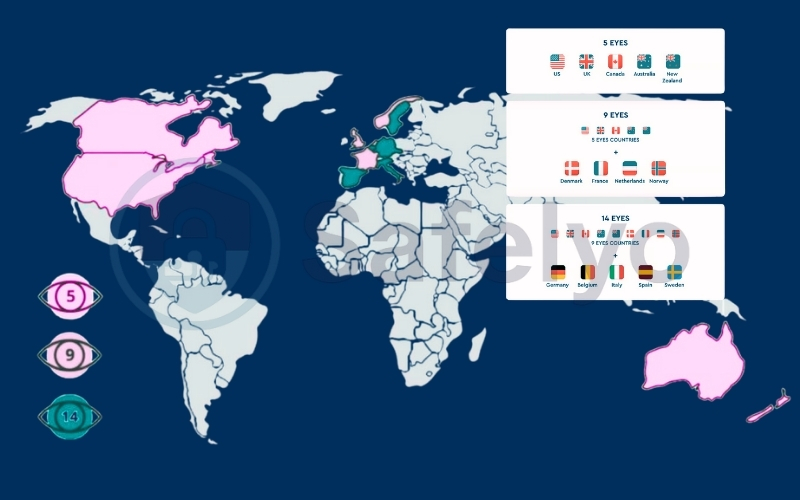
- The “Eyes” Alliances: Knowledge of the 5/9/14 Eyes intelligence-sharing alliances is now mainstream.
This shift has forced providers to move their headquarters to privacy-friendly havens to guarantee their “No-Logs” claims are legally sustainable.
7. The “Free VPN” trap: Statistics on security risks
In the world of cybersecurity, the old adage remains painfully true in 2025: “If you aren’t paying for the product, you are the product”. While the allure of a zero-cost solution is strong, free vs paid VPN statistics reveal a stark reality: No-cost services often compromise the very privacy they promise to protect.
The hidden cost: Malware and Tracking
The most alarming VPN security risks stem from the business models of free providers. Maintaining a global VPN server network costs millions. If they aren’t charging you a subscription, they must monetize you. These apps often contain critical vulnerabilities that leave device data protection weak, potentially exposing credentials to the dark web and leading to personal data breaches.
Malware Infection: In a comprehensive analysis of 283 Android VPN apps, researchers reported that 38% had at least one positive malware or malvertising report in VirusTotal. This highlights how risky “free” VPN ecosystems can be. This lack of quality control often leaves code vulnerabilities wide open for attackers to hijack the device.
“Of the apps analysed, more than a third were found to be tracking users through malvertising or malware.”
– Wired, Android VPN apps were found to contain malware in about 38% of cases in a study by CSIRO and other research institutions
Tracking Libraries: The same study found that only 28% of free VPN apps were free of embedded third-party trackers – implying that roughly 72% included at least one tracking library.
“Only 28% of free VPN apps did not use embedded third-party trackers… implying 72% had tracking.”
– Norton Blog summarizing the same study
Data brokers: The real customers
For many free VPNs, the user is merely a data source. The browsing logs are packaged and sold to third-party data brokers and advertisers. This completely defeats the purpose of using a VPN, as your data is still being traded – just by a different company.
User experience: The performance penalty
Beyond security, the user experience gap is massive.
- Speed: Free users typically face deliberate bandwidth throttling, resulting in 50-80% slower speeds compared to paid tiers.
- Limitations: Data caps (often 500MB – 2GB/month) and limited server choices (usually 3-5 locations vs. 5,000+ in paid apps) make free VPNs impractical for streaming or serious work.
At Safelyo, we classify most free VPNs not as security tools, but as “data mining apps” disguised as protection.
8. 2026 Predictions: What’s next for the industry?
As we look toward 2026, the VPN landscape is poised for a technological overhaul. The “cat-and-mouse” game between privacy tools and censors is forcing rapid innovation. Based on current R&D trends from market leaders, here are the three defining technologies for the coming year.
1. AI-Driven Protection
In 2026, the most visible shift won’t be a brand-new “AI protocol”, but AI applied across the VPN stack: Smarter routing, adaptive performance, and integrated threat filtering. Providers are increasingly using machine-learning models to optimize server selection in real time – routing users around congestion, throttling, and unstable peering to improve consistency rather than peak speed.
More importantly, many VPN products are evolving into “privacy and security suites”. Instead of claiming a VPN can stop phishing on its own, leading services are adding AI-assisted protections such as DNS-based malicious domain blocking, tracker suppression, and rapid threat-intel updates.
The result is a more practical, consumer-facing benefit: Fewer dangerous sites, fewer invasive trackers, and better stability – without requiring users to configure separate security tools. Furthermore, as Zero Trust principles evolve, future platforms will integrate these features directly to prevent sophisticated breaches in remote work environments. This enhanced stability is particularly vital for remote work, where consistent connectivity is required to maintain productivity during video calls and cloud operations.

2. Decentralized VPNs (dVPNs)
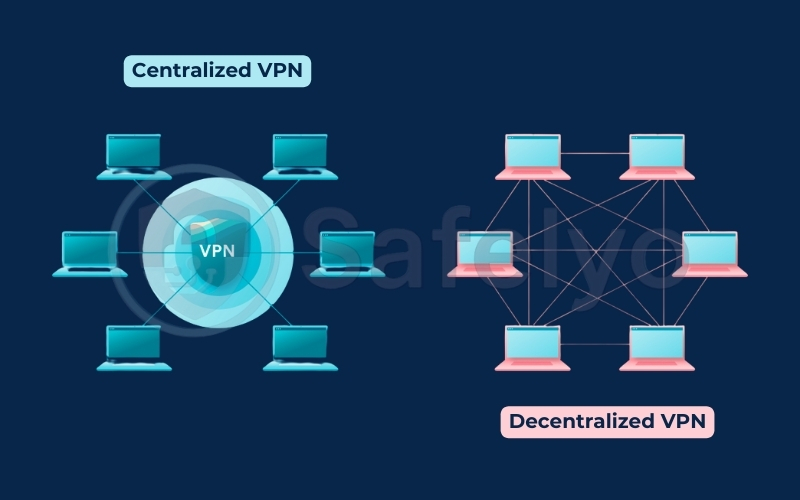
Trust in centralized entities is waning. The solution is the dVPN (Decentralized VPN), built on blockchain technology. Instead of routing traffic through servers owned by one company (a single point of failure), dVPNs distribute traffic across a peer-to-peer network of user nodes. This makes the network virtually impossible to shut down and ensures no single entity possesses user logs.
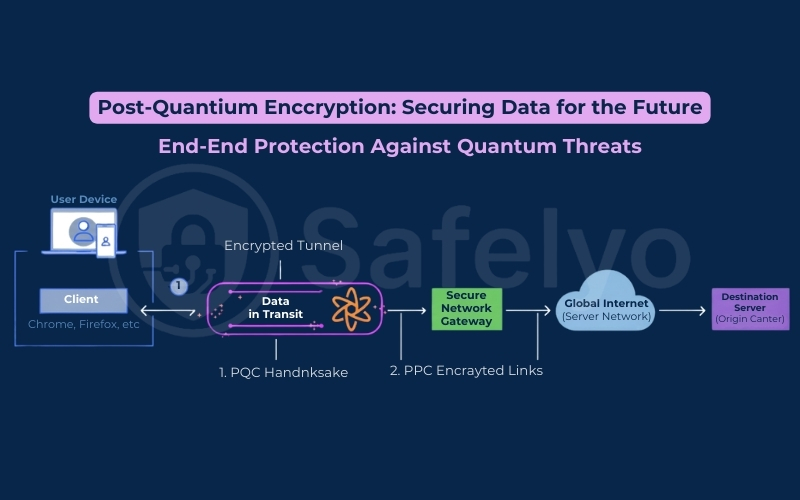
3. Post-Quantum Encryption
The looming threat of quantum computing – machines capable of cracking current encryption standards in seconds – is driving the biggest infrastructure upgrade in history. Current encryption standards contain mathematical vulnerabilities that future quantum computers will eventually exploit to decrypt past data.
Industry giants like NordVPN and ExpressVPN are already deploying Post-Quantum Cryptography (PQC) support. By 2026, this “future-proof” encryption will likely become the industry standard, ensuring that data stolen today cannot be decrypted by the quantum computers of tomorrow.
9. How we compiled these statistics
At Safelyo, we prioritize data integrity and transparency. To compile this 2025 landscape report, our research team synthesized information from a wide array of reputable public sources. These include industry whitepapers from Global Web Index (GWI), market analysis from Statista and Cybersecurity Ventures, and real-time application download metrics from the Google Play and Apple App Stores.
A Note on Projections:
Please note that specific financial figures and user growth estimates for late 2025 and 2026 are statistical projections. These were calculated by applying the established Compound Annual Growth Rate (CAGR) observed in the verified data from 2023-2024. This methodology allows us to provide researchers and journalists with the most accurate trajectory of the current market.
10. FAQs about VPN statistics
Here are the answers to the most common queries regarding VPN usage by country, security, and user demographics in 2025.
What percentage of people use a VPN?
Current data indicate that approximately 23–25% of surveyed respondents report using a VPN. Based on population-level extrapolations from these large-scale surveys, industry analysts estimate that over 1.6 billion people worldwide may rely on VPNs. This figure should be understood as an estimate rather than a precise global census.
Are Free VPNs safe to use in 2025?
Generally, no. As highlighted in our security section, nearly 38% of free VPN apps have been found to contain malware, and many others actively track and sell user data. While a Free VPN might save money upfront, the cost to your digital privacy is often much higher.
Which country has the most VPN users?
It depends on how you measure it. In terms of population penetration (percentage of citizens), the UAE and Indonesia often lead the list due to heavy internet censorship. However, if you ask how many Americans use a VPN, the US remains one of the largest markets by sheer volume. Approximately 32% of adult internet users in the US utilize this technology.
Will Netflix ban me if I use a VPN?
It is highly unlikely. Streaming services like Netflix typically fight VPNs by blocking the IP addresses of known VPN servers, preventing you from watching content. They rarely, if ever, ban the actual user account for attempting to bypass geo-blocks.
Can my parents see my search history if I use a VPN?
If they are monitoring the Wi-Fi router logs, then no – a VPN encrypts your traffic so they (and your ISP) only see gibberish. However, if they have installed parental control software directly on your device (screen recording or keylogging), a VPN cannot hide your activity from that local software.
Can the police track you if you use a VPN?
It makes tracking significantly harder, but not impossible. If you use a reputable paid VPN with a verified “No-Logs” policy based in a privacy-friendly jurisdiction (like Panama or Switzerland), there is no data to hand over. However, if the provider keeps logs and receives a court order, they can and will share your connection details.
Is using a VPN actually worth it?
Yes. In an era of increasing AI surveillance, open Wi-Fi network risks, and aggressive ISP tracking, a VPN is the single most effective tool for basic digital hygiene. It allows you to “set it and forget it.”
11. Conclusion
The data for 2025 is clear: The era of the “optional” privacy tool is over. With over 1.6 billion users and a market valuation racing toward $77 billion, VPNs have firmly established themselves as essential digital shields. The statistics show a massive shift toward mobile-first security and a growing rejection of data-harvesting free services. In an era defined by remote work and digital nomadism, ensuring your connection is encrypted is the only baseline for safety.
As we head into a more complex 2026, do not leave your digital footprint exposed. If you are currently relying on a risky free app, now is the time to upgrade. Check out the in-depth reviews and setup tutorials in the VPN Guides category on Safelyo to find a verified, secure provider that actually protects your data. Stay safe, stay private.