
Like coffee, VPN prices vary wildly, ranging from under $1 to $30.00 a month. This gap often reflects infrastructure, speed, and privacy audits, but it can be confusing.
To clarify VPN cost, we have compiled pricing data from over 30 top providers to give you a complete overview of the current market.
This guide covers the full price list, hidden fees to watch out for, and the factors that influence these costs.
Key Takeaways:
- Monthly plans are expensive: Expect to pay around $12 per month if you refuse to commit.
- Long-term is cheaper: Committing to a 2-year plan drops the average monthly cost to just $3.57.
- Hidden fees exist: Watch out for renewal hikes, taxes, and add-ons like dedicated IPs.
- Free isn’t free: Zero-cost VPNs usually pay for their servers by selling your browsing data.
- Business pricing differs: Company plans are priced per user, usually between $5 and $10 monthly.
1. How much does a VPN cost? (Price table)
We have compiled the pricing data for the most popular VPNs on the market.
If you look at the averages, a standard “rolling” monthly plan costs about $12.01/month. However, if you are willing to subscribe for two years, that average price drops significantly to $3.57/month.
Here is the complete breakdown of 30+ providers.
| VPN Provider | 1 Month | 12 Months | 24 Months | 36 Months |
|---|---|---|---|---|
| AdGuard VPN | $11.99 | $3.99 | $2.99 | N/A |
| Astrill VPN | $30.00 | $15.00 | $12.50 | N/A |
| Bitdefender VPN | $6.99 | $2.92 | N/A | N/A |
| CactusVPN | $14.00 | $3.19 | $2.19 | N/A |
| Cyberghost VPN | $12.99 | N/A | $2.03 | N/A |
| ExpressVPN | $13.99 | $4.79 | $3.59 | N/A |
| FastestVPN | $5.00 | N/A | $0.83 | N/A |
| Hide.me | $9.95 | $4.57 | $2.69 (26 Mo) | N/A |
| HMA VPN | N/A | $7.99 | $6.99 | $5.99 |
| Hola VPN | $14.99 | $7.69 | N/A | $2.99 |
| Hotspot Shield | $12.99 | $7.99 | N/A | N/A |
| IPVanish | $14.99 | $4.49 | $3.29 | N/A |
| Ivacy VPN | $12.95 | N/A | $2.14 | N/A |
| IVPN | $10.00 | $8.33 | $6.67 | $6.10 |
| VPN Unlimited | $9.99 | $5.00 | N/A | $4.49 |
| Mullvad VPN | $5.89 | $5.89 | N/A | N/A |
| NordVPN | $13.99 | $5.49 | $3.89 | N/A |
| OVPN | $14.13 | $5.87 | N/A | $4.97 |
| PIA | $11.95 | $3.33 | N/A | $1.98 |
| PrivadoVPN | $10.99 | $1.33 | $1.11 | N/A |
| PrivateVPN | $9.90 | N/A | N/A | $2.00 |
| ProtonVPN | $9.99 | $3.99 | $2.99 | N/A |
| PureVPN | $12.95 | $2.55 | $2.15 | N/A |
| StrongVPN | $11.99 | $3.97 | N/A | N/A |
| Surfshark | $17.95 | $3.39 | $2.29 | N/A |
| TorGuard | $14.29 | $10.92 | $8.25 | $7.64 |
| TotalVPN | N/A | $8.25 | N/A | N/A |
| Trust.Zone | $9.99 | $3.33 | $1.77 | N/A |
| Tunnelbear | $9.99 | $4.00 | N/A | $3.33 |
| Urban VPN | $9.56 | $3.33 | $2.21 | N/A |
| VeePN | $17.95 | $3.39 | $2.49 | N/A |
| VPNSecure | $9.95 | $6.66 | N/A | $2.99 |
| VyprVPN | $5.00 | $4.00 | $3.00 | N/A |
| Windscribe | $9.00 | $5.75 | N/A | N/A |
| ZoogVPN | $9.99 | $3.39 | $2.49 | N/A |
| AVERAGE | $12.01 | $5.32 | $3.57 | $4.25 |
Note: All prices are based on the US region and were updated on Jan 5, 2026.
2. Breakdown of VPN pricing models
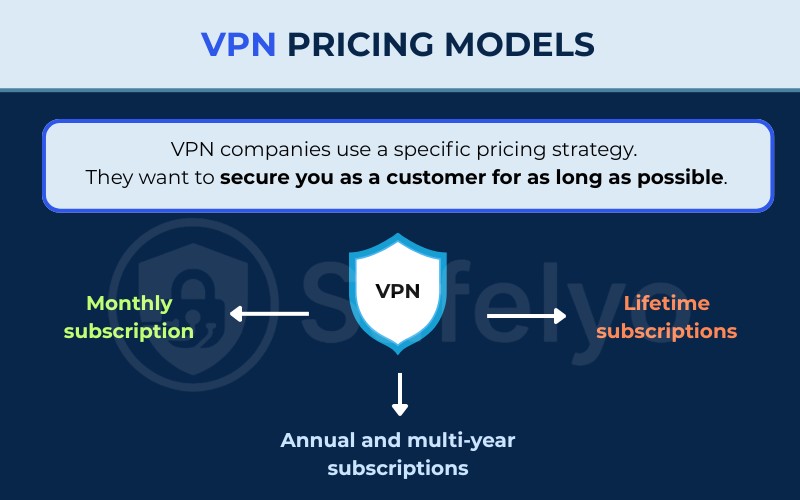
VPN companies use a specific pricing strategy. They want to secure you as a customer for as long as possible.
Because of this, you will rarely see a flat rate across all plans. Instead, the longer you commit to the service, the less you pay per month.
2.1. Monthly subscription plans (pay-as-you-go)
This is the most flexible option but also the most expensive. When you ask “How much is a VPN per month?”, the answer is usually between $10 and $15. Some providers even charge up to $30.
This tier is best for travelers who only need protection for a short trip. For example, if you are going abroad for two weeks and need to access your home bank account, paying $12.99 once is smarter than locking into a long contract.
2.2. Annual and multi-year subscriptions (best value)
If you want to know how much is VPN a year, the cost drops significantly. You can expect to pay between $2 and $5 per month for these longer commitments.
You can often see discounts ranging from 50% to 80% compared to the monthly price.
The “sweet spot” for most users is the 2-year plan. It typically offers the best balance between saving money and not committing for an eternity. Providers like Surfshark and NordVPN aggressively discount these longer terms to compete for your business.
2.3. Lifetime subscriptions (warning)
You might occasionally see a “Lifetime VPN” offer for a one-time payment of $30 or $50.
We strongly advise caution here. Running a VPN network requires constant electricity, server maintenance, and staff salaries. A business model based on a single $50 payment is rarely sustainable.
Many lifetime VPNs either shut down, limit service quality, or pivot to other business models over time.
3. How much does a VPN cost for a company?
Business VPNs function differently from the consumer apps you install on your personal phone. They are designed for teams, remote access control, and network security.
So, how much does a VPN cost for a company? The pricing is usually calculated “per user” rather than a flat fee.
- Per-user pricing: Expect to pay between $4 and $10 per user/month.
- Volume discounts: Price varies by user count (typically a minimum of 5 users), though providers like Proton VPN allow plans for as few as 2-3 users. If you have a large team (e.g., 50+ employees), sales teams will often lower the per-seat cost.
These plans cost more because they include specialized features. You get a centralized control panel to add or remove employees, Single Sign-On (SSO) integration, and often a dedicated IP address for the office network.
Here is a quick look at the pricing of some VPN for teams:
| VPN Provider | 12 months (Price per user/mo) |
| NordLayer | $7 – $14 |
| Proton VPN for Business | $6.99 – $10.99 |
| Surfshark for teams | $5.90 – $6.90 |
| ExpressVPN for teams | $3.12 – $4.68 |
Note: All prices are based on the US region and were updated on Jan 5, 2026.
4. 8 key factors that influence VPN cost
Not all VPNs are created equal. When you see a price difference between two providers, it is usually due to one of the following eight factors.
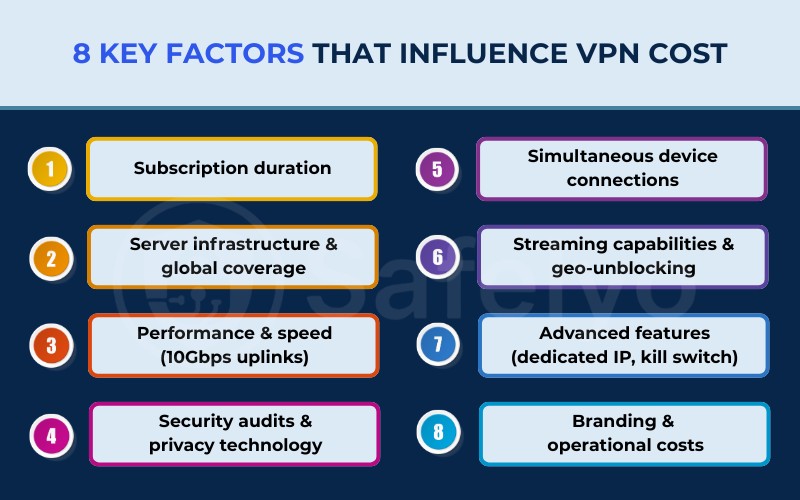
4.1. Subscription duration (commitment length)
This is the single biggest factor. As shown in the table above, the difference between a 1-month plan and a 2-year plan can be over $10 per month.
The provider gives you a “bulk discount” in exchange for guaranteed revenue.
4.2. Server infrastructure & global coverage
Servers cost money to rent and maintain. Physical servers in expensive regions (like the UAE, Japan, or Singapore) cost significantly more than virtual servers hosted in cheaper data centers.
A provider like Private Internet Access (PIA) or NordVPN maintains thousands of servers globally. This massive network requires a higher base price to operate compared to a small VPN with only 500 servers.
4.3. Performance & speed (10Gbps uplinks)
Bandwidth is expensive. To ensure you can stream 4K video or download large files without buffering, premium VPNs upgrade their servers to 10Gbps uplinks.
Budget VPNs often stick to 1Gbps servers. This saves them money but results in network congestion (slow speeds) during peak hours when everyone is online.
4.4. Security audits & privacy technology
Trust is the product. To prove they are not logging your data, top VPNs hire “Big Four” auditing firms (like PwC or Deloitte) to inspect their code and servers.
These independent audits cost hundreds of thousands of dollars. Additionally, running servers on RAM-only (diskless) technology is more expensive than using standard hard drives. These costs are passed on to the user to guarantee true privacy.
4.5. Simultaneous device connections
Most standard plans allow you to connect 5 to 7 devices at once. Providers that offer “Unlimited Connections” (like Surfshark or IPVanish) typically factor this high utility into their overall value proposition.
4.6. Streaming capabilities & geo-unblocking
Unblocking services like Netflix, Disney+, or BBC iPlayer is a constant cat-and-mouse game. Streaming services frequently block VPN IP addresses.
To bypass this, VPNs must constantly refresh their IPs and employ engineers to find new workarounds. Cheap VPNs often give up on this, while premium ones invest heavily to ensure you can still watch your shows.
4.7. Advanced features (dedicated IP, kill switch)
Basic VPNs just hide your IP. Advanced tools offer features like Double VPN (routing traffic through two servers), Obfuscation (hiding the fact you are using a VPN), and ad-blocking. Developing and maintaining these extra software layers adds to the development cost.
4.8. Branding & operational costs
Marketing plays a role. A well-known VPN that sponsors your favorite YouTubers has a massive marketing budget.
Sometimes you are paying for the brand reliability and their 24/7 customer support team, while smaller technical VPNs might be cheaper but harder to use.
5. Hidden fees: The “extra” VPN costs to watch out for
The sticker price you see on the website isn’t always the final amount that leaves your bank account.
- Renewal hikes: This is the most common surprise. You might sign up for $3.00/month for the first two years. However, when that term ends, the auto-renewal might charge you the full standard rate (often double or triple the introductory price).
- Dedicated IP addresses: If you want a static IP address that only you use (helpful for avoiding CAPTCHAs or accessing bank accounts), expect to pay an extra $3 to $5 per month.
- Taxes (VAT): In the US, sales tax is usually added at checkout. In the EU and UK, VAT can add up to 20% to the advertised price.
- Currency conversion: Some providers, like Astrill, may charge in USD regardless of where you live. If your bank account is in Euros or Pounds, you might pay a small conversion fee.
6. Free vs. paid VPN cost: Is free actually $0?
Many users search for free VPNs, hoping to save money. The reality is that “free” services often have a hidden cost that is much higher than a monthly subscription.
The golden rule of the internet applies here: “If you aren’t paying for the product, you are the product.”
- Selling bandwidth: Some free services (like the infamous case of Hola VPN) have been known to sell your idle bandwidth to other users. This turns your device into a server for strangers.
- Selling data: To pay for servers, free VPNs often collect your browsing logs and sell them to advertisers.
- Malware risks: Aggressive ads and trackers are common in free VPN apps.
However, there are also some reputable providers that offer a free version to let users experience the service. These plans usually come with significant limitations on features as well as data caps.
You can use them for light purposes or simple tasks like unblocking a website on a school network. However, we strongly advise against using random free apps for banking, entering passwords, or anything involving sensitive personal data.
Read more:
7. FAQs about VPN cost
How much does a VPN cost for a company?
Business VPNs typically cost between $5 to $10 per user/month. Enterprise plans often offer volume discounts for teams larger than 20 users.
How much does a VPN cost per month?
On average, a rolling monthly plan costs $12.01. However, prices vary significantly depending on the provider, ranging from as low as $5.00 to as high as $30.00 per month for specialized services.
How much does a VPN cost per year?
A 1-year subscription averages around $63.84/year (approx. $5.32/month). This is usually ~50% cheaper than paying month-to-month.
Is using a VPN actually worth it?
Yes. For the price of a coffee (~$3/mo), it significantly reduces certain privacy risks, such as ISP tracking and unsecured Wi-Fi interception.
Do VPN prices include tax?
Usually, no. US prices exclude sales tax. In the EU/UK, VAT (up to 20%) is often added at checkout.
How can I get a premium VPN for free?
You can utilize “Money-Back Guarantees,” which act as risk-free trials. Most top providers offer a 30 to 45-day refund window, allowing you to test the full service and get your money back if you cancel in time.
Why are some VPNs so expensive?
Some brands charge more to ensure premium consistency and speed stability. The higher cost often funds massive server networks, expensive independent privacy audits, and R&D for advanced features that budget providers cannot afford.
8. Conclusion
While the price of a VPN varies wildly, the market has settled into a predictable pattern. If you pay month-to-month, the average VPN cost is around $12. However, smart users who plan ahead can secure premium protection for roughly $3.50 per month by choosing a 2-year plan.
We recommend looking for a balance. Don’t just choose the absolute cheapest option on the list. Instead, look for a provider that offers audited security and fair pricing.
For more insights and knowledge about these tools, you can check our VPN Guides or visit Safelyo for trusted reviews.