
The average VPN cost typically ranges between $3 and $11 per month, depending on the length of your subscription. However, the promotional price displayed at checkout is rarely the ongoing price users keep paying. Introductory pricing frequently masks significant renewal hikes, making long-term commitments trickier than they appear.
This guide covers the full price list, renewal rates, pricing models, business options, and money-saving strategies to help you find the real total cost before you commit to a provider.
Key takeaways:
- Monthly plans are the most expensive, averaging $11.37 per month if you pay month-to-month.
- Long-term plans offer the best rate, with a 2-year plan dropping the average to approximately $3.06 per month.
- Introductory prices are not permanent, as most providers spike the price significantly on renewal, sometimes by 100 to 275 percent.
- Pricing tiers add up, and many VPNs now separate basic service from security bundles, so you must check what is included.
- Hidden fees exist, including renewal hikes, taxes, and add-ons like dedicated IP addresses.
- Free VPNs carry hidden risks, such as data selling, malware, and bandwidth reselling.
- Business pricing is per-user, typically ranging from $4 to $14 per user each month depending on features.
1. VPN price list: How much does a VPN cost?
The average monthly plan sits at $11.37, while the average 2-year plan drops to $3.06 per month. To make comparison simple, we have calculated the average costs across all major VPN providers to give you a clear baseline of what to expect when shopping for a subscription.
Below is our fully verified price list comparing over 35 top VPN providers on the market today. We have synchronized the pricing data to reflect accurate United States Dollar (USD) values.
The table below displays the advertised per-month breakdown for each plan. It is important to note that for 2-year and 3-year plans, many providers include bonus free months in their promotional offers. In those instances, the provider calculates the per-month price by dividing the total upfront bill by the full duration of the term, including those extra months.
| Plan Type | Price Range (per month) | Average Monthly Cost |
|---|---|---|
| Monthly | $5.00 to $30.00 | ~$11.37 |
| 1-Year | $1.33 to $15.00 | ~$5.00 |
| 2-Year | $0.83 to $12.50 | ~$3.06 |
Detailed price list:
| VPN Provider | Monthly | Annual (per mo) | 2-Year (per mo) | 3-Year (per mo) | Free Tier |
|---|---|---|---|---|---|
| AdGuard VPN | $11.99 | $3.99 | $2.99 | N/A | ✓ (3GB/mo) |
| Astrill VPN | $30.00 | $15.00 | $12.50 | N/A | ✗ |
| Avast SecureLine VPN | N/A | $4.99 | $3.99 | $3.99 | ✗ |
| Bitdefender VPN | $6.99 | $2.92 | N/A | N/A | ✓ (200MB/day) |
| CactusVPN | $14.99 | $3.19 | $2.19 | N/A | ✗ |
| CyberGhost VPN | $12.99 | $6.99 (6-mo) | $2.19 | N/A | ✗ |
| ExpressVPN | $12.99 | $4.99 | $2.49 | N/A | ✗ |
| FastestVPN | $5.00 | N/A | $0.83 | N/A | ✗ |
| Hide.me | $11.99 | $4.58 | $2.69 | N/A | ✓ (Unlimited data, speed capped) |
| HMA VPN | N/A | $4.99 | $6.99 | $2.99 | ✗ |
| Hola VPN | $14.99 | $7.69 | N/A | $2.99 | ✓ (limited) |
| Hotspot Shield | $12.99 | $7.99 | N/A | N/A | ✓ (500MB/day) |
| IPVanish | $12.99 | $3.33 | $2.19 | N/A | ✗ |
| Ivacy VPN | $12.95 | N/A | $2.14 | N/A | ✗ |
| IVPN | $6.00 | $5.00 | $4.17 | $3.89 | ✗ |
| VPN Unlimited | $9.99 | $5.00 | N/A | $4.50 | ✗ |
| Mullvad VPN | $5.82 | $5.82 | $5.82 | $5.82 | ✗ |
| NordVPN | $12.99 | $4.99 | $3.09 | N/A | ✗ |
| OVPN | $12.00 | $4.99 | N/A | $4.22 | ✗ |
| PIA | $11.95 | $3.33 | N/A | $2.03 | ✗ |
| PrivadoVPN | $10.99 | $1.33 | $1.11 | N/A | ✓ (10GB/mo) |
| PrivateVPN | $9.90 | N/A | N/A | $2.00 | ✗ |
| Proton VPN | $9.99 | $3.99 | $2.99 | N/A | ✓ (unlimited data) |
| PureVPN | $12.95 | $2.55 | $2.15 | N/A | ✗ |
| StrongVPN | $11.99 | $3.97 | N/A | N/A | ✗ |
| Surfshark | $15.45 | $3.19 | $1.99 | N/A | ✗ |
| TorGuard | $9.99 | $5.00 | N/A | N/A | ✗ |
| TotalVPN | N/A | $8.25 | N/A | N/A | ✗ |
| Trust.Zone | $9.99 | $3.33 | $1.86 | N/A | ✗ |
| TunnelBear | $9.99 | $4.99 | $3.33 | N/A | ✓ (2GB/mo) |
| Urban VPN | $9.56 | $3.33 | $2.21 | N/A | ✓ (ad-supported) |
| VeePN | $11.99 | $2.99 | $1.99 | N/A | ✗ |
| VPNSecure | $9.95 | $6.66 | N/A | $2.99 | ✗ |
| VyprVPN | $10.00 | $5.00 | $3.00 | N/A | ✗ |
| Windscribe | $9.00 | $5.75 | N/A | N/A | ✓ (10GB/mo) |
| ZoogVPN | $9.99 | $3.39 | $2.49 | N/A | ✓ (10GB/mo) |
| AVERAGE | ~$11.37 | ~$5.00 | ~$3.06 | ~$3.53 |
Note: All prices are based on the US region and were updated in May 2026. Always verify current pricing on the provider’s official website before subscribing. For providers with multiple tiers, the Basic/Standard tier is used.
1.1. How much does a VPN cost per month?
A standard monthly plan costs between $5.00 and $30.00 per month, depending on the VPN provider you choose. This option is ideal for short-term travelers or users who want to thoroughly test a service without locking themselves into a long-term contract.
However, a monthly plan represents the most expensive tier for prolonged use. VPN Providers charge a premium for monthly flexibility because it creates less predictable revenue and incurs higher payment processing fees.
For example, Astrill charges $30.00 per month for its premium service, Mullvad offers a predictable flat rate of roughly $5.82 per month (equivalent to €5), and FastestVPN sits at the budget end for exactly $5.00 per month.
1.2. How much is VPN a year?
An annual subscription averages $5.00 per month, which translates to roughly $60.00 billed upfront for the entire year. To secure this cheaper monthly breakdown, providers require you to pay for the full 12 months in a single transaction.
Based on our tracking, yearly prices range dramatically from $1.33 per month with PrivadoVPN up to $15.00 per month with Astrill VPN. For instance, Surfshark offers a 1-year plan for $3.19 per month. While a standard year is 12 months, Surfshark frequently includes three bonus months in this package. Because you are paying for 15 months upfront at that specific monthly rate, your total bill at checkout will be $47.85. This tier often represents the best balance of affordability and commitment for the average user.
1.3. How much does a VPN cost for 2+ years?
Multi-year plans offer the most aggressive discounts, bringing the average cost down to just $3.06 per month. Some VPN providers extend these commitments to 3-year cycles, such as PIA at $2.03 per month and OVPN at $4.22 per month.
While these deals look incredibly appealing on pricing pages, you must pay the entire sum upfront, which can reach $80 or more. More importantly, these heavy discounts are strictly introductory.
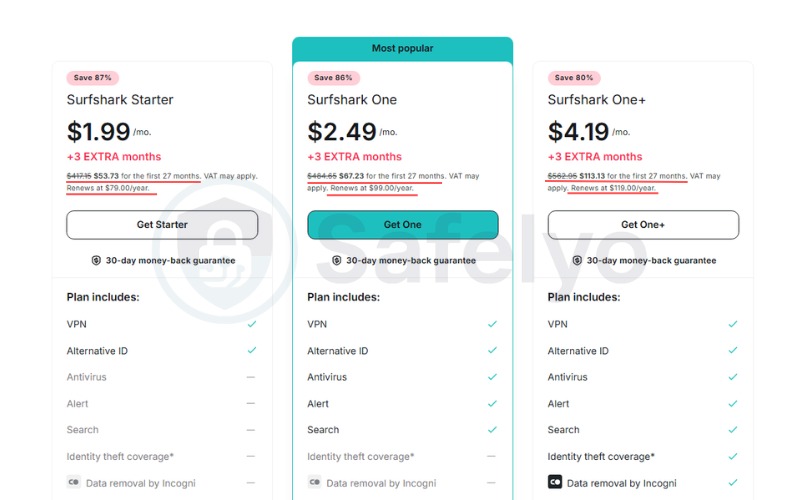
We always list the advertised per-month rate that providers display on their checkout pages. For instance, Trust.Zone advertises a rate of $1.86 per month for its “2 years + 6 months FREE” plan (billed $55.99 total). Surfshark advertises $1.99 per month for its 2-year plan (billed $53.73 total). These advertised rates often factor in the promotional free months, making the initial term highly cost-effective, but you must be prepared for the higher standard rate upon renewal.
2. The real cost of VPN ownership: Renewal rates explained
Introductory pricing only applies to your first billing cycle. The real cost of ownership becomes apparent when your plan renews at a significantly higher standard rate.
2.1. How introductory pricing works
Introductory rates are promotional discounts designed to acquire new customers. These plans automatically renew at the standard annual rate once the initial promotional term ends.
| Provider | Intro Plan | Total Billed (Intro) | Renewal Rate (annual) | Price Increase (vs annualized intro) |
|---|---|---|---|---|
| Surfshark (Starter) | 2-year + 3mo free | $53.73 | $79.00/yr | +231% |
| NordVPN (Basic) | 2-year + 3mo free | $83.43 | $139.08/yr | +275% |
| ExpressVPN (Basic) | 2-year + 4mo free | $69.72 | $99.95/yr | +234% |
| ProtonVPN (Plus) | 2-year | $71.76 | $119.88/yr | +234% |
| IPVanish (Essential) | 2-year | $52.56 | $89.99/yr | +242% |
| CyberGhost | 2-year + 2mo free | $56.94 | $56.94/yr | +117% |
| PIA | 3-year + 3mo free | $79.00 | $26.33/yr ($79 every 3 years) | +8% |
| StrongVPN | 1-year | $47.69 | $47.69/yr | 0% (flat renewal) |
| Hide.me | 1-year | $54.99 | $54.99/yr | 0% (flat renewal) |
| Windscribe | 1-year | $69.00 | $69.00/yr | 0% (flat rate) |
Auto-renewal is enabled by default across most VPN providers. This means your credit card will be automatically charged the higher rate unless you actively manage your subscription.
Our practical advice is to cancel the auto-renewal feature immediately after your initial payment succeeds. This allows you to retain the service for the fully paid term without facing unexpected charges later.
How we calculate the price increase:
To understand the true scale of these price hikes, we compare the equivalent annual cost of your first term directly against the new standard annual renewal cost.
- First, we find your real annual intro rate. We take your total upfront bill and divide it by the full duration of your plan in years (including any free bonus months). For example, NordVPN charges $83.43 for 27 months, which is 2.25 years. This means you are effectively paying $37.08 per year during your promotional term.
- Next, we compare it to the renewal rate. We look at the provider’s standard annual cost and calculate the jump. For NordVPN, going from an equivalent of $37.08 per year to their standard $139.08 per year is a 275 percent increase.
2.2. Pricing tiers and bundle add-ons
Pricing tiers separate the core VPN service from additional cybersecurity tools, meaning the heavily advertised headline price usually only covers the most basic package. NordVPN scales its offerings from the Basic VPN plan at $3.09 up to the Prime tier at $6.99, which adds identity theft protection. Surfshark bundles its higher tiers with antivirus software and data removal services.
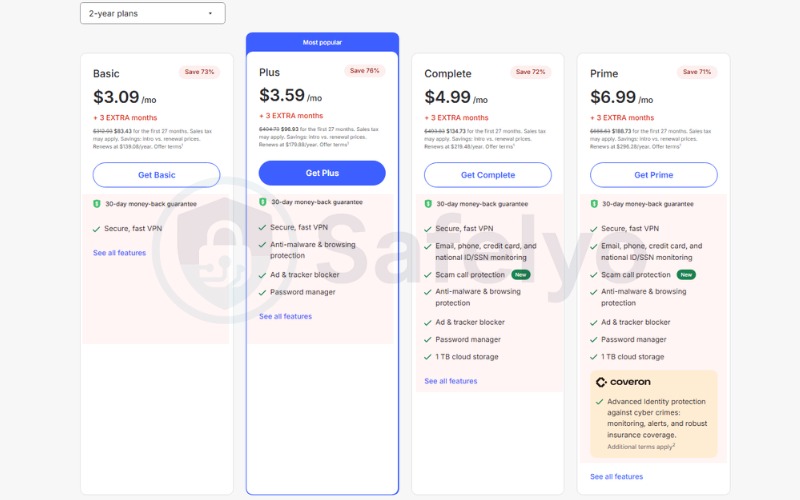
Most users see the lowest VPN price but end up paying more if they select higher tiers at checkout. Buying bundles from VPN providers is often not the most cost-effective route, as high-quality password managers like Bitwarden or built-in antivirus tools like Windows Defender are frequently available for free elsewhere.
3. VPN pricing models: Which plan type is right for you?
Choosing the right payment structure depends entirely on your usage habits and budget constraints. Providers structure their pricing into distinct models to reward long-term commitment. You trade upfront cash for a lower monthly breakdown.
3.1. Monthly subscription plans (pay-as-you-go)
Monthly plans cost an average of $11.37 and range between $5.00 and $30.00 per month, making them ideal for short-term use cases. If you are taking a two-week international trip or want to thoroughly test a network’s speeds before committing, this is the most logical choice.
This model gives you complete flexibility to cancel at any time without a large upfront payment. However, it offers the worst cost-to-benefit ratio for long-term users. Paying month-to-month for a full year will cost you more than double the price of a standard annual plan.
3.2. Annual subscriptions
Annual subscriptions average $5.00 per month, representing a steep discount of 50 to 80 percent compared to the monthly rate. To get this cheaper monthly price, you must pay the entire year upfront.
This model hits the sweet spot for regular users who want substantial savings without committing to a multi-year contract that could outlast the provider’s quality.
Always verify the renewal rate before you commit. Providers often charge an extremely low rate for the first year, but the renewal cost jumps significantly once that initial 12-month period expires.
3.3. Multi-year subscriptions
Multi-year plans span two or three years and offer the lowest initial monthly breakdown, typically ranging from $0.83 to $4.22 per month. These plans are perfectly suited for users who are certain they need a VPN for the long haul and are comfortable managing their subscription settings.
Because the introductory pricing is extremely low while the renewal rate is high, you must stay vigilant. We recommend canceling auto-renewal immediately after your initial payment clears to ensure you only pay the deeply discounted introductory rate.
3.4. Lifetime subscriptions (warning)
Lifetime subscriptions require a single upfront payment, but they pose significant reliability risks and are generally advised against. A business model relying on a one-time $50.00 fee cannot sustainably cover ongoing server costs, bandwidth, and staff salaries.
For example, if a provider acquires 5,000 users at $50.00 each, the total revenue is finite, while server bandwidth alone costs tens of thousands of dollars each month at scale. Consequently, these services often degrade in quality, fail to update their security protocols, or simply shut down entirely.
4. How much does a VPN cost for a business?
Business VPNs typically cost between $3.12 and $14.00 per user each month, depending on the provider and the required feature set. Unlike consumer plans, business solutions are priced per seat and include enterprise-grade tools such as centralized admin panels, Single Sign-On integration, dedicated IP addresses for office networks, and employee onboarding controls.
| VPN Provider | Business Price (per user/mo, annual) | Notable Features |
|---|---|---|
| NordLayer | $7.00 to $14.00 | Centralized control, SSO, dedicated IP |
| Proton VPN for Business | $6.99 to $10.99 | Swiss jurisdiction, audited no-logs |
| Surfshark for Teams | $5.90 to $9.40 | Unlimited devices per user |
| ExpressVPN for Teams | $3.12 to $4.68 | 8 devices per user, TrustedServer tech |
Most business providers require a minimum of five users to start a plan. For larger organizations with 50 or more employees, sales teams typically negotiate volume discounts, bringing the per-user cost down significantly.
5. 8 factors that affect VPN cost
The price gap between a budget option and a premium service is rarely arbitrary. Several underlying factors regarding network infrastructure, security engineering, and business models determine the final cost of your subscription.
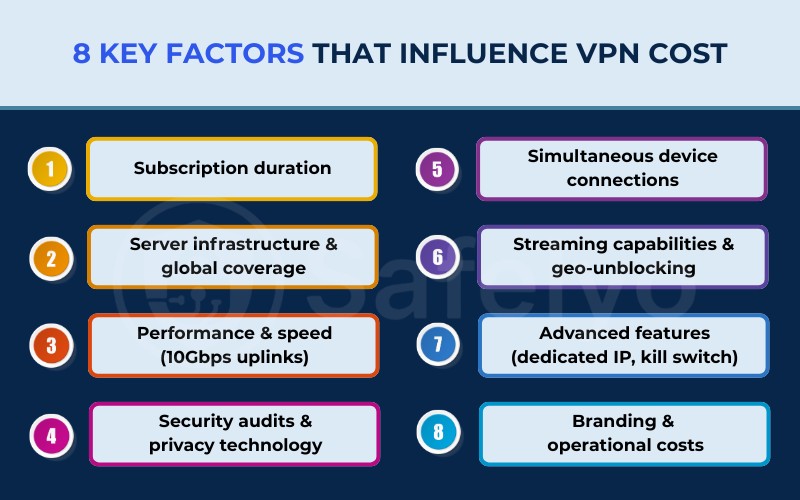
5.1. Subscription duration
The length of your commitment plays a massive role in the final price you pay. Providers offer bulk discounts to secure predictable upfront revenue, lower customer acquisition overhead, and reduce payment processing fees compared to handling 12 separate monthly transactions.
5.2. Server infrastructure and global coverage
Maintaining a vast, global network requires significant ongoing capital. Premium providers must account for hardware purchases, data center colocation fees, dedicated bandwidth costs, and ongoing maintenance.
Dedicated bandwidth is especially expensive in restricted regions. Providers maintaining thousands of servers globally demand a higher base price compared to smaller services with limited networks.
5.3. Performance and speed (10Gbps uplinks)
Connection speeds directly correlate with infrastructure investments. Budget VPN servers typically run on 1Gbps shared connections, which can become congested during peak traffic hours.
Premium providers invest heavily in 10Gbps dedicated uplinks, resulting in consistently low latency and high performance. Companies explicitly list 10-Gbps network upgrades as a primary selling feature to justify their premium pricing.
5.4. Security audits and privacy technology
Trusting a provider with your data requires verifiable proof, and obtaining that proof is expensive. High-quality VPNs invest heavily in complex engineering, including:
- RAM-only servers (diskless technology): Data is never written to a physical hard drive and is wiped clean upon every server reboot. This hardware premium increases operational complexity and overall costs.
- AES-256 encryption: Implementing military-grade encryption standards across all applications requires continuous engineering support.
- Independent audits: Hiring independent auditing firms to verify no-logs policies costs hundreds of thousands of dollars per audit, and these costs are factored into the subscription price.
5.5. Simultaneous device connections
The number of devices you can connect at once impacts the load on the provider’s network. Services offering unlimited simultaneous connections add immense value for large households. Other providers set strict limits, such as NordVPN with 10 devices and CyberGhost with 7 devices.
5.6. Streaming capabilities and geo-unblocking
Bypassing geo-blocks on major streaming platforms requires continuous engineering efforts. Streaming services actively block known VPN IP addresses, forcing providers to constantly acquire new ones and develop complex workarounds.
Premium providers invest heavily to unblock regional libraries, which reflects the ongoing engineering overhead factored into the pricing.
5.7. Advanced features (dedicated IP, kill switch, obfuscation, split tunneling)
Developing complex privacy tools beyond a basic encrypted tunnel adds significant development costs. These features include:
- Obfuscated servers: These disguise VPN traffic as regular HTTPS traffic, which is essential for bypassing strict firewalls in restrictive regions.
- Split tunneling: This allows you to choose which apps route through the VPN and which use your regular internet connection.
- Kill switch: This automatically locks your internet if the VPN disconnects unexpectedly.
- Dedicated IP: Providers often charge roughly $5.00 per month extra for a static IP address to avoid CAPTCHAs and secure office networks.
5.8. Branding and operational costs
Marketing budgets, customer support teams, and brand positioning all factor into the final price. High costs also stem from specialized operational requirements.
For example, creating and maintaining proprietary privacy protocols designed specifically for highly restricted internet environments requires significant ongoing technical investment.
6. Hidden fees: Extra VPN costs to watch out for
The advertised rate on the pricing page is rarely the final cost. Be mindful of these common hidden fees:
- Renewal hikes: Introductory rates typically apply only to the first billing term. When the plan renews, prices can increase by 110 to 275 percent.
- Dedicated IP addresses: Adding a dedicated, static IP address usually costs an extra $4.99 to $6.24 per month depending on the location.
- Taxes (VAT/Sales Tax): Prices in the US often exclude sales tax until checkout, while EU and UK users may see VAT up to 20 percent added on top of the advertised price.
- Currency conversion fees: Providers based in specific regions may charge in a single currency. If your bank account uses a different currency, you might incur a small conversion fee from your bank.
- Bundle tier upsells: Upgrading from a basic VPN-only plan to a fully-featured security suite can drastically increase the cost. For example, pricing rises significantly if you upgrade from a basic tier to a premium tier offering identity protection.
- Early termination fees: Some providers charge a penalty fee if you attempt to cancel a multi-year contract midway through the term. Always review the Terms of Service.
- BNPL interest: Using third-party installment services to split your payment might incur hidden interest charges over time.
7. How to save money on your VPN
Follow these strategic steps to minimize your overall VPN cost while maintaining top-tier security.
- Cancel auto-renewal immediately after payment. Navigate to your account settings right after purchasing and turn off the auto-renewal feature. You will retain full access for the term you paid for, but you will avoid the automatic charge at the higher renewal rate.
- Resubscribe as a new customer when your term ends. Most providers reserve their best discounts for new users. Once your plan expires, sign up with a new account to secure the introductory rate again.
- Buy during major sale windows. Wait for late November, as Black Friday and Cyber Monday offer the deepest discounts of the year. Top providers frequently offer deep discounts during these periods.
- Skip the premium bundle tier and stick to VPN-only. You rarely need the extra antivirus or password manager tools bundled into higher pricing tiers. Free alternatives like Bitwarden or Windows Defender perform these tasks exceptionally well.
- Consider pay-per-location pricing for limited use cases. If you only need a VPN to access servers in one or two countries, providers with a “Build-a-Plan” model starting at $3.00 per month are much cheaper than paying for global network access.
- Choose a reputable provider with transparent pricing policies. Industry leaders like NordVPN, ExpressVPN, and Surfshark clearly outline their introductory rates and renewal prices on their checkout pages. By selecting a trustworthy brand, you avoid hidden fees and know exactly what you will be charged when your initial term expires.
Note for privacy-conscious users: Paying with a credit card links your identity to your VPN account. For an extra layer of privacy, consider paying with cryptocurrency. Many top-tier providers accept crypto payments to ensure absolute anonymity.
8. Free vs. paid VPN: Is free really $0?
While cost-saving is important, opting for a zero-cost service often introduces severe security vulnerabilities. Understanding the business models behind free applications is crucial.
8.1. The real cost of free VPNs
If you are not paying for the product, you are the product. Free VPNs must cover their server costs somehow, which usually results in severe privacy violations.
According to a comprehensive security study by CSIRO researchers, 38 percent of free Android VPNs contain malware or invasive trackers. Furthermore, a report cited by McAfee revealed that over 21 million user records have leaked from free VPN databases in recent years due to poor security infrastructure.
Providers have also historically sold user bandwidth, effectively turning your device into a server for strangers. Ultimately, many free apps openly collect your browsing data and sell it to third-party advertisers.
Read more: Free vs paid VPN comparison
8.2. Legitimate free tiers: freemium vs. standalone free apps
The free VPN cost is zero, but you must choose the right type. The safest free VPNs are “freemium” versions offered by legitimate paid providers. These tiers are subsidized by paying customers, meaning they do not need to sell your data to survive.
Standalone free apps with generic names should be strictly avoided due to malware risks. To help you navigate this, we have compiled a table of legitimate freemium options that offer basic protection without compromising your data. All services listed below offer permanent free tiers, not limited-time trials.
| Provider | Free Tier Data | Device Limit | Notes |
|---|---|---|---|
| ProtonVPN | Unlimited | 1 device | Limited server locations, no streaming |
| Windscribe | 10GB/month | Unlimited | 10 countries included |
| PrivadoVPN | 10GB/month | 1 device | 12 server locations |
| Hide.me | Unlimited | 1 device | Restricted connection speeds |
| ZoogVPN | 10GB/month | 1 device | 5 locations, basic 128-bit encryption |
| Hotspot Shield | 500MB/day | 1 device | Ad-supported |
| TunnelBear | 2GB/month | Unlimited | Secure browsing limit increased |
| Bitdefender | 200MB/day | 1 device | Basic functionality |
If you are looking for secure, no-cost options, check out our guide to the best free VPNs to find trustworthy providers that protect your data.
8.3. Money-back guarantees as risk-free trials
Most premium providers offer a 30-day money-back guarantee. In practice, this functions as a free trial, though you must pay upfront and request a refund before the 30 days expire.
The main risk is simply forgetting to cancel in time. To use this effectively, set a calendar reminder for the 28th day. Alternatively, providers like ProtonVPN and Windscribe offer permanent free tiers that require no credit card upfront, providing a completely risk-free testing environment.
If you want to temporarily test premium features without committing long-term, explore our dedicated list of the best VPN free trials.
9. FAQs about VPN cost
Is using a VPN actually worth it?
Yes. For roughly $3.00 to $6.00 per month on a long-term plan, you gain encrypted browsing, ISP tracking protection, and the ability to securely access geo-restricted streaming content.
Do VPN prices include tax?
Usually, no. US prices exclude sales tax until checkout, while users in the EU or UK will frequently see VAT added to the final total.
How can I get a premium VPN for free?
You can utilize a 30-day money-back guarantee to test a premium service, or use permanent freemium tiers from trusted providers like ProtonVPN and Windscribe that require no credit card.
Why are some VPNs so expensive?
Premium providers charge more to cover the costs of 10Gbps server networks, independent security audits, and continuous engineering for advanced privacy features.
Will my VPN price go up after the first year?
Yes, for most providers. Introductory rates apply only to your first subscription term. Upon renewal, you are charged the standard rate, which can be 110 to 275 percent higher than your annualized introductory cost.
What is the cheapest VPN in 2026?
The lowest introductory rate is FastestVPN at $0.83 per month on a 2-year plan. The lowest sustained rate without renewal hikes is Mullvad at roughly $5.82 per month. Windscribe offers the cheapest pay-per-use model starting at $3.00 per month.
10. Conclusion
The headline price advertised by providers rarely tells the whole story. When calculating the final VPN cost, you should look at the annualized price over your entire ownership period rather than just the initial monthly breakdown.
If you need short-term flexibility, a monthly plan averaging $11.37 is your safest option. However, if you want the best balance of value and commitment, a 1-year plan averaging $5.00 per month hits the sweet spot. Just remember to cancel auto-renewal.
Alternatively, if you want the lowest sustained rate per year without fearing a massive renewal hike, flat-rate providers are excellent choices.
Always double-check the renewal rate before checking out, as that ultimately dictates your long-term expense. For more detailed breakdowns, explore our comprehensive VPN Guides or return to the Safelyo homepage for the latest cybersecurity updates.