
A dedicated IP address is a unique Internet number assigned exclusively to your account. Unlike standard network setups where you share an address with thousands of strangers, this fixed identity belongs only to you. If you feel anxious about sudden account lockouts or constant security checks, this exclusivity solves those headaches.
In this guide covering what is a dedicated IP, we break down how this technology provides complete connection stability. We also compare it to shared options so you can decide if the upgrade makes sense for your needs.
Key Takeaways:
- A dedicated IP is an exclusive internet address assigned only to your account, ensuring complete reputation control.
- It directly prevents CAPTCHA loops, stops bank account lockouts, and allows secure access to corporate networks.
- For website owners, it is absolutely essential for improving email deliverability and setting up private FTP servers.
- While it offers less “crowd-blending” anonymity than a shared IP, top-tier VPNs protect your privacy using token-based systems.
- You can add a dedicated IP to premium VPN subscriptions like NordVPN, Surfshark, or ExpressVPN for a small monthly fee.
1. What is a dedicated IP address?
A dedicated IP is a fixed Internet address assigned exclusively to a single user or a specific account. No one else shares or uses this exact identifier at the same time.
We see this feature deployed in two main technical contexts: as a VPN add-on for secure web browsing and as a web hosting add-on for advanced server management. Both environments rely on the same fundamental mechanism to provide connection stability and total reputation control.
1.1. How IP addresses work
An IP address serves as a unique numerical identifier for any device connected to the Internet. When a device attempts to access the web, the Internet Service Provider (ISP) assigns it an IP address.
Concurrently, the Domain Name System (DNS) automatically translates human-readable domain names into these numerical addresses so the browser knows exactly where to route the connection. The Internet Assigned Numbers Authority (IANA), which operates as a department of ICANN, manages the global distribution of these addresses.
Currently, the internet uses two primary versions: IPv4 and IPv6. The IPv4 system offers about 4.3 billion combinations and is nearly exhausted, while IPv6 provides 340 undecillion possible addresses. Most hosting and VPN providers still rely on IPv4 for dedicated IP assignments unless a user specifically requests the newer standard.
Here is a clear comparison of the two IP address formats:
| Feature | IPv4 | IPv6 |
|---|---|---|
| Format | Four sets of numbers (e.g., 128.175.13.92) | Eight groups of hexadecimal digits (e.g., 2001:0db8:85a3::8a2e) |
| Maximum Addresses | ~4.3 billion | 340 undecillion |
| Current Status | Nearly exhausted but universally supported | Slowly growing adoption |
| Dedicated IP Usage | The absolute standard | Available upon specific request |
1.2. Types of IP addresses: A quick breakdown
IP addresses are classified based on their assignment scope and permanency. Consumer IPs apply to personal devices, divided into private IPs assigned internally by local routers and public IPs assigned externally by ISPs.
Public IPs are further split into dynamic IPs, which change upon reconnection, and static IPs, which remain permanent. Website IPs apply to web hosting packages and are categorized as either shared or dedicated.
The following table illustrates how a dedicated IP fits into the broader technical taxonomy:
| IP Type | Assigned To | Fixed or Changing? | Exclusive or Shared? |
|---|---|---|---|
| Dynamic Public IP | Consumer devices | Changing | Shared (recycled) |
| Shared Website IP | Web hosting accounts | Fixed | Shared |
| Dedicated IP | One specific account | Fixed | Exclusive |
A dedicated IP represents the intersection of being static and exclusive. It maintains a permanent numeric string while guaranteeing that no other account on the server shares the assignment.
1.3. Dedicated IP vs. shared IP
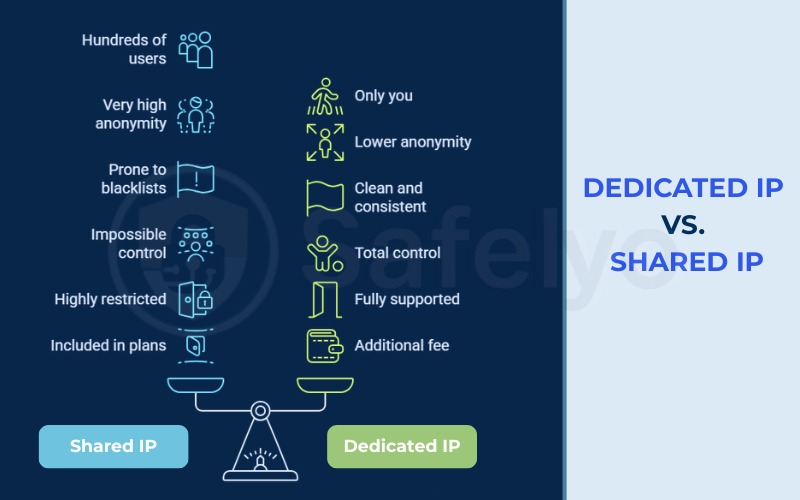
The main difference between a shared IP and a dedicated IP lies in exclusivity and reputation control. In a VPN context, a shared IP routes hundreds or thousands of users through a single address.
This mechanism provides high anonymity because user traffic blends together, but it increases the risk of the IP landing on a blacklist if another user violates terms of service. A dedicated IP grants one user a unique address, ensuring a clean reputation and stable connection, though it makes the traffic less anonymous.
In a web hosting context, a shared IP hosts multiple websites on the same physical server, with the ISP utilizing SNI technology to direct traffic to the correct domain. Conversely, a dedicated hosting IP is assigned to a single domain. This isolation is essential for maintaining high email deliverability and setting up a private FTP server.
Here is a summary of the differences between shared and dedicated IPs:
| Feature | Shared IP | Dedicated IP |
|---|---|---|
| Exclusivity | Used by hundreds or thousands of users. | Used only by you. |
| VPN Anonymity | Very high. Activity blends into the crowd. | Lower. Activity is tied to a unique IP address. |
| IP Reputation | Prone to blacklists and CAPTCHAs. | Clean and consistent. |
| Email Reputation Control | Impossible. Affected by neighbors. | Total control. |
| FTP Server Setup | Highly restricted. | Fully supported. |
| Cost | Included in standard plans. | Requires an additional monthly fee. |
A shared IP remains the best choice for general users prioritizing maximum anonymity or budget-friendly standard hosting. However, a dedicated IP becomes necessary for users needing strict reputation management and continuous access stability.
1.4. Dedicated IP vs. static IP: Are they the same?
These two terms are not entirely the same. A dedicated IP is essentially a highly specific subtype of a static IP. Every dedicated IP is static, but not every static IP is dedicated, as ISPs frequently provide shared static IPs to multiple users simultaneously.
In technical documentation, the term “public static IP address” serves as a direct synonym for a dedicated IP. Network administrators and businesses use this specific term when configuring access rules.
We can categorize these concepts based on user allocation and duration:
| IP Classification | Assigned To | Duration |
|---|---|---|
| Dedicated Static IP | One user or organization | Indefinite |
| Shared Static IP | Multiple users | Indefinite |
| Dynamic IP | One or more users | Until the lease time expires |
2. Do you actually need a dedicated IP? Take this quiz
Most internet users do not need a dedicated IP. A standard, high-quality shared IP VPN perfectly handles general online privacy and streaming needs. However, a dedicated IP address becomes an absolute necessity for specific technical groups and professionals. We have created a seven-question checklist to help evaluate this requirement.
Check the column that best describes your current situation:
| Question | Yes | No |
|---|---|---|
| 1. Do you frequently access a work network, private server, or home security system via a VPN? | ☐ | ☐ |
| 2. Do you use online banking or trade on cryptocurrency exchanges that are sensitive to IP changes? | ☐ | ☐ |
| 3. Are you annoyed by solving CAPTCHA puzzles or getting blocked by websites when the VPN is active? | ☐ | ☐ |
| 4. Do you host a game server for friends or need remote access to a Plex media server? | ☐ | ☐ |
| 5. Is your main priority to blend in with a massive crowd for maximum, untraceable anonymity? | ☐ | ☐ |
| 6. Do you send large volumes of emails (100,000+ per year) for marketing or business communications? | ☐ | ☐ |
| 7. Are you setting up an FTP server or need to access a website via IP during DNS propagation? | ☐ | ☐ |
If the answer is “Yes” to any of the questions from 1 to 4, or 6 to 7, a dedicated IP is the correct choice. The resulting stability, security, and convenience outweigh the additional monthly cost. Users with these requirements spend significantly less time dealing with lockouts and verification prompts.
If the answer is “Yes” primarily to question 5, a shared IP is the better option. Mixing traffic with thousands of other users offers a higher degree of baseline anonymity suitable for general browsing.
3. Benefits of a dedicated IP address
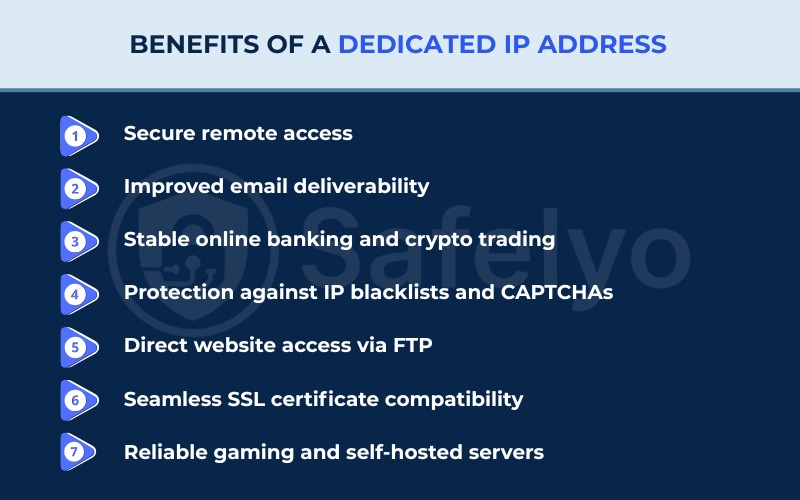
The practical advantages of a dedicated IP address fall into two primary categories. The first group covers VPN use cases, including secure remote access, stable banking, and avoiding CAPTCHAs. The second group involves web hosting and server management, covering email deliverability, direct FTP configuration, SSL compatibility, and custom gaming setups.
3.1. Secure remote access
A dedicated IP address solves remote access blocks by integrating perfectly with corporate security systems. Many companies enhance their internal network security by configuring a firewall allowlist (also known as a whitelist).
The IT administrator programs the central system to accept connections exclusively from approved IP addresses to prevent unwarranted access to sensitive systems. Attempting to log in from a constantly changing shared VPN IP results in immediate access denial, as the IT administrator simply cannot whitelist a dynamic address.
A dedicated IP allows the administrator to add one fixed address to the corporate allowlist. Remote workers can then securely access internal networks, private file storage, or cloud services without triggering security alerts. Businesses rely heavily on this method to protect critical business assets while enabling seamless remote productivity.
3.2. Improved email deliverability
Sending marketing emails that land in the spam folder is a major problem for growing businesses. Sending over 100,000 emails per year qualifies as a large volume operation, making a dedicated IP for email deliverability absolutely essential.
Email deliverability relies heavily on sender reputation. Providers like Gmail and Yahoo track the reputation of the specific IP address sending the messages. If one sender on a shared IP transmits bulk spam, the spam filter penalizes all other accounts sharing that same address.
A dedicated IP ensures total control over the sender reputation, completely isolating the domain from malicious neighbors. Additionally, properly aligning SPF (Sender Policy Framework) and DKIM (DomainKeys Identified Mail) records on a dedicated IP significantly increases the legitimacy of email campaigns.
If a business sends fewer than 10,000 emails per month, a dedicated IP is largely unnecessary. Third-party services like Mailchimp utilize established shared infrastructure that handles low-volume sending efficiently.
3.3. Stable online banking and crypto trading
Financial institutions utilize strict fraud detection algorithms that continuously monitor the IP address of every login attempt. Logging into a bank account with an IP that changes location continuously flags the account for suspicious activity.
This automated security protocol leads to locked accounts, denied transactions, and tedious identity verification processes. Cryptocurrency exchanges operate with even higher sensitivity to IP changes due to the strict security requirements of digital assets. Our testing indicates that using standard VPNs for finance often triggers these lockouts.
A dedicated IP provides a fixed, recognizable location for financial platforms. The banking system identifies the familiar address automatically, which reduces friction, minimizes lockouts, and ensures smoother trading sessions.
3.4. Protection against IP blacklists and CAPTCHAs
Turning on a VPN and immediately facing endless CAPTCHA prompts is a direct result of shared IP reputation issues. If a single user on a shared IP engages in bot activity or spam, automated security systems place that address on an IP blacklist (frequently referred to as a redlist).
This shared penalty results in “Access Denied” errors and continuous verification challenges. Streaming platforms like Netflix and Amazon actively block shared VPN IPs that exhibit heavy, simultaneous usage. Furthermore, search engine algorithms occasionally downrank websites hosted on red-listed shared IPs, even if the website itself follows all guidelines.
A dedicated IP solves this problem completely. By removing the shared element, the user assumes full, isolated control of the IP reputation, ensuring smooth browsing without constant bot checks.
3.5. Direct website access via FTP
Developers frequently need to work on websites while waiting for nameserver changes to complete. A dedicated IP enables direct IP access, allowing the administrator to type the numerical address directly into the browser to view the site during the 6 to 72 hours required for global DNS propagation.
Additionally, a dedicated IP allows for the immediate configuration of a private FTP server. This setup allows administrators to upload files, edit configurations, and manage content securely without relying on domain names. Deploying a private FTP server or SFTP (Secure FTP) provides faster data transfer rates and stronger encryption for sensitive internal files.
3.6. Seamless SSL certificate compatibility
Historically, installing an SSL certificate strictly required a dedicated IP address. The introduction of Server Name Indication (SNI) technology changed this requirement, allowing web servers to host multiple secure HTTPS certificates simultaneously on a single shared IP.
However, a dedicated IP remains necessary for SSL compatibility in three specific scenarios:
- Legacy systems: When the target audience relies on older operating systems or browsers that lack SNI support.
- EV certificates: When installing Extended Validation (EV) certificates, which display the verified company name in the browser address bar.
- High-tier e-commerce: When an online store requires an absolute guarantee of 100% compatibility across all conceivable devices.
For the vast majority of modern websites in 2026, standard SNI implementation on a shared IP handles SSL handshakes perfectly.
3.7. Reliable gaming and self-hosted servers
Hosting a multiplayer gaming server for titles like Minecraft requires a dedicated IP and highly isolated resources. Standard shared hosting plans prohibit game server deployment due to intense resource consumption and complex network configurations. This use case strictly requires a Virtual Private Server (VPS) or a dedicated machine equipped with full root access.
Self-hosted services also rely heavily on stable IP assignments. Developers and home lab enthusiasts use dedicated IPs to run Plex media servers, Nextcloud storage networks, and remote security cameras. Configuring custom firewall rules for these local services requires a static address, ensuring the owner can connect securely from any external location.
4. Dedicated IP and SEO: What is the real impact?
Google has explicitly stated that IP addresses do not directly impact search engine rankings. The ranking algorithms focus heavily on content quality, backlinks, site speed, and user experience metrics like Core Web Vitals.
However, a shared IP can cause indirect SEO damage. If a website shares an IP with platforms running black hat SEO tactics, link farms, or spam operations, automated systems may redlist the entire IP. This guilt-by-association can temporarily affect the visibility of legitimate sites sharing that exact address.
Therefore, the SEO value of a dedicated IP functions purely as insurance. It protects the website from the bad behavior of digital neighbors. Webmasters must completely avoid using dedicated IPs to build manipulative link schemes across multiple domains. Ultimately, if a site runs smoothly on shared hosting, purchasing an exclusive IP solely for SEO purposes is unnecessary.
5. The privacy trade-off: Is a dedicated IP less private?
Yes, a dedicated IP is theoretically less anonymous than a shared IP. This is the fundamental trade-off required to achieve connection stability and total reputation control.
With a shared IP, the user’s internet traffic blends into a massive stream alongside thousands of other users. This crowd effect makes isolating one specific user’s activity exceptionally difficult. A dedicated IP completely removes this crowd. Since the traffic originates from a single, unique address, it is technically easier to attribute the data flow to one specific source.
Top-tier VPN providers mitigate this privacy risk using two critical mechanisms. First, they operate under strict no-logs policies verified by independent third-party audits. They do not record browsing history, meaning the VPN tunnel remains completely dark to external observers.
Second, providers like NordVPN utilize an anonymous token-based assignment system. The user purchases the feature and receives a token to activate the IP. This system ensures that not even the VPN provider can link the specific IP address back to the original user account. Encryption remains fully active, securing all data transfers regardless of the IP type utilized.
6. Dedicated IP pricing
Pricing varies significantly depending on whether the IP is used for a VPN subscription or deployed within a web hosting environment.
6.1. VPN dedicated IP pricing
VPN providers offer dedicated IPs strictly as premium add-ons to an active subscription. They cannot be purchased as standalone products.
Here is a breakdown of the current add-on pricing across major VPN providers:
| Provider | Estimated Price | Notes |
|---|---|---|
| NordVPN | ~$3.69 to $5.89 / month | Price varies by subscription length. |
| Surfshark | ~$3.75 / month | Add-on to standard subscription. |
| ExpressVPN | ~$2.79 to $3.99 / month | Price varies by subscription length. |
6.2. Web hosting dedicated IP pricing
Web hosting costs depend heavily on the underlying server architecture and included resources.
The following table outlines the expected costs for website IP configurations:
| Hosting Type | Estimated Price | Notes |
|---|---|---|
| Shared Hosting Add-on | $2 to $5 / month | Sometimes included free with premium shared plans. |
| VPS Hosting | Starts at $5 / month | The IP comes bundled with isolated server resources. |
| Dedicated Server | $20 to $299+ / month | Includes the entire physical server and the IP. |
Upgrading to VPS hosting is generally the most cost-effective approach for developers. It bundles the dedicated IP with root access and isolated server resources. Adding a dedicated IP to a basic shared hosting plan will not improve website performance, as the CPU and RAM remain shared with other users.
7. Best VPNs with a dedicated IP (2026)
Choosing the right provider requires verifying their server infrastructure and privacy commitments. We mandate that any recommended VPN must pass a rigorous third-party audit of its no-logs policy to ensure user data remains secure.
We have evaluated the top providers for 2026 based on pricing, locations, and privacy tech:
| VPN Provider | Dedicated IP Price (Add-on) | Available Locations | Purchase & Assignment Process |
|---|---|---|---|
| NordVPN | ~$3.69 – $5.89 / month | 28 countries, including US, UK, Canada, Germany, Japan | Anonymous Token-Based: The most private method available, decoupling the account from the IP. |
| Surfshark | ~$3.75 / month | 20 locations, including the US, UK, Germany, Australia | Standard: The dedicated IP links directly to the Surfshark account but offers great overall value. |
| ExpressVPN | ~$2.79 – $3.99 / month | 20+ countries, including the US, UK, France, and Japan | Anonymous Token-Based: High-end privacy integration that maintains top-tier security standards. |
Our top picks explained:
- NordVPN: Based on our evaluation, the NordVPN token-based system offers the best overall package. It features a massive selection of server locations, and the anonymous token-based system serves as the gold standard for privacy.
- Surfshark: The Surfshark dedicated IP is an excellent, budget-friendly choice. While its assignment process is standard, Surfshark’s core service is heavily audited, maintains a strict no-logs policy, and offers great connection speeds.
- ExpressVPN: ExpressVPN is a premium contender utilizing a privacy-focused anonymous token system. It provides incredibly fast speeds and a highly reliable server network for users who demand top-tier performance.
8. FAQ about dedicated IP
Why would we want a dedicated IP address?
Users want a dedicated IP for tasks where consistency and a clean reputation are critical. Primary reasons include secure remote access to work networks, stable online banking, avoiding constant CAPTCHA verifications, improving email deliverability, and hosting personal servers.
Is a dedicated IP the same as a VPN?
No, they are different tools that work together. A VPN encrypts the internet connection and routes data through a secure server. A dedicated IP operates as an optional, premium feature of a VPN that assigns an exclusive IP address at the end of that secure tunnel.
Do we still get the security of a VPN with a dedicated IP?
Yes, absolutely. All internet traffic remains fully encrypted and routed through the secure VPN server. The core security benefits remain active. The only change is that the final IP address is unique to the user instead of being shared.
How is a VPN with a dedicated IP different from a business VPN?
A dedicated IP typically functions as a feature for a single user looking for connection stability. A business VPN operates as a comprehensive security solution designed for an entire organization. It includes centralized user management, custom access controls, and dedicated gateways.
Do we need a dedicated IP for a website?
If a website utilizes shared web hosting, it likely shares an IP with other websites. A dedicated IP for a website improves security by isolating the domain, helps secure high email deliverability, and guarantees SSL compatibility for older devices.
Can we use a dedicated IP on all devices?
Yes. As long as the VPN plan allows for multiple simultaneous connections, the VPN application can be installed on phones, laptops, and tablets. All configured devices will share the same single dedicated IP address.
Can we choose the city for the dedicated IP?
Users can typically choose the country from a list provided by the VPN service. Leading providers like NordVPN also allow users to select specific major cities (such as Los Angeles, New York, or London) when assigning the address.
How much does a dedicated IP cost?
As a VPN add-on, it costs between $2.70 and $6 per month depending on the provider and the subscription length. As a web hosting add-on, it costs $2 to $5 per month. Upgrading to a VPS, which includes a dedicated IP, starts around $5 per month.
Do we need to warm up a dedicated IP?
For email marketing, yes. A new dedicated IP must be warmed up gradually by starting with a small volume of emails and increasing the count weekly so Email Service Providers recognize the legitimate sending pattern. For VPN usage, no warm-up process is required.
What is a dedicated IP address for a website vs. a VPN?
A dedicated IP for a website (web hosting) assigns one unique IP to one domain to handle email deliverability, FTP configurations, and SSL compatibility.
A dedicated IP for a VPN assigns one fixed IP to a single user account to handle remote access, banking, and CAPTCHA avoidance. The contexts differ, but the principle remains the same: one IP strictly assigned to one entity.
9. Conclusion
Understanding exactly what is a dedicated IP is the first step toward solving specific digital access, stability, and reputation problems. Standard shared IPs simply cannot handle the strict requirements of corporate firewalls or bulk email systems. While the technology is not strictly necessary for casual web browsing, it provides critical infrastructure for advanced users, developers, and businesses.
By upgrading to an exclusive address, you eliminate the headaches of shared blacklists and constant verification prompts. To discover more ways to secure your online privacy, check out the VPN guides category on Safelyo.