
When comparing ExpressVPN vs CyberGhost, ExpressVPN is the overall winner. It uses premium technology designed for fast connections and strong privacy. CyberGhost is still a highly recommended option for anyone wanting to save money.
Ultimately, you are choosing between high-end engineering and an affordable price. ExpressVPN provides a smooth experience with its Lightway protocol, and CyberGhost saves you money on long-term renewals.
In this guide, we will look at their features, pricing, and our specific test results to help you choose.
Key Takeaways:
- ExpressVPN utilizes a universal network infrastructure designed for seamless high-bandwidth retention.
- CyberGhost offers a lower initial price and avoids significant renewal cost increases.
- ExpressVPN includes automatic obfuscation for bypassing network firewalls.
- Both VPNs utilize RAM-only servers and maintain independently audited no-logs policies.
ExpressVPN vs CyberGhost: The quick verdict:
| Comparison Category | Winner |
|---|---|
| Speed & Performance | ExpressVPN |
| Pricing & Renewals | CyberGhost |
| Streaming & Unblocking | ExpressVPN |
| China & Censorship Bypass | ExpressVPN |
| Security & Protocols | ExpressVPN |
| Privacy Policy & Audits | Tie |
| Device Compatibility | ExpressVPN |
| Torrenting & P2P | ExpressVPN |
| Gaming (Latency) | CyberGhost |
| Customer Support | Tie |
Disclaimer: Prices and information are subject to change, and readers should check before purchasing. This article is for informational purposes only and does not constitute legal advice. Please use VPNs responsibly and legally.
1. ExpressVPN vs CyberGhost: At a glance
Both ExpressVPN and CyberGhost are owned by Kape Technologies and utilize highly secure RAM-only servers.
The core difference lies in their operational approach. ExpressVPN focuses on proprietary technology, while CyberGhost relies on a massive server volume.
Here is a comprehensive side-by-side breakdown of what each provider offers.
| Category | ExpressVPN | CyberGhost |
|---|---|---|
| Best For | Users needing universal server compatibility and automated obfuscation | Budget-conscious users preferring task-optimized server profiles |
| Starting Price | $3.49/mo (2 years + 4 months) | $2.19/mo (2-year + 2 months) |
| Company | ExpressVPN (Kape Technologies) | CyberGhost (Kape Technologies) |
| Jurisdiction | British Virgin Islands | Romania |
| Independent Audit | Yes (KPMG, PwC Switzerland, Cure53, Praetorian, F-Secure) | Yes (Deloitte 2022, 2024, 2025) |
| No-Logs Policy | Yes | Yes |
| RAM-Only Servers | Yes (TrustedServer technology) | Yes |
| Total Servers | Thousands (Estimated at 3,000+) | 11,500+ (estimated) |
| Total Countries | 113 | 100 |
| Avg. Download Speed | 261.38 Mbps | 201.25 Mbps |
| Avg. Upload Speed | 113.91 Mbps | 83.18 Mbps |
| Avg. Latency | 114.19 ms | 116.43 ms |
| Core Protocols | Lightway, OpenVPN, WireGuard, IKEv2 | WireGuard, OpenVPN, IKEv2 |
| Kill Switch | Yes (Network Lock) | Yes (Automatic) |
| Obfuscation | Yes (automatic on every server) | No |
| Port Forwarding | Yes (router only) | No |
| Dedicated IP | Yes (token-based, available in 20+ countries) | Yes (token-based, $2.50/mo add-on) |
| Simultaneous Connections | 10 (Basic plan), up to 14 | 7 |
| Netflix Regions Unblocked | 25+ (US, UK, JP, etc.) | Major regions (US, UK, FR, DE, JP, etc) |
| Disney+ | Yes | Yes (dedicated optimized servers) |
| BBC iPlayer | Yes | Yes (dedicated optimized servers) |
| Torrent / P2P Supported | Yes | Yes (dedicated P2P-optimized servers) |
| Win/Mac/iOS/Android | Yes | Yes |
| Linux GUI | Yes (GUI) | No (CLI only) |
| Browser Extension | Yes (Chrome, Firefox, Edge, Brave) | Yes (Chrome, Firefox – free proxies) |
| Router Support | Yes | Yes |
| Live Chat 24/7 | Yes | Yes |
| Refund Policy | 30-day money-back guarantee | 45-day money-back guarantee |
| Free Trial | Yes (3-day on iOS and Android) | Yes (24 hours on Win/Mac, 3 days on Android, 7 days on iOS) |
| Official Website | https://expressvpn.com | https://www.cyberghostvpn.com |
2. ExpressVPN vs CyberGhost speed: Which is faster?
OVERVIEW: ExpressVPN delivers highly consistent speed retention on local connections, whereas CyberGhost exhibits drastic performance fluctuations depending on the specific server region.
Winner: ExpressVPN
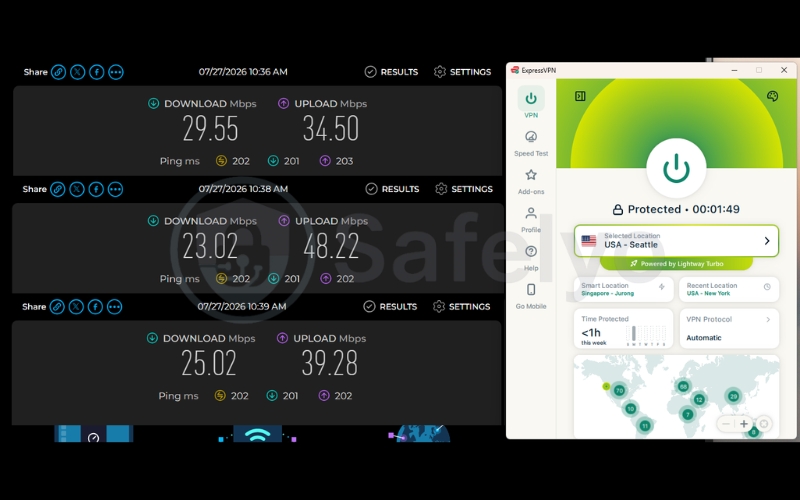
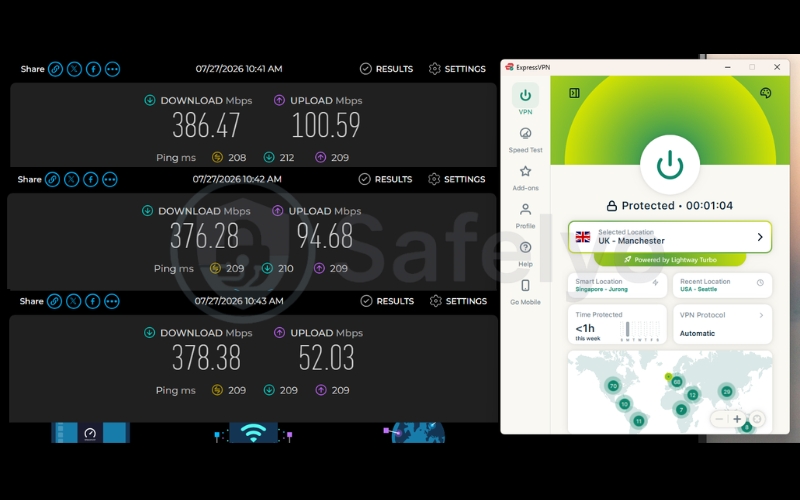
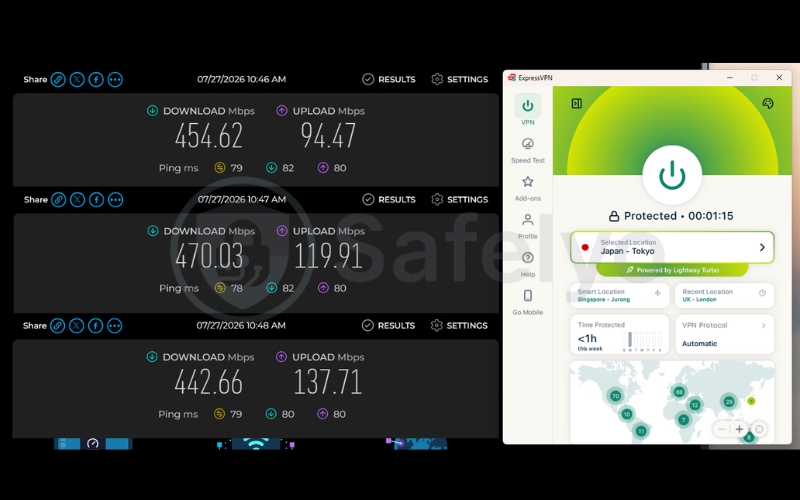
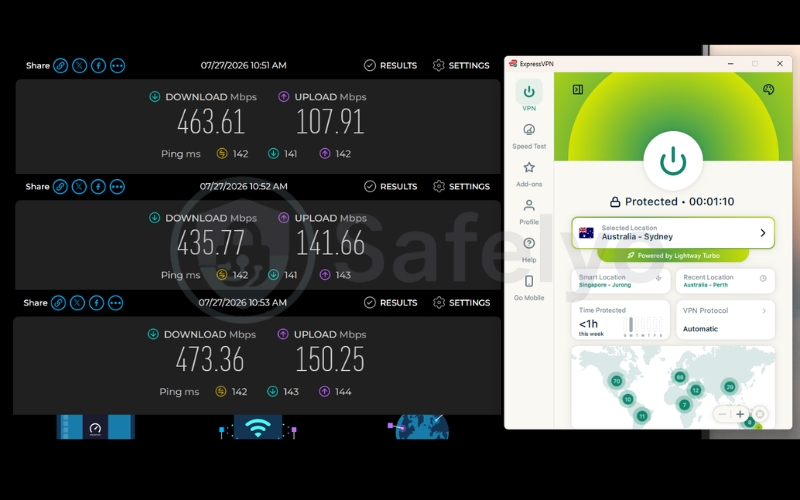
We conducted all speed tests on the exact same day, July 27, 2026, within a continuous timeframe. We tested one VPN immediately after finishing the other to ensure identical network conditions.
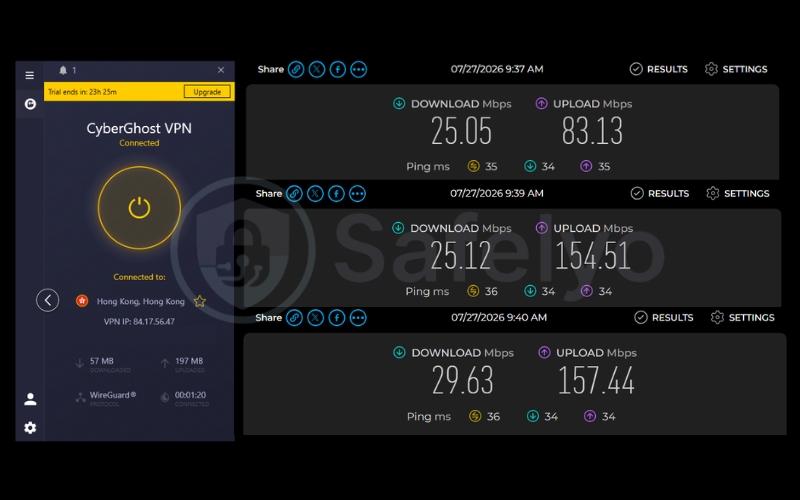
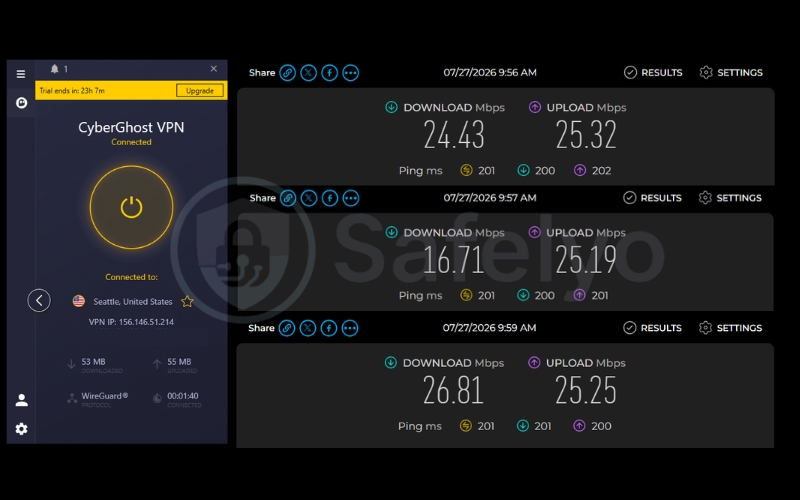
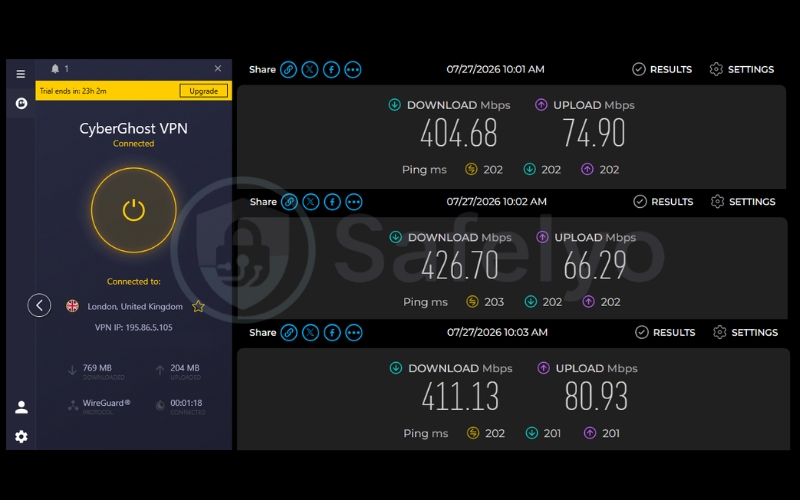
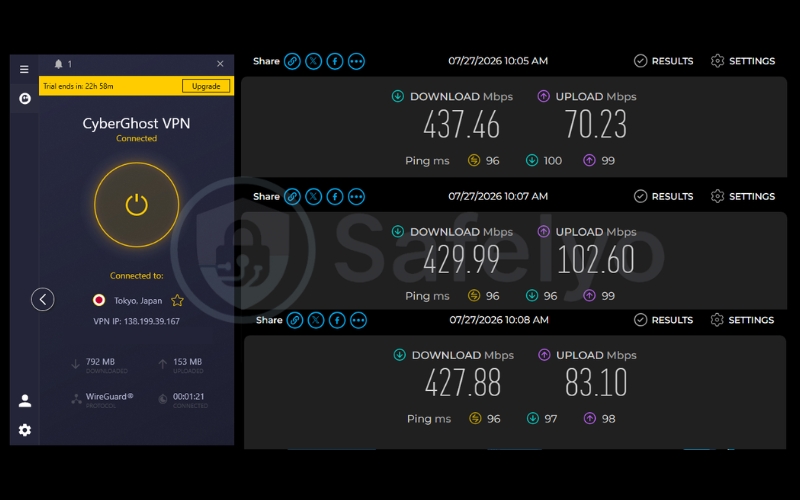
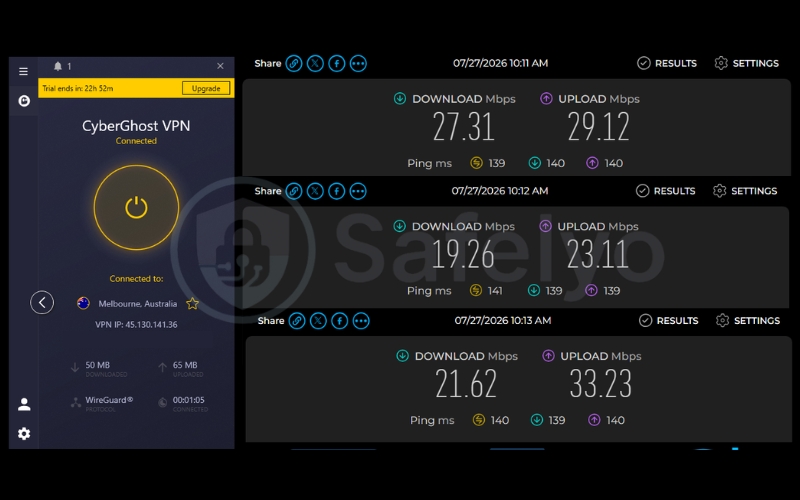
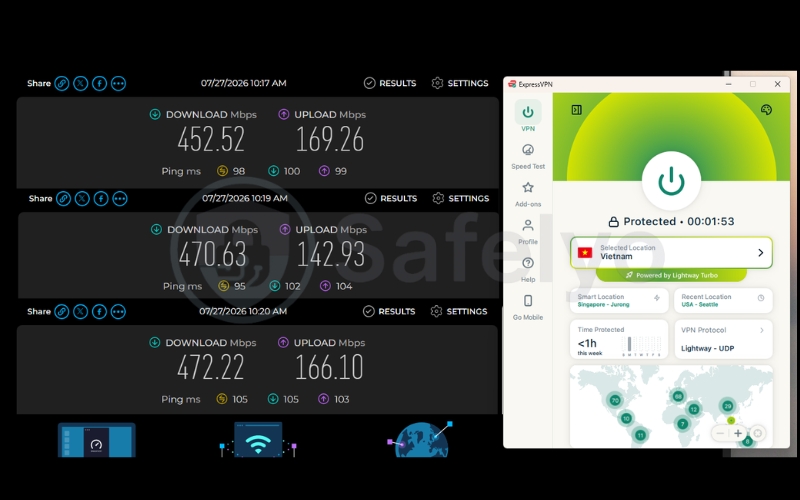
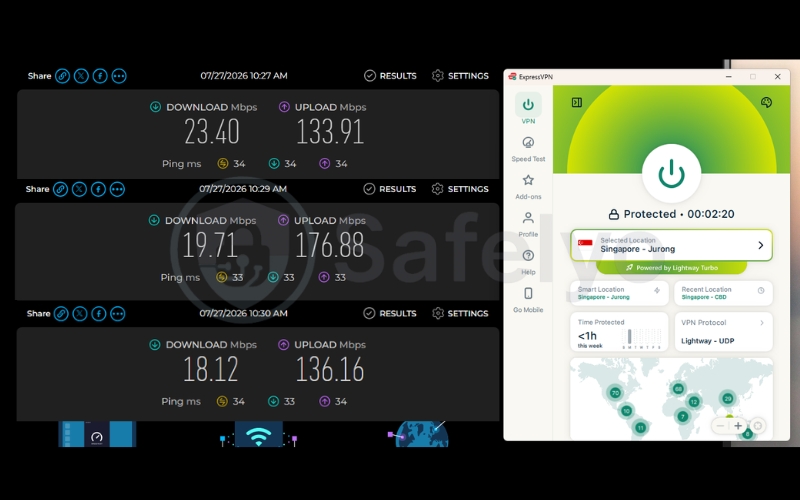
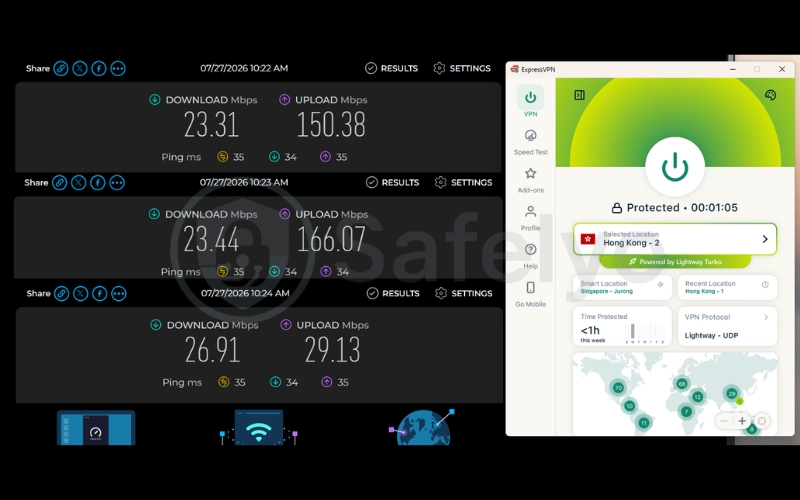
We ran three consecutive tests per VPN for each selected region on a Windows 11 PC. The baseline connection recorded 879.49 Mbps download, 283.90 Mbps upload, and a 25 ms ping.
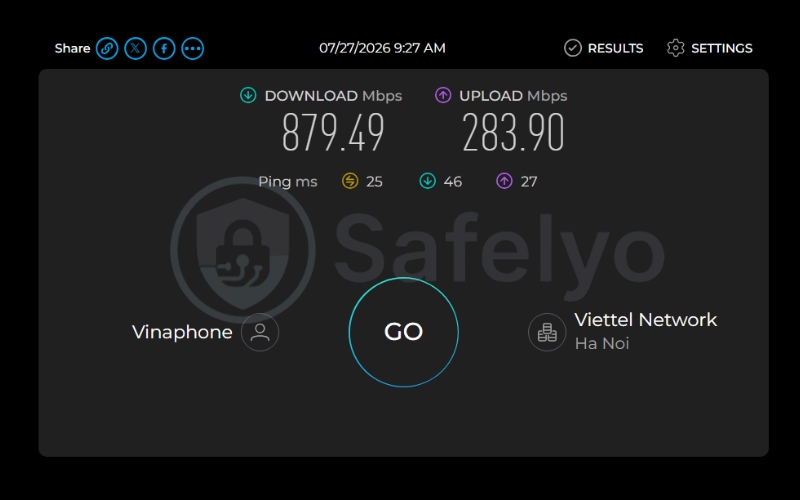
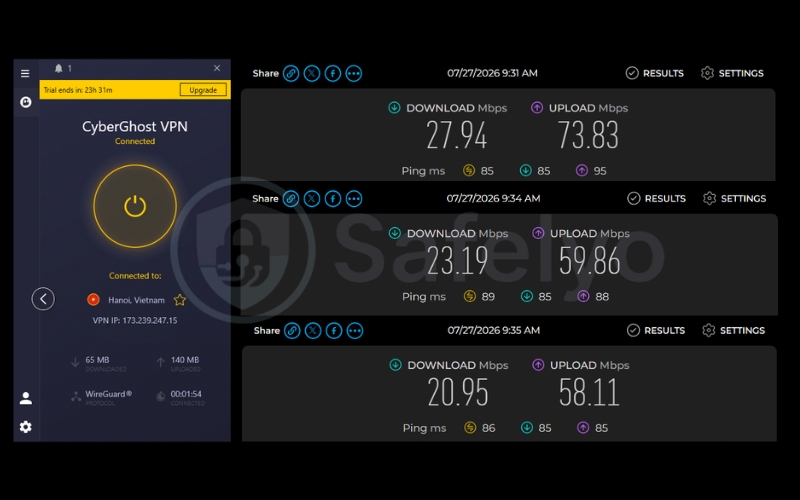
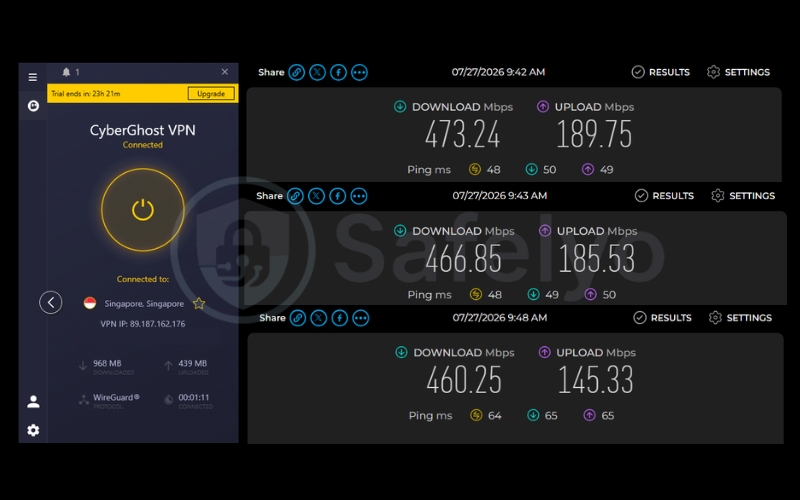
We tested one local region in Vietnam, two nearby regions in Hong Kong and Singapore, and four long-distance regions in the US, UK, Japan, and Australia.
Below is the raw data showing the average results of the three tests conducted for each server:
| Server Location | VPN | Avg. Download (Mbps) | Avg. Upload (Mbps) | Avg. Ping (ms) |
|---|---|---|---|---|
| Local (Vietnam) | Baseline (No VPN) | 879.49 | 283.90 | 25.00 |
| Local (Vietnam) | ExpressVPN | 465.12 | 159.43 | 99.33 |
| Local (Vietnam) | CyberGhost | 24.03 | 63.93 | 86.67 |
| Nearby (Hong Kong) | ExpressVPN | 24.55 | 115.19 | 35.00 |
| Nearby (Hong Kong) | CyberGhost | 26.60 | 131.69 | 35.67 |
| Nearby (Singapore) | ExpressVPN | 20.41 | 148.98 | 33.67 |
| Nearby (Singapore) | CyberGhost | 466.78 | 173.54 | 53.33 |
| Long-distance (US) | ExpressVPN | 25.86 | 40.67 | 202.00 |
| Long-distance (US) | CyberGhost | 22.65 | 25.25 | 201.00 |
| Long-distance (UK) | ExpressVPN | 380.38 | 82.43 | 208.67 |
| Long-distance (UK) | CyberGhost | 414.17 | 74.04 | 202.33 |
| Long-distance (Japan) | ExpressVPN | 455.77 | 117.36 | 78.67 |
| Long-distance (Japan) | CyberGhost | 431.78 | 85.31 | 96.00 |
| Long-distance (Australia) | ExpressVPN | 457.58 | 133.27 | 142.00 |
| Long-distance (Australia) | CyberGhost | 22.73 | 28.49 | 140.00 |
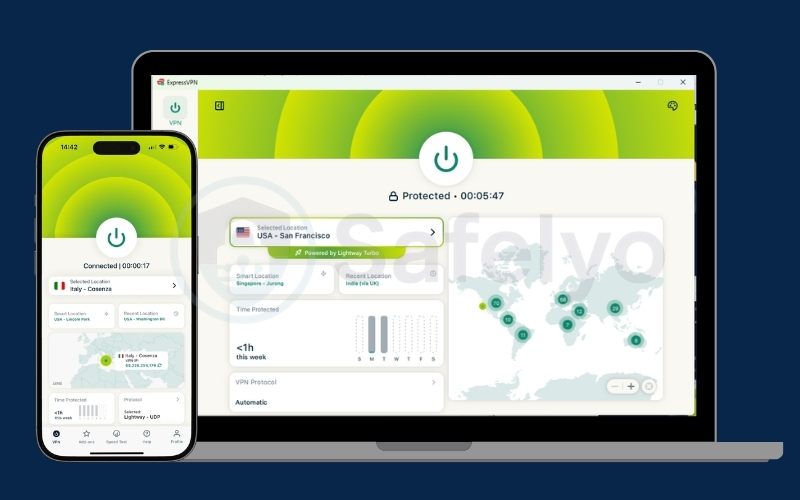
ExpressVPN secured significantly higher download rates on the local Vietnam node and maintained strong performance across multiple long-distance routes. It retained a highly stable 465.12 Mbps locally, which is a massive advantage over CyberGhost’s severe drop to just 24.03 Mbps on the exact same network.
This 465 Mbps local throughput on ExpressVPN ensures a seamless experience for heavy internet users. It easily provides enough bandwidth for households to support multi-player gaming, 4K streaming, and large file downloads simultaneously without any buffering.
Conversely, CyberGhost’s performance is highly erratic and depends heavily on your chosen routing path. While its 24.03 Mbps local drop is only sufficient for basic video streaming on a single device, it unexpectedly surged to 466.78 Mbps on the Singapore route.
CyberGhost also slightly edged out ExpressVPN on the UK route, recording 414.17 Mbps compared to ExpressVPN’s 380.38 Mbps. However, ExpressVPN quickly regained the lead on the remaining distant routes to the US, Japan, and Australia.
If you are using a 1 Gbps fiber connection, you should expect ExpressVPN to cap out around the 465 Mbps mark locally. ExpressVPN ultimately wins this round because its baseline speeds are predictably fast across the entire network, saving you from having to hunt for a functional server.
3. ExpressVPN vs CyberGhost pricing: Beware of hidden renewal costs
OVERVIEW: CyberGhost provides a lower upfront cost and eliminates long-term billing increases, making ExpressVPN’s pricing structure more expensive to maintain over time.
Winner: CyberGhost
| Plan / Metric | ExpressVPN | CyberGhost |
|---|---|---|
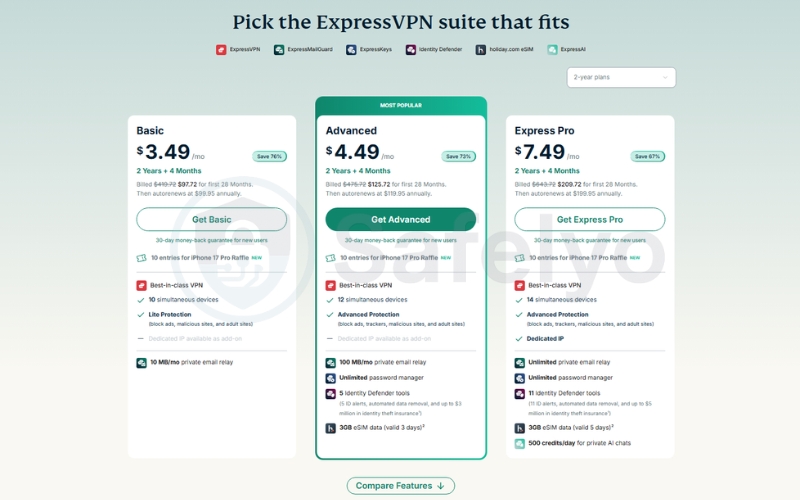
| Starting Price | $3.49/mo (2 years + 4 months) | $2.19/mo (2-year + 2 months) |
| Total Billed (First Term) | $97.72 | $56.94 |
| Renewal Price | $99.95/year | $56.94 annually |
| Money-Back Guarantee | 30 days | 45 days |
Note: This is the price in the US region.
ExpressVPN requires a significantly higher financial commitment, starting at $3.49 per month for its longest term and renewing at a flat $99.95 per year. In contrast, CyberGhost offers a much lower entry point at just $2.19 per month and locks your annual renewal rate at $56.94.
This creates a massive difference in long-term ownership costs between the two providers. By choosing CyberGhost, you avoid the steep renewal price increases common in the VPN industry, saving you $43.01 every single year upon renewal.
If you strictly need a VPN for everyday privacy and regional streaming, CyberGhost provides nearly identical core utility for a fraction of the cost. The financial gap makes CyberGhost the definitive winner for anyone looking to pay less for a VPN.
Both services offer a money-back guarantee to test their features before fully committing. While CyberGhost offers a generous 45-day refund window, community feedback indicates you may have to navigate an automated chatbot system to claim it.
Conversely, ExpressVPN offers a standard 30-day refund window. The ExpressVPN refund process is typically completed quickly and directly through their live chat agents.

4. ExpressVPN vs CyberGhost streaming: Which provides better platform access?
OVERVIEW: ExpressVPN’s universal server configuration accesses a broad global streaming catalog, outperforming CyberGhost’s reliance on specific specialty servers.
Winner: ExpressVPN
Below is the information from our streaming platform access tests:
| Platform | ExpressVPN | CyberGhost |
|---|---|---|
| Netflix Libraries | Unlocks a large number of global regions | Limited to specific dedicated regions |
| Disney+ | Yes | Yes (Optimized servers) |
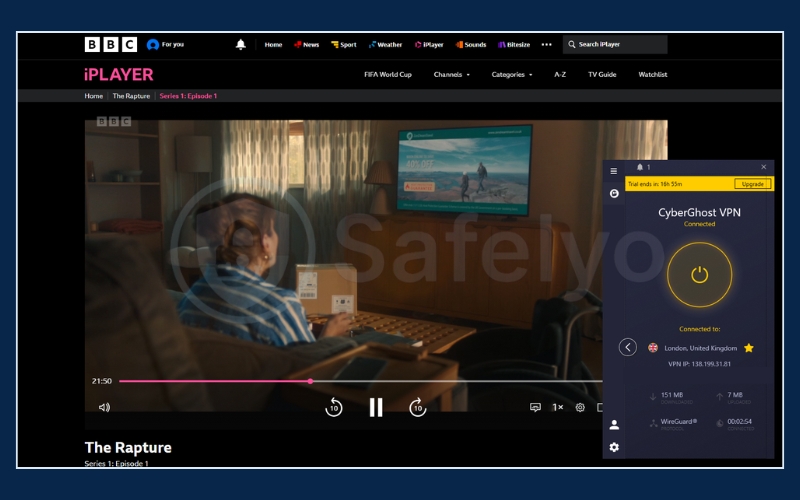
| BBC iPlayer | Yes | Yes (Optimized servers) |
| Amazon Prime Video | Yes | Yes (Optimized servers) |
ExpressVPN offers broader platform compatibility across its entire network. Our tests show that ExpressVPN unlocks more international Netflix libraries than CyberGhost.
CyberGhost restricts reliable streaming access to a smaller number of core regions via dedicated streaming servers. If you want to watch Amazon Prime Video or BBC iPlayer with CyberGhost, you must manually select the server specifically labeled for that exact platform.
ExpressVPN’s universal support allows users to connect to any standard server and start watching immediately. This eliminates the need to manually hunt for the correct optimized server on the CyberGhost app just to avoid proxy errors.

5. ExpressVPN vs CyberGhost censorship bypass: Accessing restricted networks
OVERVIEW: ExpressVPN includes advanced stealth capabilities designed to help bypass national firewalls and restrictive local networks, a feature that CyberGhost currently lacks.
Winner: ExpressVPN
ExpressVPN applies obfuscation technology on every server it operates. Obfuscation is a technical process that scrambles VPN traffic to make it look like standard HTTPS web browsing.
CyberGhost officially lacks any dedicated stealth protocol for this purpose. If you travel to a highly restrictive region or connect to a heavily monitored corporate network, the CyberGhost app will likely fail to establish a connection.
ExpressVPN’s automatic obfuscation helps users navigate these network blocks without configuring complex technical settings. This allows travelers and digital nomads to check their email and web applications in regions where standard VPN traffic is routinely blocked.
6. ExpressVPN vs CyberGhost security: Protocols and infrastructure analyzed
OVERVIEW: Both VPNs deploy standard encryption, but ExpressVPN integrates post-quantum cryptography and custom RAM-only architecture, placing it a step ahead of CyberGhost’s implementation.
Winner: ExpressVPN
Below is the data detailing their security infrastructure:
| Feature | ExpressVPN | CyberGhost |
|---|---|---|
| Primary Protocols | Lightway, OpenVPN, WireGuard, IKEv2 | WireGuard, OpenVPN, IKEv2 |
| Encryption | AES-256 (with Post-Quantum ML-KEM) | AES-256 |
| Ad / Tracker Blocker | Yes (Threat Manager) | Yes (Content Blocker) |
Both services support standard WireGuard, OpenVPN, and IKEv2 protocols. ExpressVPN also features its proprietary Lightway protocol engineered with Post-Quantum protection.
CyberGhost’s standard AES-256 encryption secures current browsing data effectively. ExpressVPN’s integration of Post-Quantum cryptography hardens the data against emerging decryption threats, future-proofing your digital footprint.
ExpressVPN utilizes its own custom-built TrustedServer technology, ensuring the operating system and VPN stack run entirely on volatile memory. CyberGhost also uses RAM-only servers, but ExpressVPN’s TrustedServer implementation is specifically engineered from the ground up for their exact infrastructure.
CyberGhost includes a built-in Content Blocker, but it struggles to filter advertisements on modern HTTPS websites because it cannot decrypt the traffic to strip the ads. This renders it largely ineffective for daily web browsing, making ExpressVPN’s DNS-level Threat Manager a much more reliable tool for blocking malicious trackers.
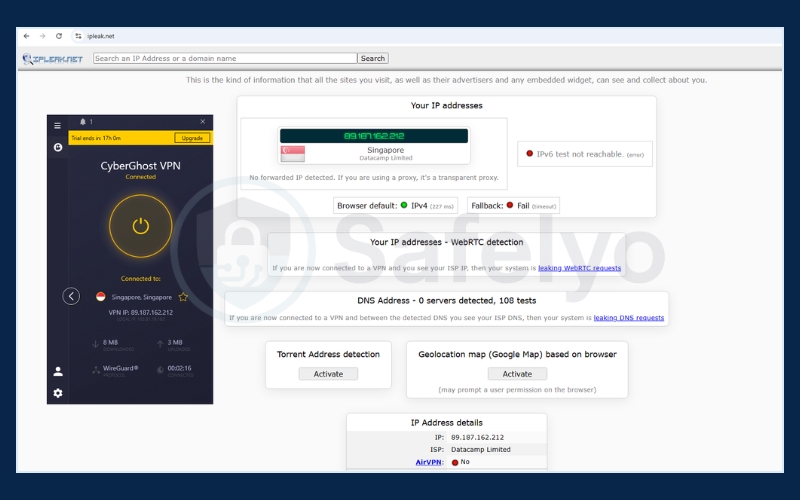
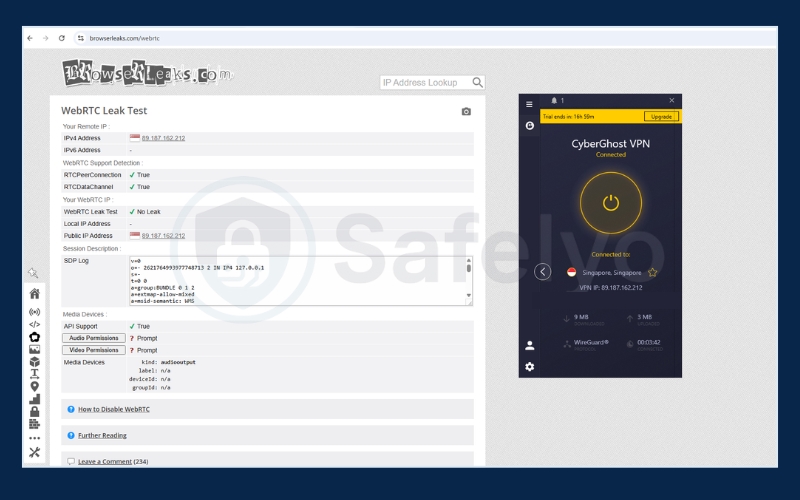
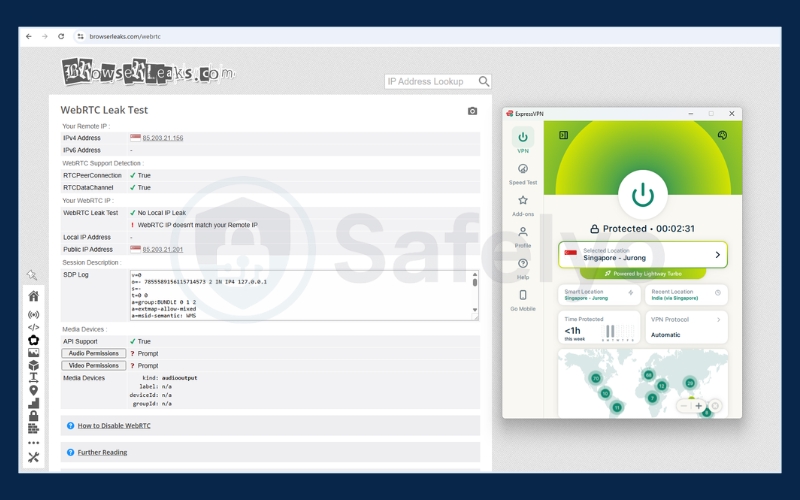
To verify their tunnel security, we tested both services on IPLeak and BrowserLeaks. Both VPNs successfully passed without exposing any IP or DNS data.

7. ExpressVPN vs CyberGhost privacy: Audits, logging, and Kape Technologies
OVERVIEW: Operating entirely on volatile memory with independently audited no-logs policies, both VPNs offer verifiable data privacy despite sharing the same corporate parent.
Winner: Tie
Below is the data comparing their core privacy policies and independent verification histories:
| Feature | ExpressVPN | CyberGhost |
|---|---|---|
| No-Logs Policy | Yes | Yes |
| RAM-Only Servers | Yes (TrustedServer technology) | Yes (10 Gbps servers) |
| Independent Audit | Yes | Yes |
| Audit Providers | KPMG, PwC Switzerland, Cure53, F-Secure | Deloitte |
| Jurisdiction | British Virgin Islands | Romania |
Both providers operate RAM-only server architectures to ensure data is not permanently stored. ExpressVPN is independently audited by multiple top-tier firms including KPMG, PwC Switzerland, Cure53, and F-Secure.
CyberGhost is audited by Deloitte, with public audits conducted in 2022, 2024, and 2025. These third-party audits confirm that neither service logs user activity or connection data.
Both VPNs are owned by Kape Technologies, a fact that draws scrutiny because the company originally operated as Crossrider, a platform with a controversial history of distributing intrusive adware.
However, both VPNs utilize RAM-only infrastructure that guarantees all user session data is wiped upon every reboot. This structural design protects you from hardware seizures regardless of the parent company’s background.
Furthermore, both providers operate in privacy-friendly jurisdictions outside the major intelligence alliances.
8. ExpressVPN vs CyberGhost apps: Device limits and usability
OVERVIEW: ExpressVPN offers greater hardware flexibility and natively supports Linux graphical interfaces, catering to multi-device households better than CyberGhost.
Winner: ExpressVPN
Below is the data comparing their application compatibility and hardware limits:
| Feature | ExpressVPN | CyberGhost |
|---|---|---|
| Simultaneous Connections | 10 to 14 (depending on plan) | 7 |
| Dedicated Router App | Yes | No (Manual configuration only) |
| Linux Support | Yes (Graphical User Interface) | Yes (Command Line Interface only) |
| Browser Extensions | Chrome, Firefox, Edge, Brave | Chrome, Firefox |
ExpressVPN provides a higher base connection limit for everyday users. ExpressVPN allows 10 simultaneous connections on its Basic plan, scaling to 12 on Advanced, and 14 on Pro. CyberGhost caps its simultaneous connections at 7 across all standard subscription tiers. These extra baseline connections on ExpressVPN prevent users from having to constantly log out of smartphones to protect other household devices.
ExpressVPN offers a full Linux GUI and a dedicated Router App. CyberGhost restricts Linux users to a Command Line Interface and lacks custom router firmware.
ExpressVPN’s dedicated router app allows you to bypass device limits entirely by protecting the whole Wi-Fi network at the source. This router-level configuration is a much more tedious and manual process on CyberGhost.
9. ExpressVPN vs CyberGhost torrenting: P2P server access and policies
OVERVIEW: ExpressVPN allows file sharing across its entire global network, whereas CyberGhost requires users to route through a limited list of specialized nodes.
Winner: ExpressVPN
ExpressVPN integrates P2P capabilities natively across its entire server fleet. ExpressVPN supports P2P traffic on all of its 3,000+ servers worldwide.
CyberGhost restricts P2P strictly to its dedicated, optimized servers. If you attempt to download a file on a standard CyberGhost server, the connection may be blocked or heavily throttled.
Because ExpressVPN supports P2P universally, you can leave the VPN running in the background and download torrents on the fly. CyberGhost requires you to actively disconnect, find an approved P2P server in the menu, and reconnect before your torrent client will function properly.
10. ExpressVPN vs CyberGhost gaming: Which offers lower ping?
OVERVIEW: CyberGhost provides lower regional routing latency on certain local nodes, though ExpressVPN delivers faster response times on specific international routing paths.
Winner: CyberGhost
Below is the data from our regional latency tests:
| Server Location | VPN | Avg. Ping (ms) |
|---|---|---|
| Nearby (Hong Kong) | ExpressVPN | 35.00 ms |
| Nearby (Hong Kong) | CyberGhost | 35.67 ms |
| Nearby (Singapore) | ExpressVPN | 33.67 ms |
| Nearby (Singapore) | CyberGhost | 53.33 ms |
| Local (Vietnam) | ExpressVPN | 99.33 ms |
| Local (Vietnam) | CyberGhost | 86.67 ms |
Ping measures the millisecond reaction time of your internet connection, which is a critical metric for competitive gaming and fast-paced matchmaking. A lower ping ensures your in-game actions register immediately without noticeable input lag.
In our local Vietnam testing, CyberGhost achieved an average ping of 86.67 ms, outperforming ExpressVPN which averaged 99.33 ms. This local latency advantage makes CyberGhost a slightly more responsive option for web browsing and regional matchmaking.
However, performance shifts when routing traffic internationally to nearby gaming hubs. In our Singapore testing, ExpressVPN achieved a much faster response time of 33.67 ms compared to CyberGhost’s 53.33 ms.
Both VPNs performed exceptionally well when routing traffic to Hong Kong, tying closely around the highly optimal 35 ms mark.
CyberGhost wins this round because it provided a tighter routing path on the local network. However, your individual gaming latency will always fluctuate depending on your physical distance to the game’s servers.
11. ExpressVPN vs CyberGhost customer support
OVERVIEW: Both platforms offer reliable, round-the-clock chat infrastructure to resolve user queries effectively.
Winner: Tie
Both providers guarantee 24/7 Live Chat support for active subscribers. They also offer comprehensive email ticketing systems and maintain extensive video and text knowledge bases for troubleshooting.
Whether you need help configuring a router or requesting a refund, you have direct access to professional support channels. Neither service leaves you waiting for email replies for basic technical issues.
12. ExpressVPN vs CyberGhost: Which one should you choose?
ExpressVPN and CyberGhost cater to very different types of digital consumers. The right choice for you depends entirely on your structural requirements, long-term budget, and how you intend to interact with the software daily.
Because real-world performance fluctuates based on external network conditions, you should base your final decision on the core architectural features each provider guarantees. We have broken down the final recommendations based on the fundamental design differences discovered during our evaluation.
Review the specific structural priorities below to see which provider aligns perfectly with your connectivity needs.
Choose ExpressVPN if you…
- Need a network architecture with universal server configurations rather than manually hunting for specialized streaming or downloading nodes.
- Require automated obfuscation protocols to help navigate heavily restricted networks and firewalls.
- Want a higher simultaneous connection limit and native graphical applications for Linux devices and routers.
Choose CyberGhost VPN if you…
- Prioritize a defined budget and want to avoid steep renewal price increases after the initial subscription period ends.
- Prefer a highly visual application interface with dedicated, task-specific servers labeled for particular platforms.
- Want the longest risk-free testing window available through a generous 45-day money-back guarantee.
13. Methodology: How we tested and compared ExpressVPN and CyberGhost VPN
We conducted the comparative tests from a physical location in Vietnam using a Windows 11 PC to ensure a consistent hardware environment. Establishing an accurate control metric is critical, so we measured our internet baseline speed prior to connecting to any VPN. This baseline recorded precisely 879.49 Mbps Download, 283.90 Mbps Upload, and a 25.00 ms Ping.
For the speed testing phase, we executed all measurements using the industry-standard Ookla Speedtest platform. This allowed us to capture raw throughput data routed to a local node in Vietnam, nearby regional hubs (Hong Kong, Singapore), and various long-distance global nodes (US, UK, Japan, and Australia).
To prevent temporal network congestion from skewing the results, we ran three consecutive tests for each server location within the same timeframe and averaged the data.
Our overall evaluation methodology was heavily weighted toward daily usability factors and long-term value to provide an objective outcome. Below is the precise breakdown of how we weighted each testing category:
| Evaluation Category | Weight |
|---|---|
| Speed & Performance | 20% |
| Pricing & Renewals | 15% |
| Streaming & Unblocking | 15% |
| China & Censorship Bypass | 10% |
| Security & Protocols | 10% |
| Privacy Policy & Audits | 10% |
| Device Compatibility | 5% |
| Torrenting & P2P | 5% |
| Gaming (Latency) | 5% |
| Customer Support | 5% |
By applying this structured framework, we ensured the final verdict was based on empirical data rather than corporate marketing claims.
14. FAQs about ExpressVPN vs CyberGhost
Is ExpressVPN blocked by Netflix?
ExpressVPN is not blocked by Netflix. It successfully unblocks multiple regional libraries because its universal server optimization adapts to platform blocks rapidly.
Do ExpressVPN and CyberGhost keep logs?
Neither VPN keeps user logs. Both are audited by top firms like KPMG and Deloitte, and both run entirely on RAM-only infrastructure that wipes data on reboot.
Which is better for torrenting: ExpressVPN or CyberGhost?
ExpressVPN is better for torrenting because it allows P2P connections natively on every single server it operates. This avoids CyberGhost’s requirement to use restricted lists of dedicated P2P servers.
Why are ExpressVPN and CyberGhost owned by the same company?
Both are owned by Kape Technologies, a large cybersecurity umbrella company. They continue to operate independently with distinct infrastructures, pricing models, and specific feature sets.
Why is the parent company of ExpressVPN and CyberGhost controversial?
The controversy surrounds Kape Technologies because it originally operated as Crossrider, a platform known for distributing intrusive adware. We note this transparently, though both ExpressVPN and CyberGhost now operate under strict third-party audits and RAM-only server networks to ensure user data cannot be logged or compromised.
15. Conclusion
ExpressVPN is the clear and definitive overall winner of this head-to-head comparison. It provides a highly versatile engineering product designed for users who require universal server capabilities and strong structural security. It navigates network restrictions seamlessly by integrating automated obfuscation across its entire fleet.
CyberGhost remains an accessible alternative for users focused heavily on long-term budget management. Its interface provides clear, task-oriented server selection for everyday streaming and downloading.
If you are ready to secure your connection, you can utilize ExpressVPN’s 30-day or CyberGhost’s 45-day money-back guarantee to test them risk-free.
For more head-to-head testing and detailed breakdowns of how ExpressVPN vs CyberGhost stacks up against the rest of the market, explore our comprehensive VPN Comparison guides or return to the Safelyo homepage for our latest digital security updates.