
IKEv2/IPsec is a VPN protocol combination that pairs two separate technologies: IKEv2 negotiates and authenticates the connection, while IPsec encrypts the data that travels through it. That is the short answer to what is IKEv2/IPsec. As of 2026, it remains one of the most widely supported VPN protocols across major operating systems, especially on mobile devices, because it handles network changes so well.
Key takeaways
- IKEv2 acts as the negotiator. It authenticates both sides and agrees on the encryption settings. IPsec then applies that encryption to the data itself.
- A feature called MOBIKE lets the connection survive network switches (for example, from Wi-Fi to mobile data) without rebuilding the tunnel.
- The protocol supports modern cryptography. On current Apple platforms (iOS 26 and macOS 26), it can be configured to use a hybrid post-quantum key exchange method as an extra layer of protection.
- IKEv2/IPsec relies on fixed UDP ports (500 and 4500), which makes it easier for firewalls and network administrators to block compared with protocols that use more flexible ports.
- On iOS and macOS, IKEv2 is built directly into the system settings, so users do not need to install a separate app.
1. What is IKEv2/IPsec?
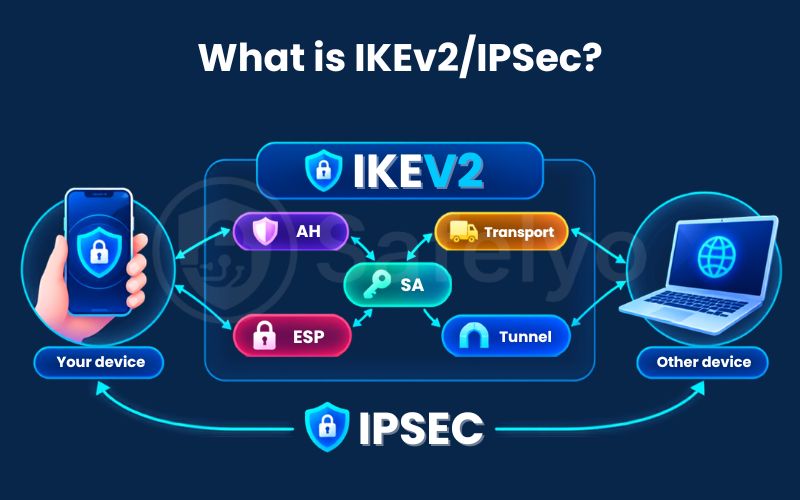
IKEv2/IPsec is not a single protocol but a pairing of two related standards that work together. Many people treat the name as one technology, yet the two parts play clearly different roles.
Think of it like preparing a secure delivery. IKEv2 is the negotiation stage: the two sides confirm each other’s identity and agree on security rules before sending anything. IPsec is the actual armored transport that protects the data once those rules are in place.
1.1. What IKEv2 does
IKEv2 handles the setup. Before any user data moves, it authenticates both the device and the VPN server (using a certificate, pre-shared key, or other method) and negotiates the cryptographic parameters the session will use. Only after both sides have agreed does the connection become active. No data is transmitted until this step is complete.
1.2. What IPsec does
IPsec works at a lower level of the operating system, usually inside the kernel. Once IKEv2 has finished the negotiation, IPsec takes the agreed keys and applies encryption and decryption to the traffic passing through the tunnel.
It can use two components: AH (Authentication Header) and ESP (Encapsulating Security Payload). Most VPN implementations rely on ESP because it provides both encryption and authentication in a single step.
1.3. How the two work together
In short, IKEv2 sets the terms and creates the secure channel. IPsec then uses those terms to protect every packet that travels between the device and the server for the rest of the session. Describing IKEv2/IPsec as a negotiation layer paired with an encryption layer is the most accurate way to understand what the protocol does.
2. How IKEv2/IPsec establishes a secure connection
Before any data is encrypted and sent, IKEv2 and the VPN server go through a structured handshake process. This sequence is defined in RFC 7296, the official technical standard for IKEv2.
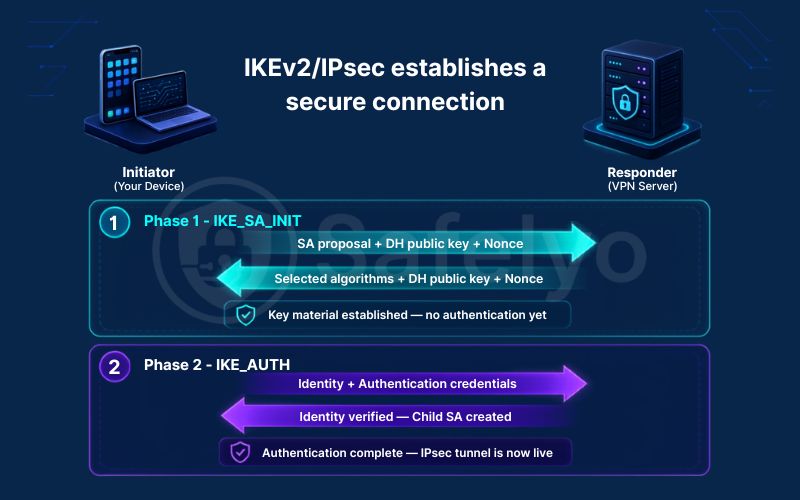
One of the clearest improvements over the older IKEv1 is efficiency. IKEv1 typically required six to nine messages to finish authentication and set up the data tunnel. IKEv2 completes the same work in just four messages: two exchanges, each consisting of a request and a response.
The process is divided into two distinct phases.
2.1. Phase one: IKE_SA_INIT
In the first phase, the device (initiator) and the server (responder) exchange the cryptographic algorithms they support and agree on which ones to use. They also exchange random values called nonces, which help protect against replay attacks.
Both sides then perform a Diffie-Hellman exchange. Each side sends its public value, and both independently calculate the same shared secret without ever transmitting the secret itself. From this shared secret and the nonces, they derive the keying material needed for the IKE Security Association (IKE SA).
Importantly, no identity authentication has taken place yet. This phase only establishes the encrypted control channel that will protect the next steps.
2.2. Phase two: IKE_AUTH
The second phase runs inside the secure channel created in phase one, so it is already encrypted and integrity-protected. Here, both sides authenticate each other. Common methods include a pre-shared key, a digital certificate, or an EAP method.
Once authentication succeeds, the first Child SA (Security Association) is created. This Child SA is what actually carries the encrypted user data. As soon as this step finishes, the VPN tunnel is ready for use.
2.3. Rekeying
Both the IKE SA and the Child SAs have limited lifetimes, usually measured in hours or in the amount of data transferred. Before they expire, IKEv2 automatically negotiates fresh keys without dropping the connection or asking the user to authenticate again.
This rekeying process supports Perfect Forward Secrecy. Even if the keys from one period are later compromised, traffic from earlier or later periods remains protected. Unlike IKEv1, IKEv2 does not require a full re-authentication during rekeying, which makes long-running sessions much less disruptive.
3. What makes IKEv2/IPsec built for mobile devices?
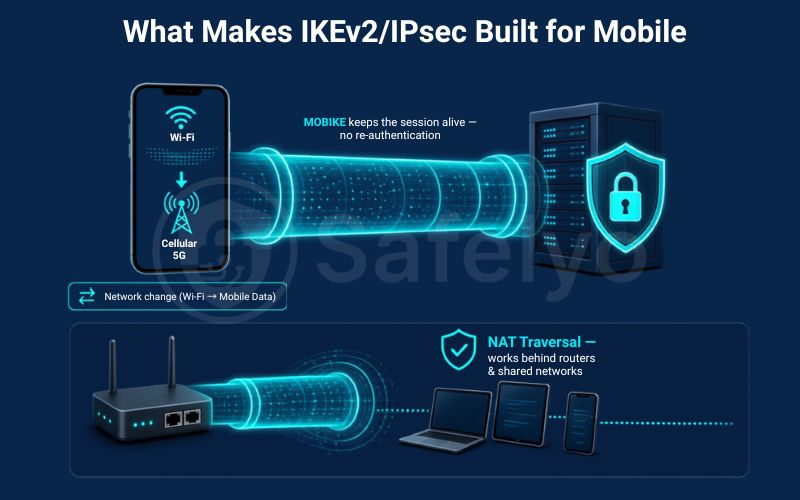
IKEv2/IPsec is often recommended for mobile use largely because of how it handles changes in network connectivity. Two features play a central role in this.
- MOBIKE and network switching
MOBIKE, defined in RFC 4555, allows the IP address linked to a VPN connection to change without forcing the entire tunnel to be rebuilt from scratch.
In real-world use, this means a connection can usually continue when a device moves between networks. For example, a video call that starts on home Wi-Fi can keep running without interruption if the device later switches to a mobile data connection. The VPN session does not need to re-authenticate or start over, which makes the experience much smoother on phones and tablets.
- NAT traversal for networks behind routers
NAT traversal enables an IKEv2/IPsec connection to work when a device is behind a router or shares a network address with other devices. This is the normal situation on most home and public networks.
Without this capability, many connections would fail to establish in the first place, because the server would not be able to route return traffic correctly back to the device. NAT traversal solves this problem and is one of the reasons IKEv2/IPsec works reliably across different network environments.
4. Is IKEv2/IPsec secure in 2026?
At the protocol level, IKEv2/IPsec is generally considered sound, relying on well-reviewed cryptographic standards. It has also recently gained support for post-quantum key exchange on select platforms. Security in practice, however, depends on how a specific provider implements the protocol, which is a separate question worth examining.
4.1. The cryptographic suite behind IKEv2/IPsec
Modern IKEv2/IPsec implementations typically use AEAD (Authenticated Encryption with Associated Data) ciphers, which combine encryption and integrity checking in a single step. IKEv2 is responsible for negotiating these algorithms and the Diffie-Hellman groups during the handshake, while IPsec applies the agreed encryption to the actual data traffic.
The specific cipher and group selection can vary by provider, so the strength of a given connection depends partly on how the VPN service has configured it.
4.2. Post-quantum security on iOS 26 and macOS 26
According to Apple’s official documentation, devices running iOS 26, macOS 26, and related current-generation operating systems can configure IKEv2 to perform an additional key exchange step using ML-KEM, a post-quantum key encapsulation method. This step strengthens the key material that IPsec later uses to encrypt the data, adding protection against a scenario in which a future quantum computer could otherwise weaken traditional key exchange methods.
This capability is already available on shipping software rather than existing only as a research proposal. Whether it is enabled, though, still depends on the specific VPN configuration in use.
4.3. Real-world limitations to be aware of
A protocol being secure in design does not automatically mean every implementation of it is free of risk. NordVPN, for example, discontinued IKEv2/IPsec support in its iOS and macOS apps after identifying conditions under which the implementation could expose user data.
Cases like this illustrate a useful distinction: the underlying protocol can be well-designed while a specific app’s implementation of it introduces separate issues that have little to do with the protocol itself. For this reason, it is generally a good idea to check whether a VPN provider currently supports IKEv2/IPsec and under what conditions, rather than assuming support is either universal or permanent.
5. Which devices support IKEv2/IPsec natively?
On iOS and macOS, IKEv2 is available as a built-in VPN option directly within system settings, without requiring a third-party app to be installed. This is one reason many organizations and IT teams choose it for internal VPN configurations, since employees can connect using tools already present on their devices.
Windows, Android, and Linux also support IKEv2, though typically through manual configuration or a dedicated client app rather than the deeper native integration found on Apple platforms. In these cases, setting up a connection generally takes a few additional steps compared with the largely built-in experience on iOS and macOS.
6. Common problems when using IKEv2/IPsec
Even when the protocol itself functions as intended, certain network conditions can interfere with an IKEv2/IPsec connection. Two issues come up most often.
6.1. Blocked UDP ports 500 and 4500
IKEv2 depends on UDP ports 500 and 4500 to establish and maintain a connection. Because these ports are fixed and well known, some ISPs, corporate networks, and school networks block them, whether intentionally or as part of broader firewall rules.
When this happens, an IKEv2/IPsec connection typically fails to establish at all, rather than connecting and then dropping. This is generally the first thing worth checking if a connection will not go through on a specific network.
6.2. Connection drops behind strict firewalls
Networks with aggressive firewall policies, such as certain corporate environments or countries with heavy internet filtering, can interrupt IKEv2/IPsec connections more frequently than protocols that are not tied to fixed ports.
In these situations, a connection may establish successfully at first but disconnect repeatedly afterward. Protocols that can operate over more flexible ports are sometimes better suited to this kind of restrictive network environment.
6.3. MTU and packet fragmentation issues
Even when an IKEv2/IPsec connection establishes successfully, some users experience slow page loads or timeouts on certain websites. This often stems from packet fragmentation caused by the extra overhead of IPsec encryption combined with UDP encapsulation (especially when NAT is involved).
When packets become too large for the network path, they may be fragmented or dropped, leading to degraded performance even though the VPN appears connected. This issue is more common with IKEv2/IPsec than with some newer protocols and can usually be improved by lowering the MTU value on the client or server side.
7. Advantages and limitations of IKEv2/IPsec
IKEv2/IPsec has earned a strong reputation for mobile use, but like any VPN protocol, it comes with both clear strengths and practical trade-offs. Understanding these points helps explain why the protocol works so well in some situations and why it may not be the best choice in others.
Pros
Excellent stability when switching networks, thanks to MOBIKE.
Native support on iOS and macOS, so no third-party app is required.
Relatively fast connection setup (only four messages).
Good battery efficiency on mobile devices compared with older protocols.
Supports modern cryptography, including optional hybrid post-quantum key exchange on current Apple platforms.
Mature and widely supported across operating systems.
Cons
Relies on fixed UDP ports (500 and 4500), which makes it easier for firewalls and some ISPs to block.
Can be less reliable on networks with strict filtering or heavy censorship.
Security and stability also depend on how each VPN provider implements the protocol.
Not always the fastest option available in 2026, and some providers have reduced or removed support in favor of newer protocols.
8. How an IKEv2/IPsec VPN server is typically set up
For anyone self-hosting a VPN rather than using a commercial provider, several automated scripts are available that install and configure an IKEv2/IPsec server on a Linux VPS. These scripts generally reduce a setup process that could otherwise involve many manual steps down to a single command sequence.
Docker images are also available for running an IKEv2/IPsec server, with configuration data stored in a persistent volume so it survives container restarts. This approach tends to suit users who are already managing other services through containers and prefer a consistent setup process across their infrastructure.
9. Should you choose IKEv2 over other VPN protocols?
IKEv2/IPsec is a strong option in certain situations, though it is not the only protocol worth considering. The right choice generally depends on the specific priorities of the person setting up or using the connection.
When is IKEv2 the better choice?
IKEv2/IPsec tends to work well for mobile devices that switch networks frequently, given its support for MOBIKE. It also suits anyone who wants to use a VPN built directly into iOS or macOS without installing a separate application.
When another protocol may fit better?
If maximum speed or getting around a strict firewall matters more than stability across network changes, other protocols may be worth considering instead. Each comes with its own set of trade-offs compared to WireGuard vs OpenVPN vs IKEv2, depending on the specific network conditions and devices involved.
10. Frequently asked questions
Is IKEv2 the same as IPsec?
Not exactly. IKEv2 handles the negotiation and authentication of a connection, while IPsec handles the encryption of the data itself. They are separate standards that work together as a single VPN protocol.
Can IKEv2 be blocked by a firewall?
Yes, this is possible. IKEv2 relies on fixed UDP ports 500 and 4500, and some ISPs or network administrators block these ports, which can prevent a connection from being established.
Does IKEv2 support post-quantum security?
On current Apple platforms, yes. Starting with iOS 26 and macOS 26, IKEv2 can be configured to perform an additional key exchange step using ML-KEM, according to Apple’s official documentation. Support on other platforms may vary.
Does IKEv2 drain battery on mobile devices?
Generally, IKEv2 tends to be lighter on battery compared with protocols that must fully reconnect after every network change. Its support for MOBIKE allows a session to resume rather than renegotiate from scratch, which can reduce the overhead involved.
11. Conclusion
Answering what is IKEv2/IPsec comes down to one core idea: it is a VPN protocol combination well suited to mobile devices and to users on iOS or macOS who want a VPN built into their system without installing another app. It is not the only option available, and anyone who regularly needs to work around a strict firewall may want to weigh other protocols as well.
For readers comparing options beyond IKEv2/IPsec, the VPN Guides section of Safelyo covers reviews, setup instructions, and comparisons across the providers most relevant to these use cases.