
Choosing the wrong network setting can instantly ruin your digital experience. It might cause massive speed drops, drain your smartphone battery rapidly, or leave you completely blocked by strict firewalls. Understanding the technical battle of WireGuard vs OpenVPN vs IKEv2 is essential to optimize your daily internet connection.
At Safelyo, our cybersecurity engineers rigorously test these three networking giants across a range of environments. We evaluate how they handle unstable mobile data, restrictive censorship, and high-bandwidth streaming tasks. This guide breaks down the complex mathematics into practical advice, so you can choose the perfect encryption standard for your specific needs.
Quick comparison table
| Feature | WireGuard | OpenVPN | IKEv2 |
|---|---|---|---|
| Speed | Excellent | Good | Very good |
| Latency | Very low | Moderate | Low |
| Connection setup | Fastest (1-RTT handshake) | Slowest | Fast |
| Battery efficiency | Excellent | Moderate | Excellent |
| CPU usage | Low | High | Moderate |
| Encryption | ChaCha20-Poly1305 | AES-256-GCM (commonly) | AES-256-GCM (via IPsec) |
| Firewall bypass | Limited | Excellent (TCP 443) | Moderate |
| Mobile roaming | Good | Poor | Excellent (MOBIKE) |
| Gaming | Excellent | Good | Very good |
| Streaming | Excellent | Good | Very good |
| Torrenting | Excellent | Good | Good |
| Enterprise support | Limited | Excellent | Excellent |
| Best for | Speed, gaming, streaming | Firewalls, censorship, flexibility | Mobile devices and travel |
1. What is a VPN protocol and how does it work
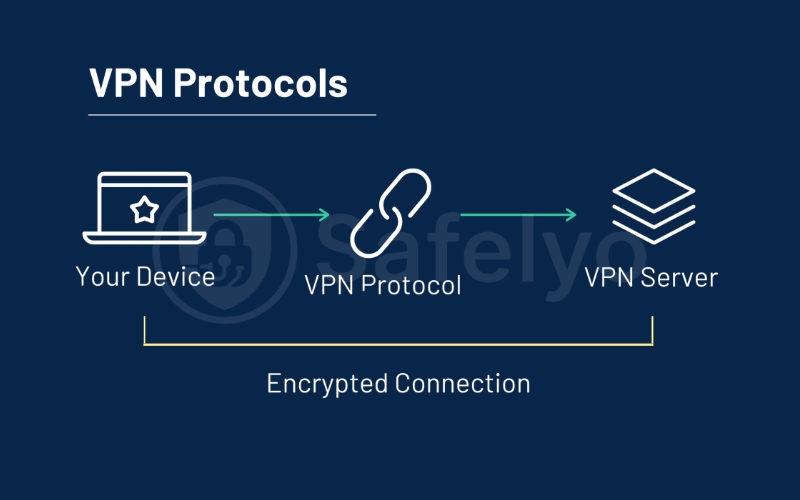
A secure network protocol is essentially a set of digital instructions that govern how your device communicates with a remote server. It dictates the exact mathematical steps required to build an invisible encrypted tunnel across the public internet.
The process begins when your device requests authentication to verify the identity of the remote server. Once verified, the two machines perform a secure key exchange to create a unique mathematical lock. This lock protects your data from outside interception by your internet service provider or local hackers.
Finally, the protocol encapsulates your data and applies the encryption cipher before sending it through the secure tunnel. Different protocols prioritize these steps differently, resulting in noticeable variations in overall connection speed and device battery consumption.
2. What is WireGuard and how does it work?
WireGuard revolutionized network encryption by prioritizing simplicity, modern cryptography, and high throughput. However, its minimalist architecture also introduces unique design trade-offs that commercial privacy providers must carefully manage.
2.1. The Noise Protocol framework and modern cryptography
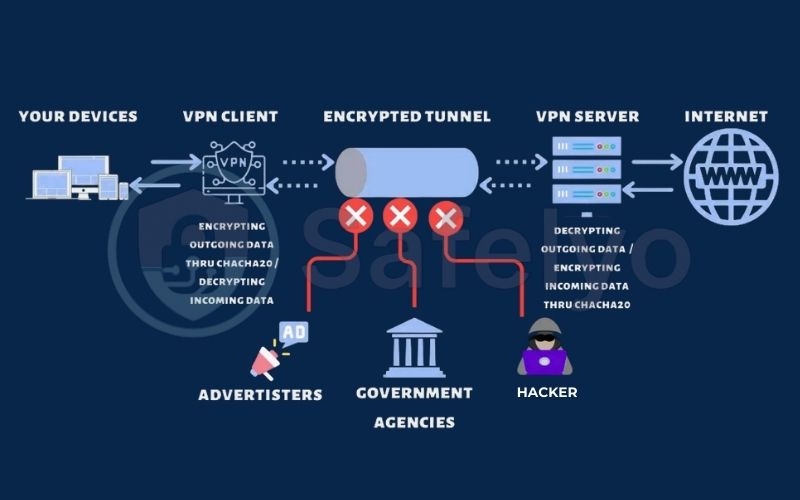
Unlike older standards that offer dozens of encryption choices, WireGuard strictly utilizes the Noise Protocol framework, specifically the Noise_IK pattern. It relies on a fixed set of modern cryptographic primitives chosen specifically for security and performance.
It uses ChaCha20 for data encryption and Poly1305 for data authentication. Furthermore, it employs Curve25519 for key exchanges and BLAKE2s for hashing, omitting legacy cipher suites for better simplicity.
By removing cipher negotiation and limiting configuration choices, this singular cryptographic suite significantly reduces the risk of misconfiguration that often plagues manual network setups.
2.2. Codebase size and kernel-space execution
A major advantage of this modern standard is its remarkably compact codebase. The Linux kernel implementation consists of roughly four thousand lines of code, making it significantly smaller than traditional VPN suites and their dependencies.
On Linux platforms, WireGuard runs directly inside the kernel, reducing context switches and improving overall throughput. Other operating systems use optimized implementations that still deliver exceptional performance across desktop and mobile hardware.
Because the protocol processes data packets efficiently with minimal overhead, it often delivers lower latency than OpenVPN. This makes it an ideal choice for latency-sensitive tasks like online gaming and high-bandwidth streaming.
2.3. Cryptokey routing and dynamic endpoint handling
WireGuard uses an architectural concept called cryptokey routing, requiring the server to track each peer’s most recent network endpoint IP and port. While efficient, this creates a unique privacy consideration for commercial VPN providers.
To avoid maintaining long-term mappings between real user identities and internal VPN addresses, commercial services use custom workarounds. For instance, NordVPN’s NordLynx implementation uses a Double NAT system to assign dynamic internal addresses.
This dynamic allocation ensures that the server does not rely on static internal mappings. It allows individuals to enjoy high-speed performance while minimizing data retention risks on commercial servers.
2.4. WireGuard pros and cons
WireGuard prioritizes speed and simplicity, making it one of the fastest VPN protocols available today. However, its streamlined design also comes with a few trade-offs.
Pros
Extremely fast with low latency.
Lightweight codebase and modern cryptography.
Low CPU usage and excellent battery efficiency.
Cons
Less effective at bypassing restrictive firewalls.
Requires provider-specific solutions to improve privacy.
Offers fewer configuration options than OpenVPN.
3. What is OpenVPN and how does it work?
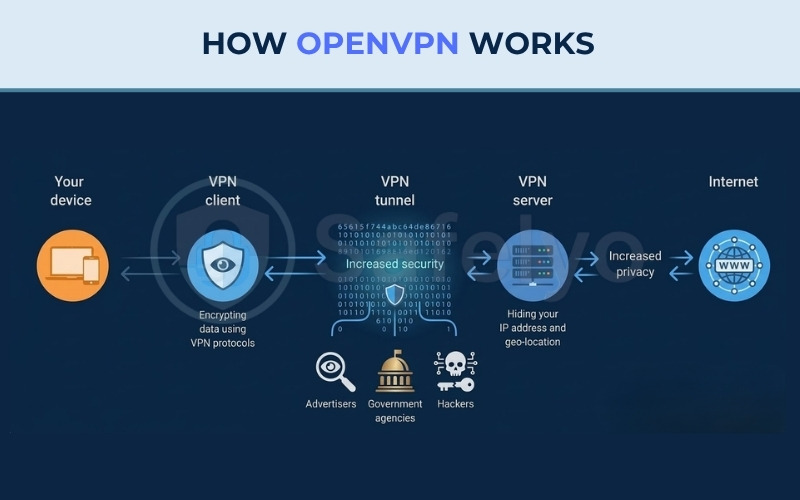
OpenVPN remains one of the most versatile and thoroughly audited protocols in the cybersecurity industry. Its flexible design allows administrators to configure security parameters, transport protocols, and encryption suites based on specific network requirements.
3.1. Dual-channel architecture for control and data
OpenVPN operates using a distinct dual-channel architecture that separates administrative tasks from actual user payload data. This separation allows connection management and key negotiation to occur independently from encrypted user traffic.
The Control Channel utilizes TLS to handle mutual authentication, certificate verification, and secure key exchanges. It establishes the initial connection framework using tools like certificates, passwords, or TLS-auth and TLS-crypt mechanisms.
The Data Channel securely encrypts user traffic while protecting it from tampering. Modern OpenVPN deployments commonly use AES-256-GCM, which provides both encryption and data authentication within a single AEAD cipher suite, while older configurations may use AES-256-CBC with HMAC authentication.
3.2. Perfect forward secrecy and dynamic session keys
Security in OpenVPN is heavily reinforced through a cryptographic property known as Perfect Forward Secrecy (PFS). This mechanism ensures that compromising a server’s long-term private key does not expose past browsing sessions.
The protocol establishes ephemeral session keys using Diffie-Hellman or ECDHE key exchanges during the TLS handshake and can periodically renegotiate them during long connections. These session keys expire after a set time limit or after a specific volume of data transfers through the tunnel.
If an attacker records your encrypted traffic and later obtains the server’s master key, they still cannot decrypt past recorded sessions. Each past connection relies on a unique session key that cannot be reconstructed from the long-term private key.
3.3. TCP versus UDP packet delivery for firewall bypass
A major strength of OpenVPN is its ability to run over either UDP or TCP transport protocols. This flexibility allows users to adapt their connection to different network conditions and port restrictions.
OpenVPN UDP is the recommended choice for daily use, offering better speed and lower latency. It is ideal for bandwidth-heavy tasks like high-definition streaming and online gaming where low overhead is essential.
OpenVPN TCP is commonly configured to use port 443, the same port used by standard HTTPS web traffic. When combined with obfuscation techniques, OpenVPN traffic can more closely resemble ordinary HTTPS traffic, helping it bypass some restrictive firewalls and censorship systems.
3.4. OpenVPN pros and cons
OpenVPN remains a trusted choice thanks to its flexibility and long security track record. The trade-off is higher resource usage and slower performance than newer protocols.
Pros
Highly secure and extensively audited.
Excellent at bypassing firewalls over TCP port 443.
Flexible configuration for different environments.
Cons
Slower than WireGuard.
Higher CPU and battery usage.
Longer connection setup time.
4. What is IKEv2 and how does it work?
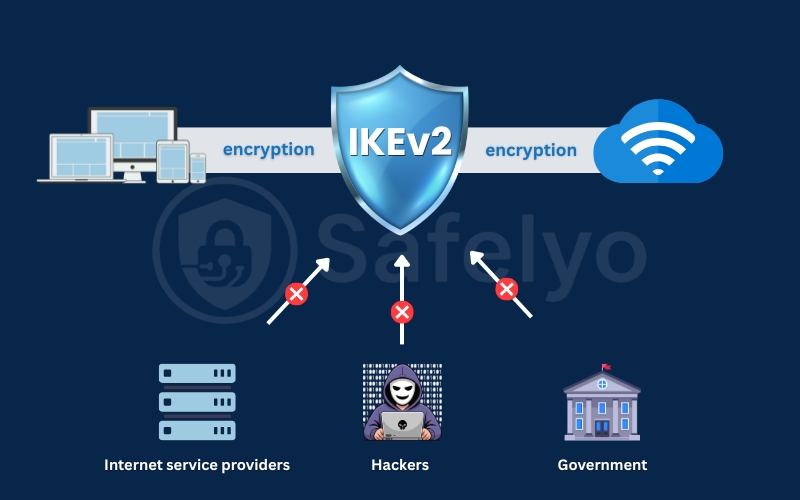
Internet Key Exchange version 2 (IKEv2) is a modern VPN protocol widely used alongside IPsec and particularly well suited to mobile devices because of its fast reconnection capabilities. Standardized through the IETF with major contributions from Microsoft and Cisco, it reliably handles dynamic network environments.
4.1. Connection setup and Security Association negotiation
To understand IKEv2, it helps to know that it works as a control protocol paired with IPsec for encryption. IKEv2 manages the initial connection setup and key exchange, while IPsec Encapsulating Security Payload (ESP) handles data transmission.
During initial setup, IKEv2 authenticates the client and server using digital certificates or pre-shared keys. It establishes an initial IKE Security Association (IKE SA) to secure control messages before creating one or more Child Security Associations (Child SAs) used to protect user traffic.
Once this control channel is active, the protocol negotiates the specific encryption parameters used to scramble your web traffic. This two-step negotiation ensures that authentication and key exchange occur securely before any sensitive personal data leaves your device.
4.2. MOBIKE extension for seamless cellular roaming
The standout feature of IKEv2 on mobile operating systems is its native support for the Mobility and Multihoming (MOBIKE) protocol extension (RFC 4555). MOBIKE allows a VPN connection to survive sudden IP address changes seamlessly.
When you leave home Wi-Fi and switch to a 5G cellular network, your device is assigned a completely new IP address. Instead of dropping the VPN and requiring a full re-authentication handshake, MOBIKE simply updates the existing session with your new network endpoint.
This dynamic address updating minimizes unexpected connection drops during mobile travel. It ensures background app activities and messaging services continue working smoothly without requiring manual reconnect attempts.
4.3. Hardware acceleration and firewall limitations
Because the underlying IPsec framework is a long-standing networking standard, many modern mobile processors include hardware acceleration for AES encryption. This hardware support can reduce CPU usage and improve energy efficiency during extended VPN sessions.
However, IKEv2 has notable operational drawbacks regarding restrictive firewalls. The protocol typically relies on UDP ports 500 and 4500 for key exchange and NAT traversal.
Unlike OpenVPN TCP, IKEv2 cannot easily re-route over standard web-browsing ports. If a restrictive firewall at a school, hotel, or office blocks these specific UDP ports, the IKEv2 connection may fail to establish unless those ports are explicitly permitted.
4.4. IKEv2 pros and cons
IKEv2 is designed for stability, especially on mobile devices that frequently switch between networks. Despite its strengths, it is not the best option for every environment.
Pros
Excellent for mobile devices and roaming.
Fast reconnections with MOBIKE support.
Good battery efficiency on supported hardware.
Cons
Can be blocked on restrictive networks.
Less effective than OpenVPN for bypassing censorship.
Fewer customization options than OpenVPN.
5. Head-to-head showdown: WireGuard vs OpenVPN vs IKEv2
Evaluating these three protocols side-by-side reveals distinct engineering priorities. Comparing their core metrics helps clarify why each protocol fits different real-world scenarios.
5.1. Real-world speed and battery consumption
Connection setup time varies significantly because each protocol requires a different number of round-trips. WireGuard’s 1-RTT handshake allows it to establish connections in a fraction of a second, whereas OpenVPN TCP can take up to 2.0 seconds due to its multi-step TLS negotiation.
In throughput and latency tests, WireGuard generally delivers the highest throughput with the lowest delay. Its lightweight architecture reduces protocol overhead, which often translates into better battery efficiency on mobile devices.
OpenVPN typically consumes more battery because its user-space architecture requires greater CPU resources to process packets. IKEv2 falls comfortably in the middle, benefiting from hardware acceleration on supported mobile processors.
5.2. Security audits and attack surface
A protocol’s security profile depends heavily on the size of its codebase. More lines of code naturally create a broader attack surface for potential vulnerabilities and software bugs.
With roughly 4,000 lines of code, WireGuard has a substantially smaller attack surface than OpenVPN, whose implementation involves tens of thousands of lines plus external dependencies. This compact footprint allows independent security auditors to review WireGuard far more thoroughly.
However, OpenVPN and IKEv2 have been extensively battle-tested in production for decades. Both protocols have undergone numerous independent security audits and support highly flexible cryptographic configurations, making them trusted choices for enterprise environments.
5.3. Network compatibility and captive portals
Connecting through restrictive environments like hotel Wi-Fi or corporate firewalls highlights the stark differences in network compatibility.
OpenVPN TCP is the most versatile option for bypassing network blocks because it can route traffic over port 443 to operate alongside standard HTTPS traffic. When paired with obfuscation techniques, it reliably traverses firewalls that block standard connections.
Conversely, both WireGuard and IKEv2 primarily rely on UDP transport. If a network administrator strictly blocks UDP traffic or restricts connections to specific ports, these protocols may fail to connect unless those ports are explicitly permitted
6. Best VPN protocol for specific use cases
Understanding these technical foundations allows you to optimize your connection based on your current environment. The following recommendations match specific network protocols to the daily activities they handle best.
6.1. Best for gaming and streaming 4K content: Choose WireGuard
WireGuard is the top choice for high-bandwidth activities requiring minimal lag. Its lightweight architecture processes data efficiently, ensuring your multiplayer gaming sessions remain highly responsive and competitive.
For media consumption, this protocol provides the massive throughput necessary to stream 4K-resolution video without buffering. You will notice significant improvements in loading times when accessing region-blocked content on distant international servers.
6.2. Best for travel and mobile roaming: Choose IKEv2
IKEv2 remains the premier choice for frequent travelers who rely heavily on smartphones and tablets. Its native MOBIKE extension ensures your secure tunnel survives intact when you switch from indoor Wi-Fi to outdoor cellular data.
This seamless transition prevents your applications from timing out and exposing your real IP address during network changes. It offers excellent battery efficiency on supported mobile processors, making it ideal for long travel days.
6.3. Best for corporate networks and high censorship: Choose OpenVPN TCP
OpenVPN TCP is the ultimate fallback option when you face aggressive network restrictions. Unlike UDP connections that get blocked easily, TCP traffic routing over port 443 mimics standard secure web browsing perfectly.
When combined with obfuscation techniques, this setup allows you to pierce through strict corporate firewalls and national censorship filters. While it trades raw speed for stealth, it guarantees you can access the open internet safely.
7. Top VPN providers supporting these protocols
To take full advantage of these encryption standards without having to configure complex network settings manually, you need a premium VPN service. When evaluating the fastest VPN 2026 options, you will notice that the top providers integrate these advanced protocols directly into their easy-to-use apps.
While WireGuard and OpenVPN remain widely available in most VPN apps, IKEv2 has become less common as a user-selectable protocol. Many providers now prioritize WireGuard or proprietary alternatives because they deliver faster performance and a better user experience. However, IKEv2 is still supported by some services for manual configurations and devices that benefit from its fast roaming capabilities.
7.1. NordVPN with its custom NordLynx protocol
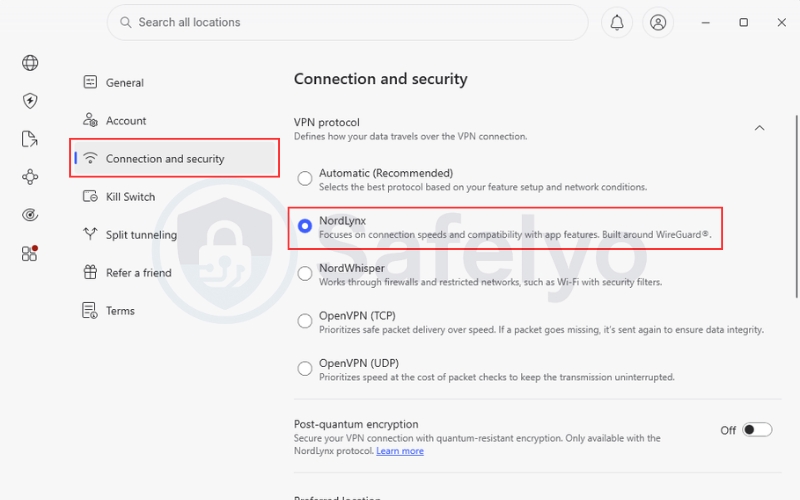
NordVPN took the foundational code of WireGuard and engineered it into their proprietary NordLynx protocol. By integrating a custom Double NAT system, they solved WireGuard’s static IP privacy flaw, delivering blazing-fast speeds without compromising your anonymity.
The app also provides easy access to OpenVPN (TCP/UDP) and specialized Obfuscated servers for bypassing strict censorship. This makes NordVPN the most complete all-around security tool for both speed and stealth.
7.2. Surfshark for easy WireGuard access on all devices
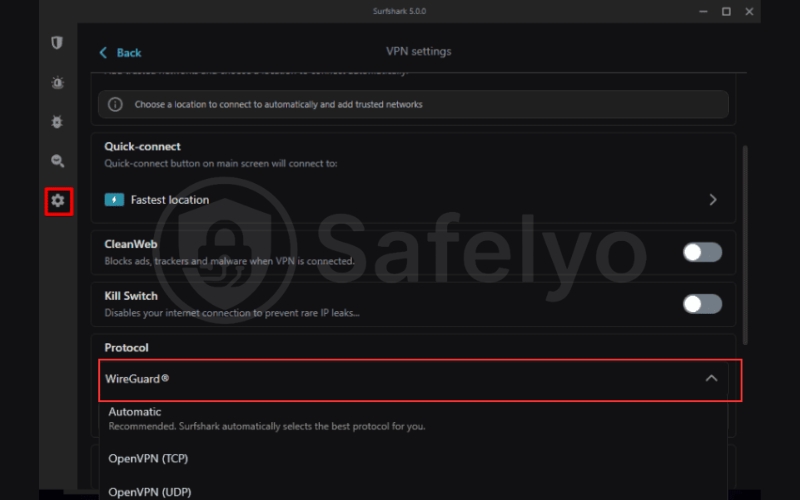
Surfshark offers incredible value by using the WireGuard protocol across its entire application fleet. It provides incredibly fast, battery-efficient connections that are perfect for streaming and general web browsing.
What sets Surfshark apart is its unlimited simultaneous connections policy. You can easily switch between WireGuard, OpenVPN, and IKEv2 on every smartphone, tablet, and computer in your household using a single, budget-friendly subscription.
7.3. ExpressVPN with its proprietary Lightway alternative
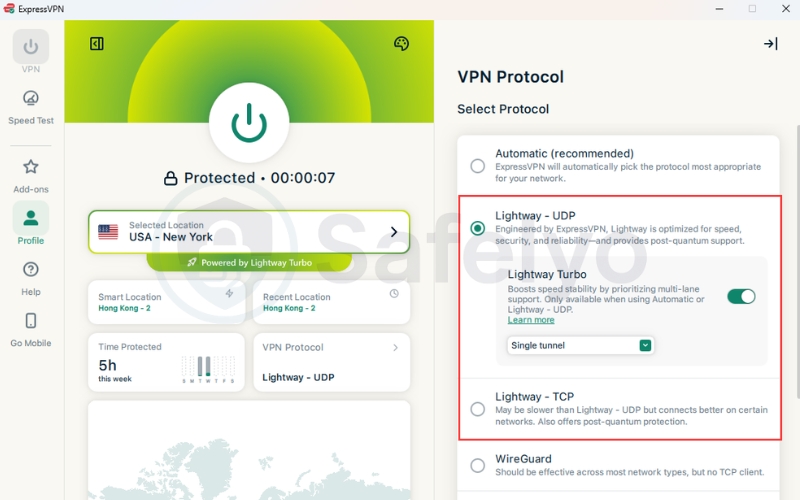
Instead of adopting WireGuard, ExpressVPN built its own modern protocol from scratch called Lightway. Like WireGuard, Lightway is incredibly lightweight and fast, but it includes built-in obfuscation and seamless network switching out of the box.
ExpressVPN also provides excellent, fully audited support for OpenVPN and IKEv2. This makes it a highly reliable, premium choice for users who want ultra-fast reconnections and an intuitive interface on unstable mobile networks.
8. Debunking common myths about VPN protocols
The rapid evolution of network security has created several misconceptions among everyday users. Let’s clear up the most persistent myths regarding these three tunneling standards to ensure you are making informed privacy decisions.
- WireGuard is completely anonymous by default
This is entirely false. In its raw, default state, WireGuard requires storing your static IP address on the server, which is a major privacy risk. Commercial VPN providers must implement custom workarounds, like NordVPN’s Double NAT, to guarantee true anonymity.
- OpenVPN is outdated
While it is certainly older, OpenVPN is far from obsolete. Its massive cryptographic flexibility and ability to route traffic over TCP port 443 make it the undisputed king of bypassing firewalls, a feat modern lightweight protocols still struggle to match.
- TCP connections are always too slow to use
TCP prioritizes packet delivery confirmation over raw speed, which naturally introduces processing overhead. However, on modern broadband connections, OpenVPN TCP is still fast enough for seamless HD streaming; it simply isn’t optimized for competitive, low-ping gaming.
9. Frequently asked questions
Which VPN protocol is the fastest?
WireGuard is widely considered the fastest modern protocol. Its streamlined 1-RTT handshake and lightweight codebase allow it to maximize your internet throughput while keeping latency incredibly low during heavy data transfers.
Is WireGuard more secure than OpenVPN?
Neither is inherently more secure, but they take different approaches. WireGuard benefits from a substantially smaller attack surface due to its concise code, while OpenVPN has been heavily battle-tested and independently audited for over two decades.
Which protocol uses less smartphone battery?
WireGuard and IKEv2 are the most battery-efficient choices for mobile users. WireGuard uses highly optimized modern ciphers, while IKEv2 often utilizes hardware acceleration built into mobile processors to significantly reduce CPU strain.
Can I switch VPN protocols while connected?
No, you cannot seamlessly swap protocols mid-session. Your VPN application must completely drop the current connection, apply the new cryptographic rules, and then re-establish a fresh encrypted tunnel to the server.
Which protocol is best for torrenting safely?
WireGuard is the superior choice for peer-to-peer file sharing. Its low cryptographic overhead allows you to maximize your download speeds safely, provided your VPN application has a functional kill switch to prevent accidental IP leaks.
Why is my VPN blocked on public Wi-Fi?
Public networks frequently block the specific UDP ports used by WireGuard and IKEv2 to prevent high-bandwidth activities. Switching your app settings to OpenVPN TCP over port 443 usually bypasses these strict hotel and airport firewalls immediately.
Does my choice of protocol affect my IP address?
No, the encryption protocol only dictates how your data is packaged and securely transmitted. Your newly assigned public IP address is determined entirely by the geographic location of the VPN server you choose to connect to.
10. Conclusion
Resolving the technical debate of WireGuard vs OpenVPN vs IKEv2 ultimately depends on your specific network environment. If you want blistering download speeds, WireGuard is unmatched; if you need to defeat strict censorship, OpenVPN TCP is essential; and for seamless cellular roaming, IKEv2 handles the job perfectly.
Understanding these technical foundations empowers you to optimize your connection, but you still need a highly trusted provider to deliver the service safely. Explore our comprehensive, independent tutorials in the VPN Guides category at Safelyo to master your network settings and find an application that expertly supports all these modern protocols.