
Are VPNs legal in the US? Using a VPN is legal in the United States. No federal law generally prohibits individuals from using a VPN for privacy, security, or other lawful purposes. A VPN doesn’t, however, make illegal activity legal, and a handful of state rules now affect how certain websites must treat VPN traffic.
This guide breaks down what’s legal, what still isn’t, how streaming and torrenting fit in, whether law enforcement can track VPN use, and what Utah’s 2026 age-verification law actually changed and hasn’t changed for ordinary VPN users.
Key takeaways
- VPNs are legal in the US: There is no general federal or state ban on using VPN software for lawful purposes.
- A VPN doesn’t make illegal activity legal: Copyright infringement, fraud, hacking, and other unlawful activities remain illegal when using a VPN.
- Streaming is generally legal: Using a VPN with Netflix or other streaming services isn’t a crime, but platforms may restrict VPN traffic under their own terms.
- Utah’s 2026 law doesn’t ban VPNs: SB 73 introduces age-verification requirements for certain websites and treats users in Utah as Utah users even when they connect through a VPN.
1. Are VPNs legal in the US?
Using a VPN in the US is legal. No federal law prohibits individuals from using a VPN for privacy, security, or other lawful purposes, and no state has passed a law banning VPN software itself.
Millions of people use VPNs for ordinary purposes every day. Businesses rely on them for secure remote access, and the FBI’s Protected Voices guidance recommends using a VPN to protect communications on public or untrusted Wi-Fi.
The VPN itself is treated like any other networking software: app stores and major retailers sell VPN services openly, and installing one requires no waiver or registration with any government body. The law focuses on what you do online, not on whether your traffic happens to be encrypted or routed through another server.
That said, some state laws can impose requirements on websites or online services when users try to bypass specific restrictions with a VPN. Utah’s SB 73, covered later in this guide, is the clearest 2026 example, and it’s worth understanding since it doesn’t work quite the way many headlines suggest.
2. What can you legally do with a VPN in the US?
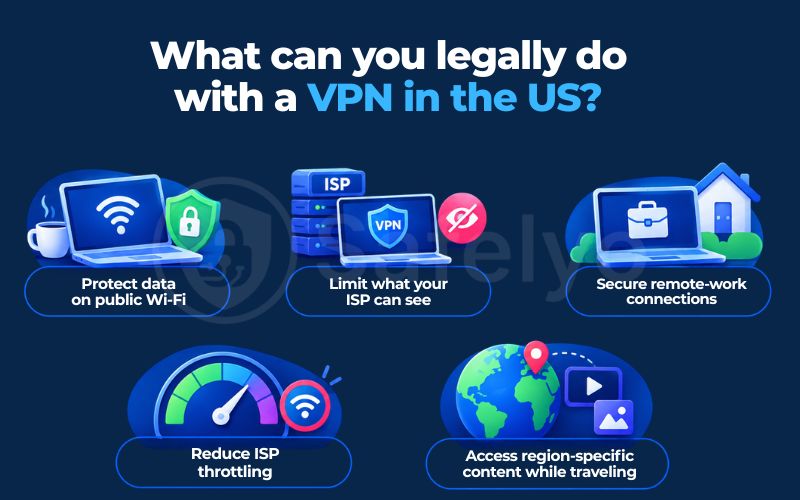
A VPN is a legitimate privacy and security tool. The most common, everyday uses raise no legal issues in the US:
- Protect data on public Wi-Fi: Public networks in cafes, airports, and hotels are often unencrypted. A VPN creates an encrypted tunnel so other users on the same network can’t easily intercept passwords, emails, or browsing data.
- Limit what your ISP can see: A VPN prevents your ISP from directly seeing the contents of your encrypted traffic and generally hides which specific websites you visit, though the ISP can still see that you’re connected to a VPN server and may observe connection metadata.
- Secure remote-work connections: Many companies require employees to use a VPN when accessing internal systems from home or while traveling. This is standard practice and fully legal.
- Reduce ISP throttling: Some providers slow down certain types of traffic, such as video streaming or large downloads. Routing that traffic through a VPN can sometimes make it harder for an ISP to apply that throttling, though it doesn’t guarantee faster speeds.
- Access region-specific content while traveling: A VPN can make your connection appear to come from another country. This is legal under US law, though individual streaming services may restrict it under their own Terms of Service.
These uses are routine and create no legal risk on their own. The VPN itself is legal; only the activity carried through it can create legal exposure.
3. A VPN doesn’t make illegal activity legal
A VPN only encrypts and reroutes traffic. It doesn’t change the legal status of the underlying activity. If an action is illegal without a VPN, it stays illegal with one; courts and prosecutors look at the conduct, not the tunnel used to carry it.
3.1. Is torrenting or downloading pirated content legal with a VPN?
No. Downloading or distributing copyrighted material without authorization can constitute copyright infringement under US copyright law. Depending on the circumstances, this may lead to civil liability, and willful infringement carried out for commercial advantage or private financial gain can also lead to criminal penalties under federal copyright law.
A VPN may hide your IP address from copyright-monitoring systems in the short term, but it doesn’t eliminate the possibility of identification through other evidence or legal processes, and it doesn’t create a legal defense. Rights holders can still pursue civil claims, and in the right circumstances, criminal referrals, regardless of whether a VPN was used.
3.2. What other online activities stay illegal with a VPN?
The same rule applies to other crimes. A VPN offers no protection against prosecution for:
- Hacking or unauthorized computer access under the Computer Fraud and Abuse Act
- Fraud, identity theft, or phishing
- Cyberstalking or online harassment that meets legal thresholds
Law enforcement can still investigate these cases. A VPN may slow down identification, but it doesn’t block warrants, subpoenas, or other investigative tools when relevant evidence exists elsewhere.
4. Is it illegal to use a VPN for Netflix or streaming?
No, using a VPN with Netflix or another streaming service isn’t a crime under US law. However, Netflix may restrict access when it detects a VPN or proxy connection, typically limiting the catalog to titles it holds worldwide streaming rights for, or asking you to disable the VPN. VPNs also aren’t supported for live events or the full range of features on some plans. Full account termination solely for VPN use is uncommon, but Netflix reserves the contractual right to restrict service under its Terms of Use.
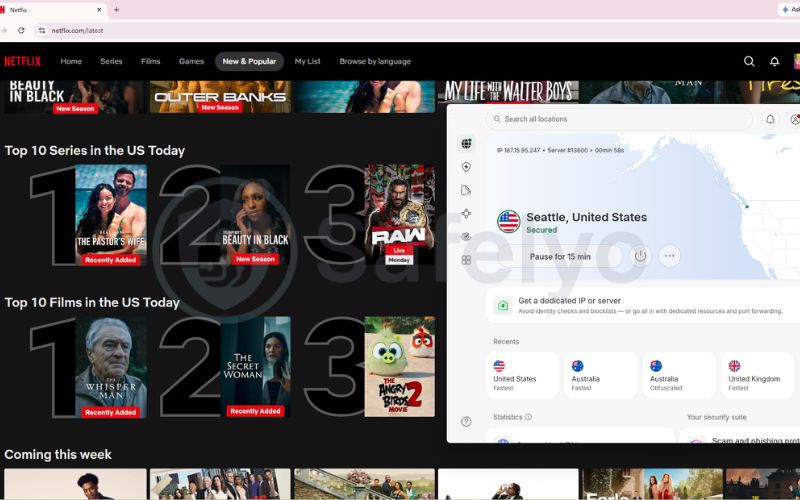
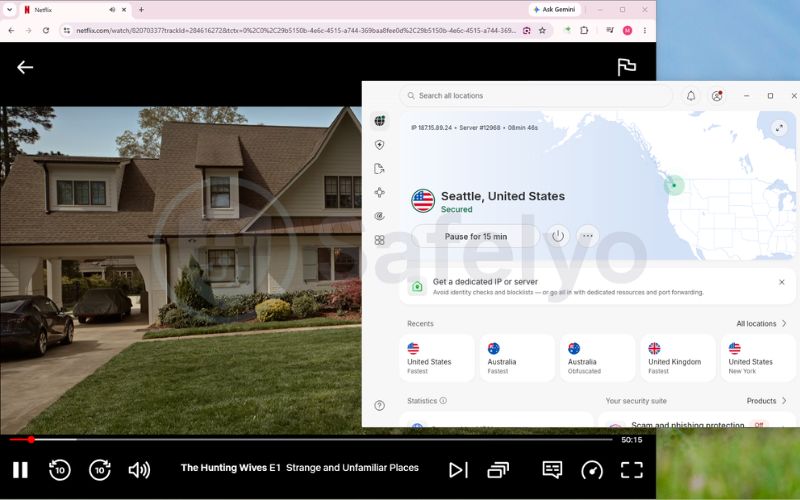
Breaking a company’s Terms of Service is a contract issue between you and that company. Breaking the law is a matter for courts and law enforcement, and using a VPN for streaming only touches the first one.
The same pattern applies to most major streaming platforms:
| Aspect | US law | Streaming service terms |
|---|---|---|
| VPN use itself | Legal | May be restricted |
| Enforcement | Government / legal system | Service provider |
| Possible consequence | No criminal penalty for VPN use alone | VPN detection, restricted catalog, or access limitations |
| Criminal risk from VPN use alone | None | None |
5. Can the FBI or police track your VPN use?
Law enforcement can’t easily monitor the contents of an encrypted VPN connection the way it might observe unencrypted traffic. That doesn’t make a VPN user invisible, though.
Depending on the investigation and the data available, authorities may use legal processes, such as a subpoena or court order, to obtain information from a VPN provider or from other sources entirely. What can actually be obtained depends in large part on what records the provider keeps.
A provider that genuinely keeps minimal logs may have less historical information available to disclose. But a no-logs policy is a claim made by the provider, not a technical guarantee of complete anonymity.
The FBI’s Protected Voices guidance treats VPNs as a legitimate tool for protecting communications on public or untrusted networks; ordinary VPN use is not, on its own, something federal investigators view as suspicious.
6. Are there any US laws restricting VPN use in 2026?
No federal law restricts ordinary VPN use by individuals. One state measure has begun addressing VPN traffic in a narrow context tied to age-verification requirements for certain websites.
6.1. What Utah’s SB 73 actually changed
Utah Governor Spencer Cox signed Senate Bill 73 (the Online Age Verification Amendments) on March 19, 2026. SB 73 applies to certain commercial websites where material considered harmful to minors makes up more than one-third of the site’s content, and it requires those sites to verify the age of users accessing them from Utah.
The distinctive part of the law is its “deemed-location” provision: it treats anyone physically located in Utah as a Utah user for age-verification purposes, even if that person connects through a VPN, proxy, or other location-masking technology. Covered websites are also restricted from publishing instructions that help users bypass the age-verification requirement with a VPN.
SB 73 does not ban individuals from using a VPN. Ordinary privacy, security, and remote-work use of a VPN remain fully legal in Utah. The compliance obligation, and the penalties for violating it, fall on the covered websites, not on individual VPN users.
6.2. Current enforcement status
As of September 24, 2026, SB 73 remains in effect statewide. Enforcement of the challenged “deemed-location” provision against Aylo, Pornhub’s parent company, is currently paused under a non-enforcement agreement with Utah’s Department of Commerce while a federal court reviews Aylo’s constitutional challenge. That agreement has been extended to October 22, 2026, or until the court rules on Aylo’s preliminary-injunction request, whichever comes first.
This pause applies specifically to the Aylo litigation. It is not a statewide suspension of SB 73, and other covered websites remain subject to the law. Because the situation is still active, verify the current status before relying on any specific date.
7. Why do people in the US use VPNs?
Millions of Americans rely on encrypted tunnels every single day to protect their constitutional right to digital privacy. These tools provide an essential layer of defense against pervasive corporate data tracking and aggressive local network surveillance.
Citizens primarily activate these applications to secure sensitive financial data on public networks or hide personal browsing habits from their internet providers. The software is also widely used by travelers to securely access restricted domestic streaming catalogs from out of state.
8. How to choose a legal, trustworthy VPN in the US
Selecting a service that complies with federal law while maintaining strict privacy standards requires evaluating corporate data retention policies. A trustworthy provider will openly share independent security audits to prove they never track your personal browsing activity.
Identifying the best VPN for the USA typically involves verifying the use of RAM-only servers and offshore legal jurisdictions. These specific technical features guarantee that your private information remains completely inaccessible to domestic internet service providers and government monitors.
9. Frequently asked questions
Is it a crime to use a VPN in the USA?
No. There’s no federal or state law that makes using a VPN a crime. What you do while connected can be a crime, such as downloading pirated content or committing fraud, but the VPN itself is not illegal.
Can the FBI track a VPN?
A VPN can make direct observation of your traffic more difficult, but it doesn’t make you anonymous. Law enforcement may still obtain information from your VPN provider or other sources through legal processes such as a subpoena or court order. How much information is available depends largely on the provider’s logging practices.
Will I get in trouble for using a VPN?
Simply using a VPN for lawful purposes is not generally a crime in the United States. Legal issues come from the underlying conduct, such as illegal downloads, fraud, or unauthorized access, not from the VPN connection itself.
Is using NordVPN illegal?
No. Using NordVPN or another commercial VPN service is not generally illegal in the United States. Legality depends on what you do while connected, not on which VPN brand you choose.
Is it illegal to use a VPN for Netflix?
No. Using a VPN with Netflix is not itself a criminal offense in the United States. However, Netflix may detect the VPN connection and restrict the content available to you or ask you to disable it.
Are VPNs legal for streaming?
Yes. Using a VPN to stream content is legal under US law. Individual streaming services can still restrict or block VPN traffic under their own Terms of Service.
Is it illegal to use a VPN to watch sports?
No. Using a VPN to access sports content isn’t generally a crime in the United States. However, a streaming provider or broadcaster may restrict access if it detects a VPN or if the connection doesn’t comply with its regional licensing terms.
10. Conclusion
So, are VPNs legal in the US? Yes. Using a VPN is legal in the United States, whether you’re using it to protect your privacy, secure a public Wi-Fi connection, or work remotely. What matters legally is what you do through the VPN, not the VPN itself.
A VPN won’t make illegal activity lawful or guarantee anonymity. Streaming with a VPN is generally not a crime, although services may restrict VPN traffic under their own rules. Likewise, Utah’s 2026 age-verification law does not ban VPN use; it applies specific requirements to covered websites.