
Using a VPN can make government tracking more difficult, but it cannot prevent authorities from identifying you through account records, provider data, metadata, devices, or other evidence. VPN and government surveillance involve more than encryption: detecting VPN use, identifying a user, monitoring activity, and decrypting traffic are separate capabilities.
This guide explains what ISPs, VPN providers, websites, law enforcement, and intelligence agencies can see when you use a VPN. It also covers current U.S. surveillance rules, VPN detection, provider data requests, traffic correlation, and the practical limits of VPN privacy.
Key takeaways
- A VPN hides your real public IP address from websites and encrypts traffic between your device and the VPN server.
- Your ISP can detect a VPN connection but normally cannot inspect the traffic inside a properly encrypted VPN tunnel.
- Detecting VPN use, identifying the user, monitoring activity, and decrypting traffic are 4 different capabilities.
- Government agencies can use account records, provider data, metadata, payment records, and device evidence without breaking VPN encryption.
- Commercial VPNs can complicate location-based surveillance rules because many users in different countries may share one VPN server IP address.
- Standard single-hop VPNs cannot fully prevent traffic correlation by adversaries with broad network visibility.
- A no-logs policy can reduce records held by the VPN provider, but it does not eliminate information stored by websites, accounts, payment services, or devices.
1. Can the government track you if you use a VPN?
Using a VPN makes some forms of government tracking more difficult, but it does not prevent authorities from identifying a user through information available outside the encrypted VPN connection.
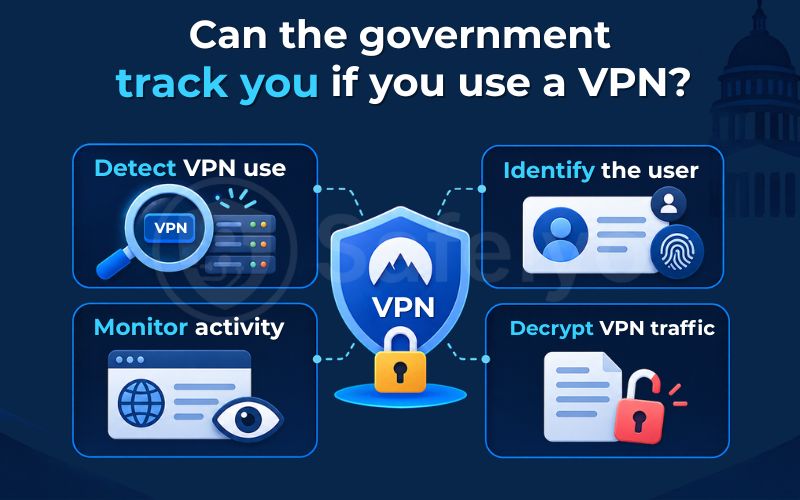
Four different capabilities are often confused when discussing VPN surveillance:
- Detect VPN use: Determine that a device is communicating with a known or suspected VPN server.
- Identify the user: Connect VPN activity to a particular person through records or other evidence.
- Monitor activity: Learn information about the person’s online activity through network data or other sources.
- Decrypt VPN traffic: Access the encrypted contents of the VPN tunnel.
Access to one capability does not automatically provide the others. For example, an ISP may recognize a connection to a VPN server without knowing which websites the user visits inside the encrypted tunnel.
Government investigators can also identify a user without decrypting VPN traffic. Account records, provider data, payment information, website logs, metadata, and evidence obtained from a device all exist outside the encrypted tunnel.
2. What can different parties see when you use a VPN?
A VPN changes which parties can see different parts of your internet connection. Your ISP, VPN provider, websites, and government investigators each have different access, so they don’t see the same information.
The table below shows the main differences. Actual visibility can vary depending on the VPN configuration, provider practices, website, and source of evidence.
| Observer | Real IP address | VPN use | Websites inside the VPN tunnel | Other information |
|---|---|---|---|---|
| ISP | Visible | Visible | Normally hidden | Server IP, timing, duration, data volume |
| VPN provider | Visible when connecting | Visible | Depends on infrastructure and traffic | Account and connection data it collects |
| Website | Normally hidden | Often detectable | Sees activity on its own service | Accounts, cookies, browser fingerprint |
| Government investigator | Depends on evidence source | Potentially detectable | Not automatically visible | Provider records, accounts, metadata, devices |
The table highlights why VPN privacy is not an all-or-nothing question. A VPN can restrict one observer’s visibility while another service still holds information that identifies the same user.
2.1. What can your ISP see?
Your ISP knows your real public IP address because it provides your internet connection. When a VPN is active, the ISP can also see encrypted traffic traveling between your device and the VPN server. Information such as the VPN server IP, connection timing, duration, and data volume remains visible. The ISP normally cannot directly inspect the websites or traffic contents carried inside a properly encrypted VPN tunnel.
2.2. What can your VPN provider see?
A VPN provider receives the connection from your original IP address before routing traffic to the internet. Depending on its systems and policies, it may also hold account details, payment information, device data, or connection records. The amount of information retained varies between services. For privacy purposes, the specific data covered by a provider’s no-logs policy matters more than the “no logs” label itself.
2.3. What can websites see?
Websites normally see the VPN server’s public IP address instead of your original public IP. This prevents them from using your home IP alone to identify your internet connection or estimate your location. However, websites can still recognize users through logged-in accounts, cookies, tracking pixels, browser fingerprints, and personal information submitted directly to the service. Changing an IP address does not remove these identifiers.
3. How can websites and governments detect VPN use?
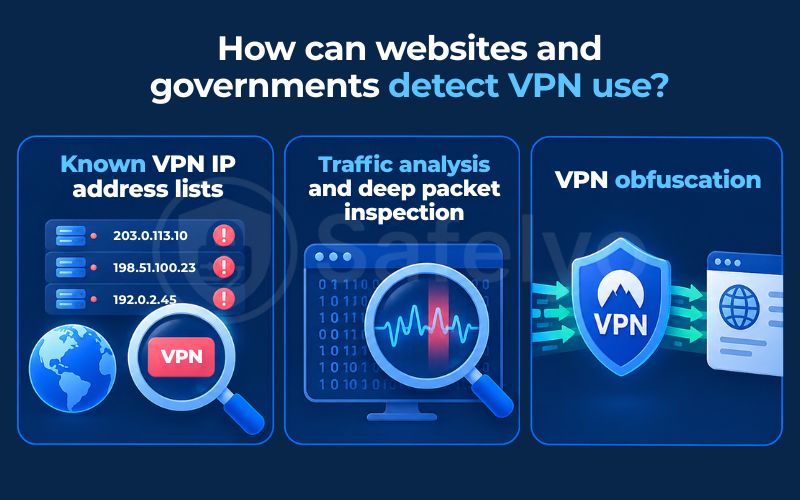
VPN use can often be detected without decrypting the traffic inside the tunnel. Common methods include identifying known VPN server IP addresses and analyzing characteristics associated with VPN connections.
The March 26, 2026 congressional letter to the Director of National Intelligence noted that cybersecurity companies maintain and sell lists of IP addresses associated with commercial VPN services. These lists can reveal that traffic comes from VPN infrastructure without revealing the user’s true location.
3.1. Known VPN IP address lists
Commercial VPN providers operate servers shared by many customers. Once a server is identified as VPN infrastructure, its IP address can be added to databases used by websites, security systems, and network operators. The March 2026 congressional letter notes that a single commercial VPN server may simultaneously carry traffic from hundreds or thousands of users in multiple countries. Those users can therefore appear online through the same server IP address.
This makes VPN detection different from user identification. Recognizing a VPN server does not reveal which customer generated a particular connection or where that person is physically located.
3.2. Traffic analysis and deep packet inspection
Network operators can analyze protocol behavior and packet characteristics to identify traffic that resembles a VPN connection. Deep packet inspection (DPI) can examine network traffic characteristics rather than relying only on the destination IP address. Encryption prevents DPI from simply reading properly encrypted VPN contents. However, protocol signatures and other observable network characteristics can still provide evidence that a VPN is being used.
3.3. VPN obfuscation
VPN obfuscation attempts to make VPN traffic look more like ordinary internet traffic. It can help on networks that identify or block connections based on recognizable VPN protocol characteristics. Obfuscation does not guarantee that VPN use becomes undetectable. Known server IP addresses and other traffic-analysis techniques can still reveal the connection.
4. Can the NSA track you if you use a VPN?
A VPN can limit what the NSA can learn directly from a network connection, but it cannot prevent the agency from obtaining relevant information through other intelligence sources. Tracking also does not necessarily require breaking the VPN’s encryption. The NSA’s mission centers on foreign signals intelligence and cybersecurity, which differs from an ordinary domestic criminal investigation conducted by an agency such as the FBI.
Public evidence does not establish that the NSA can decrypt every modern commercial VPN at will. Historical disclosures about older surveillance capabilities should also not be treated as proof of current decryption capabilities because VPN protocols, encryption standards, and infrastructure have changed.
The more relevant limitation is that encryption protects traffic contents rather than every piece of information surrounding a connection. Metadata, accounts, provider records, and traffic patterns can provide information without revealing the encrypted contents directly.
5. Can the FBI track you through a VPN?
The FBI can identify a VPN user without breaking VPN encryption when an investigation produces sufficient evidence from accounts, providers, websites, devices, or other sources. Depending on the investigation and applicable legal authority, evidence can include account records, service-provider information, payment records, website data, IP records, or information obtained from devices.
This is different from directly accessing an encrypted VPN tunnel. Investigators can associate online activity with a person even when the underlying VPN encryption remains intact. A VPN can still reduce network-level evidence, particularly information based on the user’s original public IP address. It does not prevent an authorized investigation from using records held elsewhere.
6. How do Section 702 and Executive Order 12333 affect VPN users?
Commercial VPNs create a specific issue for U.S. surveillance rules because a VPN server’s IP address may not reliably reveal the user’s actual country. Six U.S. lawmakers, including Senator Ron Wyden, raised this issue with the Director of National Intelligence on March 26, 2026.
Their letter discusses procedures under both Section 702 of the Foreign Intelligence Surveillance Act (FISA) and Executive Order 12333. The concern centers on how surveillance rules apply when a VPN makes the user’s location or nationality uncertain, rather than VPN use automatically making an American a surveillance target.
6.1. What is the current status of Section 702?
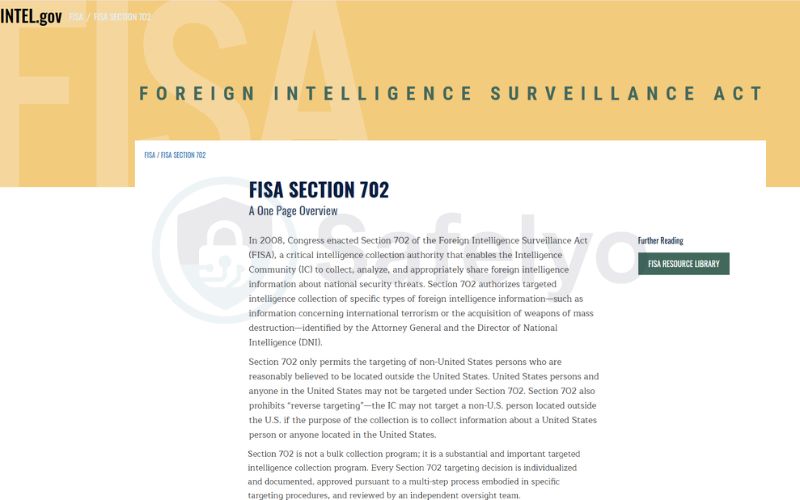
As of September 2026, Section 702’s statutory authorization expired on June 12, 2026, but collection authorized under existing certifications did not immediately end. The FISA Court approved certifications in March 2026 that can remain effective until approximately March 2027.
Section 702 permits the targeting of qualifying non-U.S. persons reasonably believed to be outside the United States to acquire foreign intelligence information. It does not authorize intentionally targeting U.S. persons under Section 702.
Americans’ communications can nevertheless be collected incidentally when they communicate with lawful foreign targets. Previously acquired Section 702 information can also be subject to U.S.-person queries under applicable querying rules and restrictions.
6.2. Why does a VPN create a location problem?
A commercial VPN replaces the user’s original public IP address with the address of a VPN server. Because one server can carry traffic from users in several countries, that server’s IP address cannot reliably establish an individual user’s physical location.
The March 26 congressional letter highlights a more specific concern. The lawmakers state that relevant NSA procedures allow a person to be presumed to be a non-U.S. person located outside the United States when the agency cannot determine otherwise, unless specific information indicates that the person is a U.S. person or is inside the country.
A commercial VPN can make that location determination more difficult. The lawmakers therefore asked the Director of National Intelligence to clarify how these procedures protect Americans whose VPN use obscures their real location. The letter raises a privacy and legal concern about existing procedures. It does not establish that American VPN users are routinely subjected to foreign intelligence surveillance.
6.3. What does Executive Order 12333 have to do with VPNs?
Executive Order 12333 establishes a broader framework governing U.S. intelligence activities, including foreign intelligence collection outside the Section 702 framework.
The March 26 letter refers to procedures under both Section 702 and EO 12333 when discussing how agencies determine whether a person is a U.S. person and whether they are located inside or outside the United States. The VPN issue therefore extends beyond Section 702 itself. The underlying concern is how location and nationality rules operate when a commercial VPN prevents an IP address from reliably indicating where a user actually is.
6.4. What role does the FISA Court play?
The Foreign Intelligence Surveillance Court oversees certain surveillance activities conducted under FISA. Under Section 702, it reviews government certifications and procedures governing targeting, minimization, and querying rather than approving every foreign target individually.
This certification structure is also relevant to the current status of Section 702. Certifications approved before the June 2026 statutory lapse can remain operative for their authorized period.
7. Can the government request data from a VPN provider?
Government authorities can seek records from a VPN provider through applicable legal processes. What they can obtain depends on the jurisdiction, type of legal demand, and information the provider actually collects and retains.
In the United States, VPNs are legal for ordinary use, but providers and users remain subject to applicable laws. For more context, see our guide to VPN laws in the US. The Stored Communications Act provides mechanisms for compelling different categories of electronic records, including subpoenas, court orders, and search warrants.
7.1. What are subpoenas, court orders, search warrants, and NSLs?
These legal mechanisms are not interchangeable. They involve different legal standards and can apply to different categories of information.
- Subpoena: Can compel certain subscriber and other records without meeting the probable-cause standard required for a search warrant.
- Court order: Allows access to specified records when the statutory requirements for judicial authorization are satisfied.
- Search warrant: Generally requires probable cause and judicial approval and can authorize access to information within the warrant’s lawful scope.
- National Security Letter (NSL): A written demand the FBI can use under specific statutory authorities for limited categories of records relevant to qualifying national-security investigations.
The FBI explains that an NSL is not a court order because a judge does not issue the letter itself. Its use and the categories of records available depend on the underlying statutory authority.
7.2. What happens if a VPN provider keeps no useful logs?
A provider cannot produce historical records that it never collected or no longer retains. This makes the actual implementation of a no-logs policy relevant when authorities request historical VPN data.
A real-world example occurred on April 18, 2023, when Swedish police visited Mullvad’s Gothenburg office with a search warrant. According to Mullvad, officers intended to seize computers containing customer information but left without taking equipment or customer data because the requested data did not exist.
Mullvad later reported that the Swedish Prosecution Authority said the search resulted from international legal cooperation involving Germany. The case does not mean every provider advertising “no logs” has no information to provide. Providers can retain account, payment, technical, or other records even when they do not store browsing activity.
7.3. Does VPN jurisdiction matter?
A VPN provider is subject to legal obligations applicable to its operations, making jurisdiction one factor in how government data requests are handled. Jurisdiction alone does not determine privacy, however. Logging architecture, data retention, ownership, account requirements, transparency, and independent audits determine how much useful information a provider actually possesses.
When evaluating privacy, the practical question is therefore not only where a VPN company is based but what identifiable information it retains when a valid legal demand arrives.
8. Can a single-hop VPN prevent traffic correlation?
A standard single-hop VPN cannot fully prevent traffic correlation when an adversary can observe network traffic at multiple points. Encryption protects the contents, but characteristics such as timing and data volume may remain observable.
A Congressional Research Service memo released by Senator Ron Wyden on September 2, 2026, examined this risk in the context of sophisticated foreign intelligence agencies. It explains how adversaries with broad network visibility may correlate encrypted traffic without breaking the underlying encryption.
8.1. How does traffic correlation work?
Encrypted traffic still has observable characteristics, including timing, direction, duration, and data volume. An adversary that can observe traffic at multiple network locations can attempt to match these patterns.
For example, a distinctive sequence of encrypted traffic entering a VPN server may resemble traffic leaving the server shortly afterward. Matching those patterns can reveal information about the connection even though the traffic contents remain encrypted. This is a limitation of the network architecture rather than a failure of the encryption algorithm.
8.2. Can multi-hop systems reduce the risk?
Multi-hop systems can make traffic correlation harder by routing a connection through multiple intermediaries rather than a single VPN server.
The CRS memo discusses systems including Tor, Apple iCloud Private Relay, and Nym as examples of architectures that route traffic through multiple servers. Other defenses can include techniques such as traffic padding, random delays, and cover traffic. These approaches do not guarantee anonymity. Their effectiveness depends on system architecture, the adversary’s visibility, traffic characteristics, endpoint security, and other factors.
8.3. What did lawmakers ask the NSA to do in September 2026?
On September 2, 2026, Senator Wyden asked the NSA to update federal cybersecurity guidance about the limitations of standard commercial VPNs for users facing sophisticated foreign surveillance. The letter asked about single-hop VPN protection, multi-hop tools, and technical defenses against traffic correlation. Wyden requested unclassified responses by September 20, 2026.
The request addresses a high-level threat model involving adversaries with extensive network visibility. It does not mean that a standard VPN provides no privacy benefit against ordinary ISP monitoring or IP-based tracking.
9. What can’t a VPN protect you from?
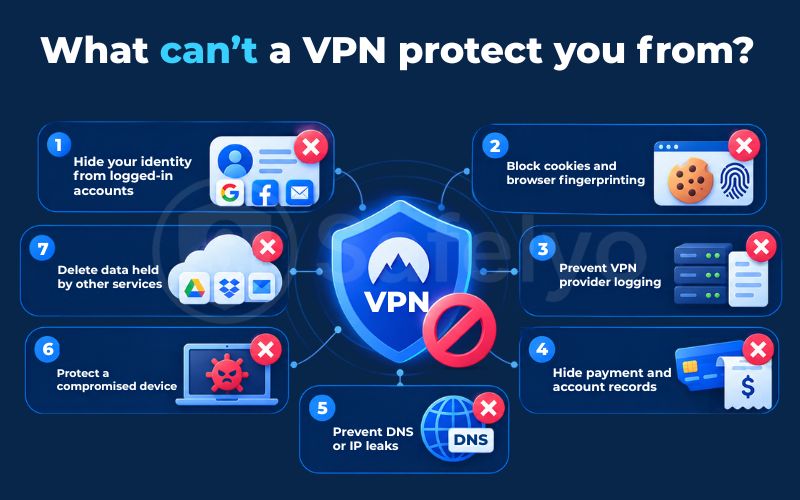
A VPN protects the network connection between your device and the VPN server, not every source of information associated with your online activity. Accounts, browser tracking, provider logs, payments, leaks, compromised devices, and third-party records remain outside that protection.
- Hide your identity from logged-in accounts
A VPN cannot conceal information you provide directly to a service. Signing into Google, email, social media, banking, or another personal account can associate your activity with your identity even when your real IP address is hidden. Your email address, username, phone number, and other account information remain available to the service independently of the VPN connection.
- Block cookies and browser fingerprinting
Websites can recognize browsers through cookies, tracking technologies, and browser fingerprinting without relying entirely on IP addresses. Changing your IP with a VPN therefore does not reset every identifier used for tracking. Browser-level privacy controls address these methods more directly.
- Prevent VPN provider logging
A VPN cannot prevent its own provider from creating records if the service is designed to log connection or account information. Check exactly what a no-logs policy covers, how long other data is retained, and whether recent independent audits have tested the provider’s claims.
- Hide payment and account records
VPN subscriptions can generate records outside the VPN tunnel. Payment processors, financial institutions, app stores, and email providers may retain information associated with the purchase or account. A VPN provider storing no browsing history therefore does not mean that no information about the customer exists elsewhere.
- Prevent DNS or IP leaks
Configuration problems or VPN connection failures can expose information outside the encrypted tunnel. A DNS leak can send requests through an unintended resolver, while a dropped VPN connection can expose the user’s original IP if normal internet traffic resumes.
DNS leak protection and a kill switch help reduce these risks. A kill switch blocks network traffic when the VPN connection unexpectedly fails.
- Protect a compromised device
A VPN cannot secure information already exposed on the device itself. Malware can capture passwords, files, messages, screenshots, or other information before it enters the VPN tunnel. Device security therefore remains necessary even when VPN encryption is working correctly.
- Delete data held by other services
Websites, cloud providers, email services, payment companies, and other third parties maintain records independently of the VPN provider. A VPN cannot erase those records. They can remain relevant to an investigation even when little useful historical information exists at the VPN provider.
10. How can you reduce surveillance and tracking risks?
Reducing tracking requires combining VPN protection with browser privacy, secure devices, and careful account practices. The appropriate measures depend on whether you are addressing everyday tracking or a sophisticated targeted adversary.
A practical privacy checklist includes:
- Choose a VPN with a clearly defined logging policy and recent independent audits.
- Check what account, payment, device, and connection information the provider collects.
- Use modern VPN protocols and current encryption standards.
- Enable a kill switch so traffic does not continue unprotected after a VPN failure.
- Test the connection for DNS, IPv6, and other IP leaks.
- Use browser anti-tracking protections to reduce cookies and fingerprinting.
- Remember that signing into personal accounts identifies you to those services.
- Keep your operating system, browser, VPN application, and security software updated.
- Review which apps and websites can access your location and personal information.
- Consider multi-hop or anonymity-focused systems when your threat model includes advanced traffic correlation.
For most users, these measures address more realistic privacy risks than trying to become completely untraceable. People facing targeted state-level surveillance may require specialized security guidance beyond a standard consumer VPN.
11. FAQs about VPN and government surveillance
Can the government tell if you are using a VPN?
Yes. Government agencies and network operators can identify VPN use through known VPN server IP addresses and traffic characteristics. Detecting the VPN does not automatically reveal your real location or the contents of a properly encrypted tunnel.
Can police track you if you use a VPN?
Yes. Police can identify a VPN user through account records, provider data, payment information, websites, devices, and other evidence obtained through applicable investigative and legal processes.
Can the FBI see through a VPN?
No, not automatically. Knowing that someone uses a VPN does not give the FBI direct access to properly encrypted VPN traffic. Investigators can instead obtain identifying information from providers, accounts, devices, and other sources.
Does a VPN hide you from the NSA?
Not completely. A VPN masks your real IP address and encrypts network traffic, but metadata, traffic patterns, accounts, provider records, and other intelligence sources can still reveal information.
Can your ISP see what you do when using a VPN?
Generally, no. Your ISP can see the connection to a VPN server and associated metadata, but it normally cannot directly inspect the websites or traffic contents inside a properly encrypted VPN tunnel.
Can the government request logs from a VPN provider?
Yes. Authorities can seek available records through applicable legal processes. What the provider can supply depends on its jurisdiction, the legal demand, and the information it actually collects and retains.
12. Conclusion
A VPN reduces network-level exposure by hiding your real public IP address from websites and encrypting traffic between your device and the VPN server. Its protection does not extend to every source of identifying information, including accounts, provider records, payment data, devices, browser tracking, or advanced traffic analysis.
When evaluating VPN and government surveillance, focus on your threat model and the information available outside the VPN tunnel. A provider with transparent data practices and strong technical protections, combined with secure devices and privacy-conscious browsing, offers more practical protection than relying on a VPN alone.