
While VPNs encrypt your internet traffic, paying with a standard credit card permanently links your legal identity to the service. To achieve total privacy, you must learn how to pay for a VPN anonymously and sever this financial connection completely.
This guide explores proven methods like cryptocurrency, cash, and store gift cards to keep your subscription off bank statements. We analyze the trade-offs of each method to help you maintain zero financial trace in the increasingly surveillance-heavy landscape of 2026.
-
Buy a gift card with cash
Purchase a supported retail gift card at a store and pay with cash.
-
Select Pay with Gift Card
On the VPN checkout page, choose Pay with Gift Card.
-
Enter card details
Input the card number and PIN to redeem it for VPN subscription time.
-
Create a private wallet
Set up a non-custodial wallet (e.g., Exodus, Electrum) and store your crypto there.
-
Buy crypto privately
Use P2P markets or Bitcoin ATMs to avoid linking purchases to your bank.
-
Pay with crypto
-
Buy a prepaid card with cash
Purchase a non-reloadable Visa/Mastercard prepaid card at a retail store and pay with cash.
-
Register if required
If the issuer requires registration for online payments, complete it following their instructions and terms.
-
Pay at checkout
-
Sign up for a virtual card
Create an account with a virtual card provider and complete any required identity verification.
-
Generate a dedicated card
Create a single-use or merchant-locked card for the VPN purchase.
-
Pay with the card
-
Generate a cash payment token
Access the VPN site and choose Cash to get a unique payment token.
-
Prepare the envelope
Place the cash and the token (or its printout) in a sealed, opaque envelope.
-
Mail and wait for credit
1. Why anonymous payment matters in 2026
Digital privacy is shrinking, and financial records are often the weakest link in personal security. Understanding the importance of anonymous payments helps you decide if the extra effort is worth the protection it offers against surveillance and data profiling.
- Preventing financial footprints
Banks and credit card issuers track every transaction, creating a detailed profile of your lifestyle and habits. Paying anonymously ensures no permanent record exists on your statement, preventing data brokers, advertisers, or snooping partners from seeing your VPN subscription history.
- Protection in restrictive regions
In nations with aggressive internet censorship, purchasing privacy tools via traditional banking can flag you for government surveillance. Using untraceable payment methods is critical for journalists and activists to access the open web without risking legal repercussions or identification.
- Mitigating data breaches
Even the most secure VPN providers are not immune to database hacks or accidental leaks. By withholding your real name and billing address, you ensure your identity remains safe even if the provider’s payment logs are compromised by cybercriminals.
2. The “invisible” workflow: preparation before you pay
Before executing any payment, you must secure the metadata surrounding the transaction itself. If you pay with cryptocurrency but register using your real IP address or primary email, you leave digital breadcrumbs that effectively break your anonymity.
Step 1: Use a burner email
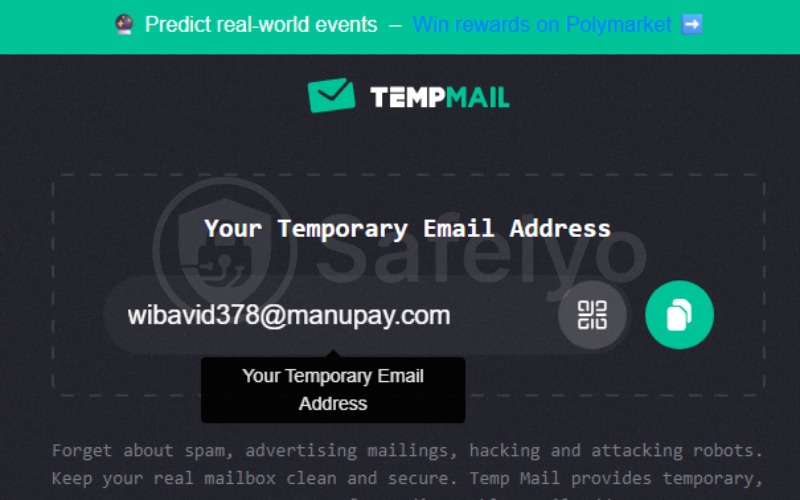
Standard providers like Gmail link accounts to phone numbers and real identities. Create a temporary or encrypted email account using services like Proton Mail, Temp Mail or SimpleLogin to receive subscription credentials without revealing your primary contact details to the VPN provider.
Step 2: Mask your IP address
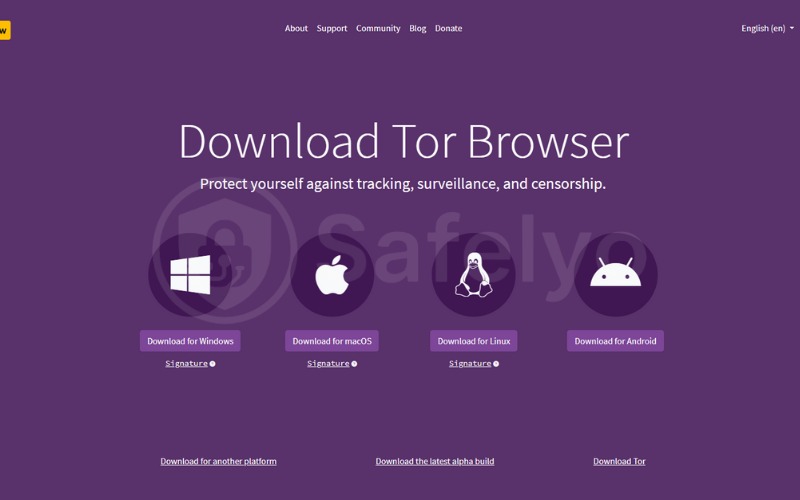
When you visit a VPN website to sign up, your Internet Service Provider (ISP) logs the connection request. Use the Tor Browser or a trusted free proxy to hide your real IP address during the registration process, ensuring the provider does not unintentionally log your physical location.
Step 3: Avoid Personally Identifiable Information
Personally Identifiable Information (PII) destroys privacy instantly. Since you are not using a traditional credit card that requires verification, you should safely use pseudonyms and fake addresses to complete the registration fields without triggering fraud detection systems.
3. How to pay for a VPN anonymously
Choosing the right payment method depends on your threat model and convenience needs. While cryptocurrencies offer digital speed, physical cash remains the king of untraceable transactions. Below are the most effective ways to fund your subscription without revealing your identity.
3.1. Gift card (Retail store purchase)
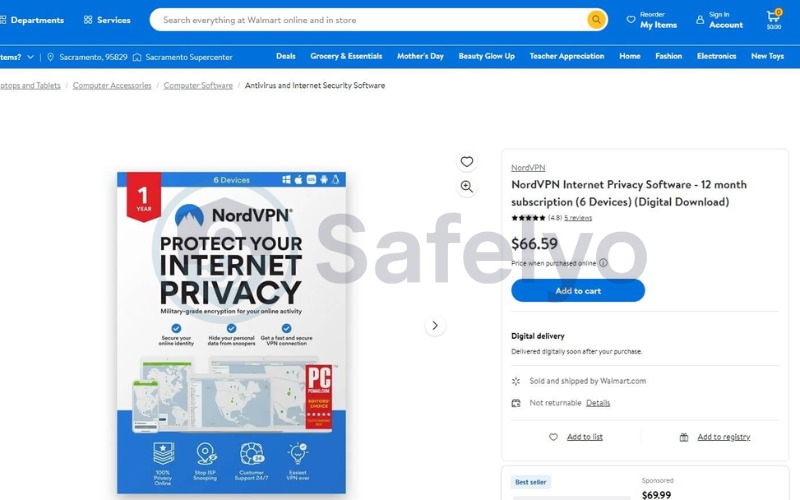
Major VPN providers often accept gift cards from unrelated retailers like Amazon, Best Buy, or Walmart as a valid payment option. This method allows you to use a generic store card bought with physical cash to fund your digital privacy tools without linking a bank account.
How it works
- Step 1: Visit a local convenience store or supermarket and purchase a major retail gift card using cash to ensure no paper trail.
- Step 2: Go to the VPN provider’s checkout page and select the “Pay with Gift Card” option (often powered by third-party processors like PayGarden).
- Step 3: Enter the card number and PIN code to trade the card’s remaining balance for the equivalent VPN subscription time.
Pros and Cons
This method effectively breaks the digital money trail, but it comes with strict limitations regarding refunds and potential exchange fees.
| Pros | Cons |
| High Anonymity: Cash purchase leaves no digital record. | No Refunds: Transactions are final; you cannot get money back. |
| Easy Access: Cards are available at most grocery stores. | High Fees: Exchange rates for gift card balances can be poor. |
3.2. Cryptocurrency (Bitcoin, Monero, Ethereum)
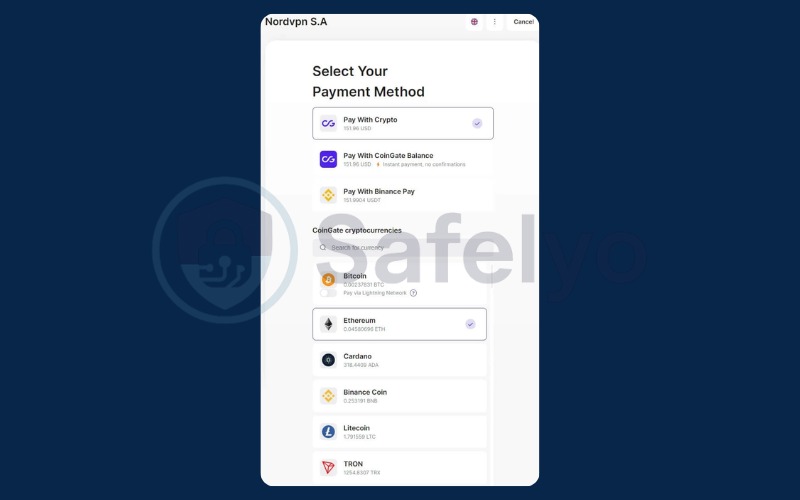
Cryptocurrency is the standard for online privacy, allowing peer-to-peer transfers without banking intermediaries. While Bitcoin is the most supported option, privacy coins like Monero offer superior protection by obscuring transaction details on the blockchain to prevent tracking.
How it works
- Step 1: Create a non-custodial wallet (like Exodus or Electrum) to hold your funds; avoid keeping coins on centralized exchanges for maximum privacy.
- Step 2: Purchase crypto using P2P marketplaces or physical Bitcoin ATMs to ensure the initial buy is not linked to your personal bank ID.
- Step 3: Select “CoinGate” or “BitPay” at the VPN checkout, scan the QR code, and transfer the exact amount to finalize the subscription.
Pros and Cons
Crypto offers a balance of speed and privacy, though technical complexity and price volatility can be barriers for new users.
| Pros | Cons |
| Global Access: Works anywhere without banking restrictions. | Complexity: Requires knowledge of wallets and gas fees. |
| Pseudonymous: Harder to track than credit cards. | Volatility: Price fluctuations can affect refund values. |
3.3. Prepaid card (Non-reloadable debit card)
Prepaid debit cards, such as “Vanilla Visa,” function like standard credit cards but are not linked to a bank account. They are an excellent middle ground for users who want the convenience of card payments without generating a monthly bank statement entry.
How it works
- Step 1: Buy a non-reloadable prepaid card (Visa/Mastercard) at a retail store using cash to keep the purchase anonymous.
- Step 2: Register the card online if required by the issuer, using a fake name and address (e.g., 123 Privacy Lane) to pass verification.
- Step 3: Select “Credit Card” at the VPN checkout and enter the prepaid card details just like a standard transaction.
Pros and Cons
While convenient, the high fraud detection rates of international payment processors can make this method frustrating to use.
| Pros | Cons |
| Widely Available: Easy to buy off the shelf at any store. | High Rejection Rate: Many VPN gateways block these cards. |
| No Bank Link: Not tied to your personal checking account. | Activation Fees: Cards often have an initial purchase fee. |
3.4. Virtual credit card (Masked cards)
Services like Privacy.com allow you to generate “burner” credit card numbers linked to your bank account. These cards mask the merchant name on your bank statement, showing a generic descriptor instead of the VPN provider’s name to protect your privacy.
How it works
- Step 1: Sign up for a virtual card service and link a funding source; this step does require Identity Verification (KYC).
- Step 2: Create a “single-use” or “merchant-locked” card specifically for the VPN provider to limit exposure.
- Step 3: Use the generated card number and any name you choose at the VPN checkout to complete the purchase.
Pros and Cons
This method offers excellent control over billing and prevents auto-renewals, but it requires trusting a third-party service with your data.
| Pros | Cons |
| Billing Privacy: VPN name is hidden on bank statements. | Not Truly Anonymous: The service knows your real identity. |
| Control: Set strict limits to prevent unwanted charges. | Region Locked: Mostly available only to US residents. |
3.5. Cash by mail
For the ultimate level of privacy, some providers like Mullvad and IVPN accept physical cash sent via postal mail. This analog method eliminates all digital footprints, ensuring no electronic record of the transaction exists on any server or bank ledger.
How it works
- Step 1: Log in to the VPN website via Tor and select “Cash” payment to generate a unique, random Payment Token.
- Step 2: Place the physical banknotes (EUR/USD) and the token into a secure, opaque envelope to prevent detection.
- Step 3: Mail the envelope directly to the VPN provider’s headquarters and wait for them to credit your account manually.
Pros and Cons
This is the “nuclear option” for privacy, trading speed and convenience for absolute anonymity that digital methods cannot match.
| Pros | Cons |
| Zero Digital Trace: The most anonymous method possible. | Very Slow: Can take weeks for the payment to arrive. |
| No Metadata: No IP logs or timestamps linked to payment. | Risk of Loss: Cash sent via mail cannot be recovered. |
4. Which VPNs accept these anonymous payments?
Finding a provider that genuinely supports privacy goes beyond just encryption; it requires a payment policy that minimizes data collection. While almost all providers accept cards, very few support Cash by Mail or Retail Gift Cards, which are the gold standard for true anonymity.
The table below compares the top VPN providers in 2026 based on their support for all 5 anonymous methods discussed in this guide.
| VPN Provider | Cryptocurrency | Cash by Mail | Gift Cards | Prepaid Cards | Virtual Credit Card |
|---|---|---|---|---|---|
| Mullvad VPN | Yes | Yes | Yes | Yes | Yes |
| Proton VPN | Yes | Yes | No | Yes | Yes |
| IVPN | Yes | Yes | No | Yes | Yes |
| NordVPN | Yes | Retail Box | Retail Box | Yes | Yes |
| PIA | Yes | No | Yes | Yes | Yes |
| ExpressVPN | Yes | No | No | Yes | Yes |
| Surfshark | Yes | No | No | Yes | Yes |
| CyberGhost | Yes | No | No | Yes | Yes |
| PureVPN | Yes | No | No | Yes | Yes |
| PrivateVPN | Yes | No | No | Yes | Yes |
| Ivacy VPN | Yes | No | No | Yes | Yes |
| IPVanish | No | No | No | Yes | Yes |
5. The trade-offs: what you lose by paying anonymously
While anonymity offers peace of mind, it fundamentally changes the customer relationship. By severing the financial link, you also lose the convenience features and consumer protections built into standard billing systems, which can significantly affect your user experience.
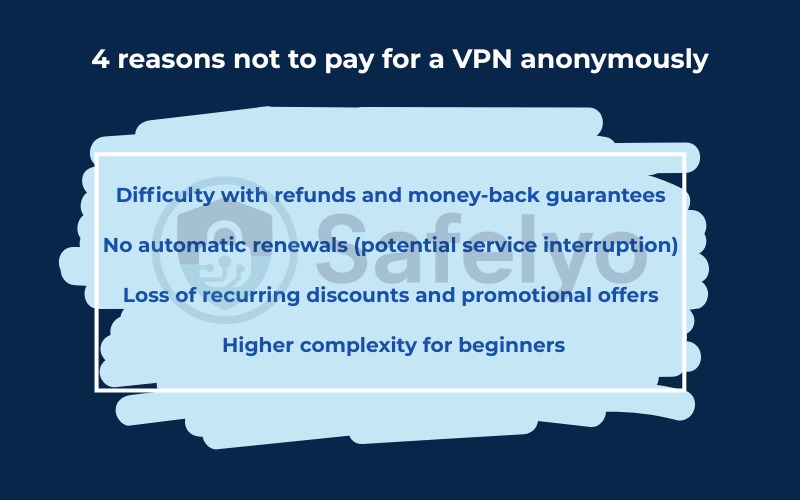
5.1. Difficulty with refunds and money-back guarantees
Most premium VPNs offer a “30-day money-back guarantee,” but claiming this is nearly impossible with anonymous methods. Cash payments are strictly non-refundable as there is no digital proof of purchase or mechanism to reverse the transaction.
Even with cryptocurrency, refunds are often processed in fiat currency. This means you might lose money due to exchange rate volatility or network “gas” fees. Furthermore, some providers explicitly state in their terms that “Crypto payments are final” and cannot be refunded at all.
5.2. No automatic renewals (potential service interruption)
Anonymous transactions are typically one-time payments, meaning the provider cannot automatically charge you to extend your subscription. This creates a significant risk of service interruption if you forget to top up your account before the expiration date manually.
If your plan expires while you are browsing, the VPN connection will cut off instantly. Without a configured “Kill Switch,” this sudden disconnection could expose your real IP address to your ISP and websites without you realizing it, defeating the purpose of your privacy efforts.
5.3. Loss of recurring discounts and promotional offers
The deepest discounts, such as “2-year plans with 3 months free,” usually require a recurring credit card subscription to lock in the lower rate. When paying with Gift cards or Crypto, you are often restricted to non-recurring plans that carry a significantly higher monthly cost.
Essentially, you end up paying a “privacy premium.” You purchase services at their full list price rather than the promotional rates offered to standard users, and you miss out on loyalty bonuses tied to long-term auto-renewal commitments.
5.4. Higher complexity for beginners
Compared to entering a 16-digit Visa number, anonymous workflows require significantly more technical effort. Cryptocurrency demands setting up private wallets, purchasing coins on P2P exchanges, and calculating network fees, which can be daunting for non-technical users.
Physical methods add real-world friction as well. Buying a Gift card requires a trip to a retail store, while Cash by mail involves postal delays and the anxiety of waiting days – or even weeks – to see if your payment arrives safely at the provider’s headquarters.
6. FAQs
Is it illegal to pay for a VPN anonymously?
No, using privacy-focused payment methods like cash or cryptocurrency is perfectly legal in most jurisdictions. However, while the act of paying anonymously is lawful, using the VPN service itself to commit crimes or bypass specific government censorship may still violate local laws in your region.
Can I pay for a VPN with PayPal anonymously?
No, PayPal is not anonymous because it requires linking a verified bank account or credit card to function. Both PayPal and the VPN provider will have a record of the transaction, linking your legal identity directly to the service subscription.
Which cryptocurrency is the safest for VPNs? (Monero vs Bitcoin)
Monero (XMR) is widely considered the safest option because it uses advanced privacy technologies to obscure the sender, receiver, and transaction amount. Bitcoin is only pseudonymous, meaning your transactions are recorded on a public ledger and can potentially be traced back to your identity through chain analysis.
Can I use a Starbucks or Amazon gift card to buy a VPN?
Yes, certain providers like Private Internet Access allow you to trade unused balances from major brand cards (like Walmart or Best Buy) for subscription time. This is done through third-party processors like PayGarden, effectively washing the transaction of your personal banking details.
Are Google Pay and Apple Pay considered anonymous?
No, these mobile wallets are essentially tokenized versions of your physical credit card. While they add a layer of security against card skimming, Apple and Google still record the transaction history, and your linked bank account will clearly show the payment to the VPN provider.
Does paying anonymously mean the VPN provider won’t know my identity?
Paying anonymously protects your financial data, but the provider can still see your real IP address when you sign up or connect. To remain truly unidentified, you must also use a burner email and hide your registration IP using Tor Browser or a proxy during the sign-up process.
Why not just use a free VPN instead of paying anonymously?
Free VPNs often monetize their service by logging and selling user data to third-party advertisers to cover server costs. Paying anonymously for a premium service ensures you are the customer, not the product, guaranteeing that your browsing habits remain private and secure.
7. Conclusion
Achieving true digital privacy goes beyond encryption; it requires severing the financial link to your identity. Learning how to pay for a VPN anonymously is the definitive step to ensure your personal data remains protected, even if a provider’s sales logs are compromised. For the absolute highest security in 2026, Cash by Mail and Monero remain the gold standards, while Retail Gift Cards offer a balanced alternative for everyday users.
Ultimately, the method you choose should align with your specific threat model and convenience needs. To navigate these options effectively and set up your secure connection, explore our comprehensive VPN Guides at Safelyo. We provide step-by-step tutorials and expert insights to help you safeguard your digital footprint with confidence.