
The difference between audited no-logs vs self-claimed no-logs policies determines whether a VPN actively protects your digital identity or records connection metadata for law enforcement.
History shows that unverified, self-claimed policies have exposed user IP addresses to the FBI during criminal investigations, as seen with PureVPN. In contrast, RAM-only server architecture was proven in the real world when Swedish police raided a data center and seized hardware without acquiring any user data from Mullvad.
This guide explains the technical differences between these claims, exposes historical logging failures, and provides a framework to verify real privacy architecture.
Key takeaways:
- Self-claimed no-logs policies offer limited technical guarantees and frequently hide connection metadata retention in the fine print of their terms.
- Independent ISAE 3000 audits and technical penetration testing verify that network infrastructure matches a published privacy policy.
- Connection metadata logs allow law enforcement to execute time-correlation attacks, identifying users without needing to inspect browsing history.
- Real privacy verification is strengthened by real-world legal evidence, such as physical server seizures or court subpoenas yielding zero user data.
The core difference: Audited no-logs vs self-claimed no-logs
- Self-claimed no-logs: A marketing promise. The VPN provider writes “we keep no logs” on their website, but their internal servers are completely unverified.
- Audited no-logs: A third-party audited infrastructure. An independent auditor (like Deloitte) or cybersecurity firm (like Cure53) has inspected the active server configurations and verified that no user IP addresses or timestamps were being stored at the time of evaluation.
Disclaimer: This article is for informational purposes only. Please use VPNs responsibly and legally.
1. Why “no-logs” is often just a marketing claim
Marketing slogans often exploit vague legal definitions to collect sensitive connection metrics while advertising complete privacy. The actual technical operations of a VPN provider determine whether your connection details stay private or get saved on a disk.
To understand these privacy risks, we must first categorize the exact data types VPN servers capture and examine how metadata exposes users.
1.1. The 3 types of VPN logs (Activity vs. Connection vs. Aggregate)
A VPN server captures distinct categories of data during an active user session. We explain these three data tiers below to clarify what information networks retain:
- Usage Logs (Activity Logs):
- Browsing history: The specific website URLs and web pages visited during an active session.
- DNS requests: The domain name queries sent from the client device to translate web addresses into IP addresses.
- File payloads: The exact contents of downloaded or uploaded files. For unencrypted traffic (like HTTP or basic P2P), a VPN server could technically intercept this data.
- Connection Logs (Metadata Logs):
- Timestamps: The precise date, hour, minute, and second a connection starts and ends.
- Bandwidth consumption: The total amount of data transferred during an individual session.
- Original IP addresses: The physical home or mobile IP address assigned to the user by their local Internet Service Provider (ISP). This specific metadata point represents where self-claimed no-logs policies consistently fail.
- Aggregate Logs:
- Server load metrics: Non-identifying diagnostics and overall bandwidth load per server location.
- Performance statistics: General operational data required by network engineers to maintain infrastructure health.
Understanding these distinct categories helps you see that a simple “no-logs” claim on a homepage often only applies to activity logs. This misleading wording leaves your connection metadata completely exposed.
1.2. How connection metadata exposes you (The time-correlation attack)
Connection timestamps and source IP addresses allow intelligence agencies and law enforcement to trace online activity through time-correlation attacks. Investigators do not need access to your unencrypted browsing history to determine your identity if connection metadata exists on a server disk.
Law enforcement executes a time-correlation attack by matching external network activity with local internet connection logs using precise timestamps. For example, if a target web server logs an incoming action at 10:04:02 AM from a known VPN IP address, investigators obtain a court order for the target server’s traffic record.
They then request the VPN provider’s connection metadata for that exact second.
If the VPN provider retains connection metadata showing that your home IP address connected to that specific server at 10:04:02 AM, investigators match the two entries. By linking the timestamp from the website with the timestamp from the VPN, authorities can trace the activity directly back to your home router.
This process completely exposes your real identity, proving that retaining connection metadata destroys user privacy.
2. Caught logging: When self-claimed “no-logs” policies collapse
When a VPN policy lacks independent verification, users have to rely entirely on marketing promises.
However, past cases where VPN providers handed over connection logs to law enforcement agencies prove that these unverified claims present a real threat to privacy. The historical case studies below show exactly what happens when unverified VPN providers face formal legal demands.
2.1. PureVPN (2017): Handing connection logs to the FBI
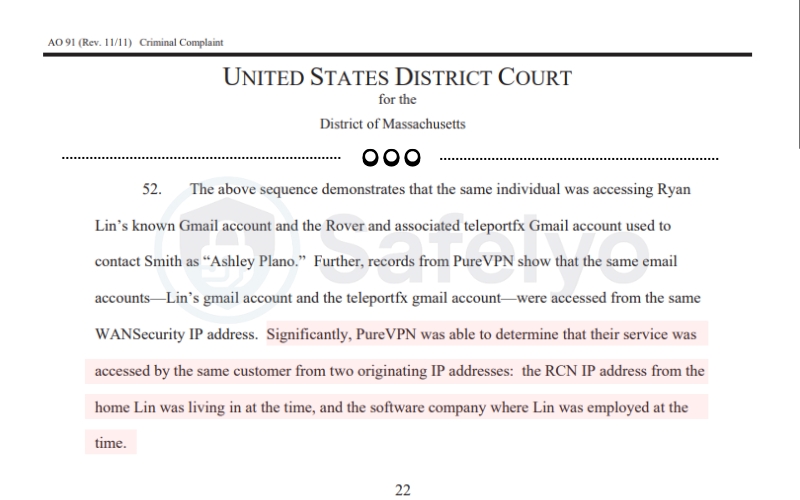
In 2017, PureVPN handed connection timestamps and originating user IP addresses to the FBI during an active cyberstalking investigation. Federal court records revealed that PureVPN tracked user session records despite advertising a zero-logs stance on its website.
Federal investigators used the connection metadata provided by PureVPN to execute a time-correlation attack. The FBI matched the connection timestamps from PureVPN with traffic records obtained from the target user’s home ISP and workplace network.
This matching timestamp evidence directly led to the suspect’s arrest and prosecution. The public court filings proved that retaining connection metadata provides law enforcement with the exact information necessary to identify individual users.
Note: This incident is a historical event from 2017. It represents a past failure and does not reflect PureVPN’s current policies, modern infrastructure, or current verified audit status.
2.2. IPVanish (2016): Providing user IPs to the DHS
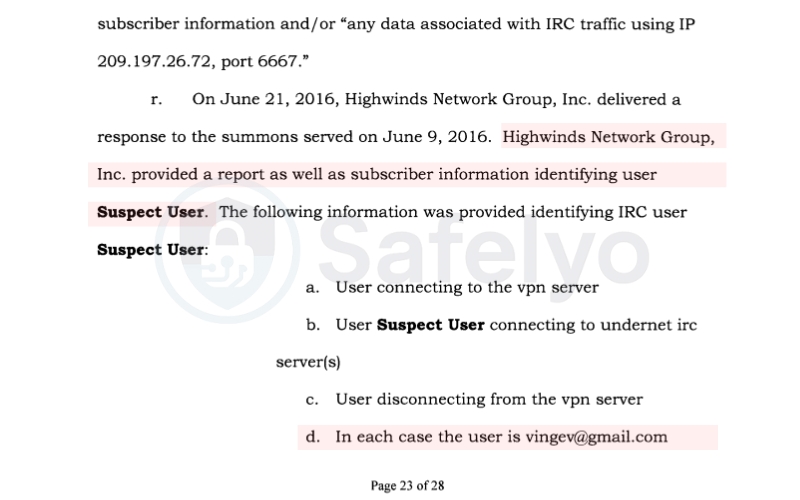
In 2016, Highwinds Network Group, then IPVanish’s owner, provided DHS with a user’s real IP address and connection timestamps during a child-exploitation investigation. At the time of the investigation, IPVanish actively marketed a no-logs policy to all prospective customers.
Court records showed that, after receiving an administrative summons from federal investigators, Highwinds provided subscriber information and connection-related data associated with a specific user.
The information included the user’s real-world IP address and the dates and times when the user connected to and disconnected from an IRC network.
This incident showed that, without independent audits, a VPN provider’s internal data-retention practices may operate in direct opposition to its public marketing claims. The lack of external verification at the time made it difficult for users to determine what information the provider actually retained.
Note: Similar to the PureVPN case, this 2016 incident occurred under previous management. It reflects past infrastructure and does not represent IPVanish’s current operations or modern verified status.
3. How to verify a VPN’s privacy: The 4-step framework
To verify VPN privacy, you should move trust away from marketing claims and rely on external validation.
Confirming that a network truly enforces data non-retention requires checking for independent audits and solid server architecture. The following sections explain how third-party accounting standards, technical testing, and diskless servers protect your data.
3.1. Independent audits: Policy checks (ISAE 3000) vs. Hack tests (Cure53)
When evaluating a third-party security report, you should understand the main differences between audit standards. We compare the two primary forms of independent evaluation below:
- ISAE 3000 (International Standard on Assurance Engagements 3000):
- Accounting firms such as Deloitte, PwC, KPMG, and EY conduct these assurance engagements.
- Auditors review internal access controls, administrative policies, server configurations, and software deployment procedures.
- The resulting report confirms whether the VPN provider’s active infrastructure and operational management align with its written privacy policy.
- Technical Security Audits (Penetration Testing):
- Specialized cybersecurity firms like Cure53 and Securitum execute these technical evaluations.
- Engineers perform source code reviews, attempt exploit injections, and conduct active security attacks against network servers.
- The analysis identifies codebase vulnerabilities, memory leaks, or misconfigured software routines that could accidentally store user traffic.
Ultimately, a trustworthy VPN provider needs both ISAE 3000 audits to confirm policy rules and technical penetration tests to ensure the software itself is secure against data leaks.
3.2. Audit expiration: Why a 3-year-old security report is useless
Security audits provide verification for a single point in time. An audit completed in 2023 offers little privacy assurance years later because server configurations, codebase updates, and corporate ownership structures change over time.
Continuous annual audits are necessary to confirm that software updates or infrastructure changes have not introduced logging routines into active production servers. Regular evaluations ensure that server deployments remain aligned with the published privacy policy.
To meet this modern baseline for trust, leading VPN providers now schedule these evaluations every year. For example, Proton VPN has completed 5 consecutive annual audits conducted by Securitum to maintain verifiable proof of its privacy architecture.
Similarly, NordVPN has completed 6 independent audits performed by Deloitte and PwC to validate its no-logs operations continuously.
3.3. RAM-only servers: The physical hardware barrier
RAM-only server architecture replaces traditional hard disk drives and solid-state drives with volatile random-access memory. Data stored in volatile memory requires continuous electrical power to remain intact on the hardware.
This hardware configuration acts as a physical security barrier against data retention. The operating system and application files run entirely from RAM, loaded from a secure read-only image during the initial boot sequence.
If law enforcement agencies physically remove a RAM-only server from a data center rack, the server loses power instantly. The interruption of electrical current causes all stored session data to evaporate immediately, preventing post-seizure data recovery.
3.4. Warrant canaries & transparency reports
Here are two common mechanisms VPN providers use to publish legal requests and show ongoing compliance:
- Warrant Canary:
- A regularly updated, publicly published statement signed by the VPN provider.
- The document confirms that the VPN provider has not received secret government subpoenas, national security letters, or court gag orders.
- If the warrant canary fails to update or disappears from the site, users can infer that the VPN provider received a confidential order compromising user privacy.
- Transparency Report:
- A public ledger documenting the total number of legal requests, copyright notices, and court subpoenas received by the VPN provider.
- The record details the exact volume of user data requested versus the volume of data handed over to authorities.
- Verified privacy VPN providers consistently record zero data delivered due to non-existent server logs.
While warrant canaries offer a simple passive warning system, public transparency reports are updated more regularly and are now much more widely used by top VPN providers to prove privacy compliance.
4. Real-world proof: Surviving server seizures and court orders
While paper audits verify operational procedures, real-world court orders and physical server seizures show whether a VPN provider actually keeps no logs. These historical events serve as the ultimate proof of a provider’s claims.
The legal cases detailed below demonstrate how verified, zero-logs VPN infrastructures perform during actual government interventions.
4.1. Physical hardware seizures (Mullvad, Windscribe)
When law enforcement bypasses administrative channels and physically seizes server hardware from a data center, local storage drives undergo direct technical analysis. Diskless RAM-only networks ensure that physical hardware extractions yield zero user activity records.
Review the recorded outcomes of physical server seizures in the data table below:
| Provider | Year | Jurisdiction | Law Enforcement Event | Reported Outcome |
|---|---|---|---|---|
| Mullvad | 2023 | Sweden | National Operations Department (NOA) police raid with a search warrant targeting customer data. | Zero data existed; authorities left empty-handed. |
| Windscribe | 2026 | Netherlands | Dutch authorities physically seized a VPN server from a data center rack without a warrant. | RAM-only server yielded zero user logs. |
4.2. Legal subpoenas (The PIA federal court cases)
Federal court subpoenas compel VPN providers to produce historic connection metadata under threat of legal penalties. An inability to comply with a court order confirms that the requested connection records were never stored on the server network.
A prominent example of this legal non-retention involves Private Internet Access (PIA) in the United States. In both 2016 and 2018, the VPN provider received formal FBI subpoenas regarding federal bomb threat and hacking investigations.
During these legal events, the provider confirmed IP address ownership but could produce zero identifying user data to the authorities. This inability to hand over logs proved that their infrastructure did not retain the requested connection metadata.
5. How to spot a fake “no-logs” VPN policy
To identify weak privacy policies, you can look for common red flags in corporate structures and policy terms. Follow this numbered checklist to spot potential privacy issues before choosing a VPN provider:
The Free VPN Paradox:
- Operating global server infrastructure requires capital for bandwidth, server hardware, and routine maintenance.
- Many free VPN providers generate revenue by capturing connection metadata and packaging user activity metrics for sale to third-party data brokers.
- Free VPN providers generally lack the financial resources necessary to fund recurring ISAE 3000 assurance audits by established auditing firms.
Vague Policy Language:
- Be cautious when a privacy policy uses general phrases such as “we do not track what you do online.”
- Legitimate policies explicitly state: “We do not record originating IP addresses, outgoing VPN IP addresses, connection timestamps, or session bandwidth.”
- Ambiguous phrasing allows a VPN provider to claim a “no-logs” policy while quietly recording connection timestamps for internal network management.
Jurisdiction and Surveillance Alliances:
- Check the physical registration location of the VPN provider’s parent company.
- Entities registered in 5/9/14 Eyes Alliance jurisdictions (such as the United States, United Kingdom, Canada, Australia, and New Zealand) operate under intelligence-sharing agreements.
- Local court orders and data-sharing treaties can compel a VPN provider to start logging target accounts, limiting the privacy they can offer.
By checking these three areas before signing up, you can easily filter out deceptive marketing and identify VPN providers that actually prioritize your privacy.
6. FAQs about audited no-logs vs self-claimed no-logs
What does an audited no-logs policy actually mean?
An audited no-logs policy means an independent auditing firm, such as Deloitte or Securitum, conducted a formal inspection of the VPN provider’s infrastructure. The auditors evaluate server configurations, deployment scripts, and access controls to verify that the physical system does not capture connection metadata, IP addresses, or browsing history.
How does corporate ownership impact a VPN’s no-logs policy?
Corporate ownership dictates whether a VPN provider operates independently or answers to parent entities involved in digital advertising or data analytics. For instance, historical questions surrounding NordVPN’s operational ties to Tesonet, along with corporate consolidations under Kape Technologies, highlight why users demand continuous third-party audits to verify operational independence.
Are free VPNs with self-claimed no-logs policies safe?
Free VPNs with unverified no-logs policies present privacy risks. Because operating server infrastructure incurs continuous overhead costs, free VPN providers typically generate revenue by recording connection metadata and selling user activity patterns to third-party data brokers.
Can a VPN provider truly keep zero logs?
In strict technical terms, a VPN provider must process some temporary operational data in RAM to route your traffic and manage server bandwidth. However, a true “zero logs” or “no-logs” VPN provider ensures that no identifying data, such as your real IP address, browsing history, or connection timestamps, is ever written to a permanent hard drive. Once your session ends or the server reboots, all traces of your connection disappear completely.
7. Conclusion
Relying on self-claimed no-logs policies exposes users to technical and legal vulnerabilities, as unverified VPN providers frequently collect connection metadata used in time-correlation attacks.
True digital privacy requires verifiable architecture, including independent ISAE 3000 audits, RAM-only server hardware, and a proven track record of handling legal subpoenas.
Understanding the difference between audited no-logs vs self-claimed no-logs helps you avoid unverified services that put your connection data at risk. Check the date of your current VPN provider’s latest third-party audit and review its public transparency report.
If those documents are missing or outdated, switch to a VPN provider that undergoes continuous annual audits and utilizes diskless hardware to protect user privacy.
If you’re ready to switch to a provider that transparently protects your data, skip the marketing fluff and check out our updated guide to the Best No-Log VPNs. We rank the industry’s top services based strictly on verifiable audits, RAM-only architecture, and court-tested history.
For more practical tips on securing your connection and choosing the right provider, explore our VPN Guides on Safelyo.