
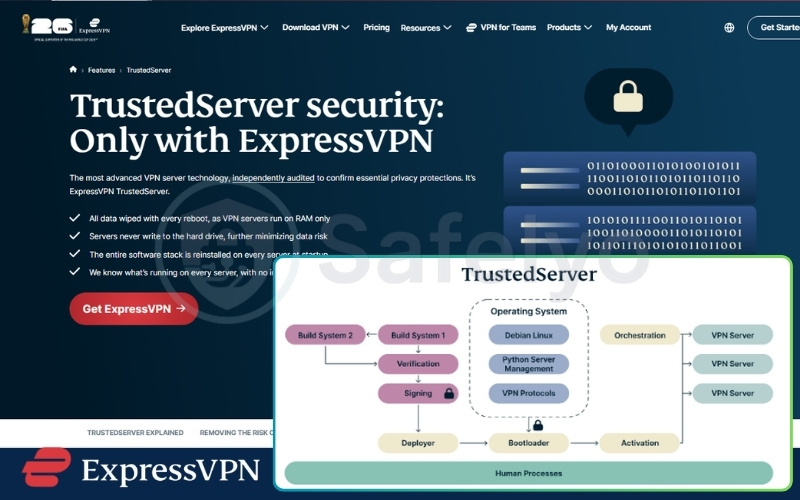
ExpressVPN TrustedServer is a proprietary server architecture that physically prevents data persistence by running entirely on volatile memory (RAM).
When evaluating VPN infrastructure, many users face a significant trust deficit regarding generic no-logs marketing claims. ExpressVPN solves this mechanically, ensuring that user browsing data cannot be permanently recorded or extracted.
In this guide, we will break down exactly how this RAM-only hardware works, explain the mechanics of block-level OS updates, and review the independent audits that verify these claims.
Key takeaways:
- The infrastructure runs exclusively on volatile memory (RAM).
- All data is structurally wiped on every reboot.
- The system utilizes a fresh, verified read-only image to prevent persistent modifications.
1. What is ExpressVPN TrustedServer?
ExpressVPN TrustedServer is a special server design created to protect your privacy. Its main goal is very simple: it ensures that no user data stays on a hard drive.
To do this, the servers run only on volatile memory (RAM). Normal servers use hard drives to save data permanently. TrustedServer completely removes this step, which creates a true zero-knowledge infrastructure. Because the servers do not write to a disk, logging your web traffic becomes physically impossible.
The system also changes how the software loads. Every time a server turns on, it loads everything fresh. It pulls the operating system and VPN software directly from a secure, read-only image.
ExpressVPN built this specific method to stand out from standard servers used across the internet. By running exclusively on RAM, the physical hardware simply cannot hold data after a reboot. This absolute data volatility is the real proof behind the company’s privacy promises.
If you want to see how this proprietary technology stacks up against other major providers, check out our full comparison of ExpressVPN vs PIA.
2. RAM-only architecture: Why hard drives are a security risk
Traditional servers require read and write permissions to a physical hard drive to function properly. Sensitive data, configuration files, and potential hacker backdoors write directly to these disks and persist indefinitely until someone manually overwrites them.
ExpressVPN replaces this traditional storage method entirely with volatile memory. Volatile memory requires continuous electrical power to hold any form of data. If authorities raid a data center and physically pull the server’s power cord, the RAM instantly forgets everything.
While the server still contains a hard drive, it is strictly restricted to read-only access. There is no writable disk space available for investigators or malicious actors to extract user logs from. Because the data physically vanishes the moment the power cycle breaks, the RAM-only architecture guarantees that your browsing history cannot survive a server shutdown.
3. How TrustedServer eliminates the “Tetris” patching vulnerability
The structural difference between standard hardware and ExpressVPN TrustedServer extends deeply into how the operating system is deployed across the network. By fundamentally changing how software updates are applied, the VPN mitigates a major industry-wide security risk. The following concepts illustrate exactly how this methodology compares to standard server management.
3.1. The danger of configuration drift on traditional servers
Traditional server administration relies on loading the operating system, the VPN software, and individual security patches one piece at a time over several years. This process causes configuration drift across the network. Different servers receive different patches at different times, causing pieces to misalign and creating hidden security holes.
This piece-by-piece patching model functions exactly like a game of Tetris. As the blocks stack up over time, the system becomes disorganized and highly vulnerable to zero-day exploits. ExpressVPN identifies this standard practice as a major structural hardware flaw across the VPN industry.
3.2. Block-level reinstallation: Rebuilding the OS on every reboot
To eliminate configuration drift, ExpressVPN TrustedServer loads the entire software stack all at once as a single, unified block. The server does not apply individual patches to an old operating system. Instead, the VPN reinstalls the complete operating system from scratch on every single reboot.
This block-level reinstallation guarantees strict operational consistency. Every single one of ExpressVPN’s global servers runs the exact same, up-to-date, factory-verified codebase every time it powers on.
4. The cryptographically signed read-only image explained
Inside the TrustedServer environment, the hard drive is restricted strictly to holding a cryptographically signed read-only image. The operating system and the installed applications are physically prevented from writing any new data to this drive.
If a hacker breaches the server while it is running and attempts to install a backdoor, the volatile RAM will simply drop the hacker’s malicious code upon the next restart. Because the read-only image is cryptographically signed by ExpressVPN’s private keys, the server physically cannot load altered or corrupted code.
The cryptographic signature forces the server to revert to a pristine, factory-verified state on every reboot. This mechanic effectively locks out persistent threats, ensuring that no unauthorized changes can survive a power cycle.
5. Real-world proof: Does TrustedServer actually work?
To validate these mechanical claims, the TrustedServer architecture has undergone rigorous independent technical audits and financial stress tests. These third-party evaluations provide empirical evidence that the infrastructure functions exactly as designed.
5.1. PwC and Cure53 independent security audits
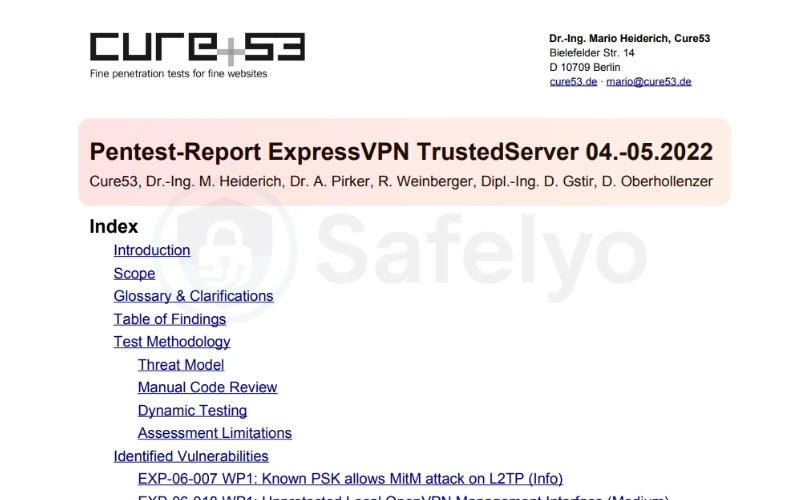
ExpressVPN validates its technical marketing claims through rigorous third-party testing. PricewaterhouseCoopers (PwC) and Cure53 (in 2022) have both independently audited the TrustedServer architecture.
These independent auditing firms reviewed the proprietary codebase and confirmed the essential privacy protections are fully functional. The audits empirically verified that the infrastructure strictly adheres to its zero-logs mandate.
5.2. The $100,000 bug bounty failsafe
ExpressVPN hosts a specific $100,000 one-time bonus award on the YesWeHack platform to further test its infrastructure. This bounty is dedicated specifically to any security researcher who can discover a functional vulnerability within TrustedServer.
This financial commitment represents a high level of corporate confidence in the architecture. By inviting global security researchers to constantly test the read-only image, ExpressVPN actively funds the independent verification of its own servers.
6. FAQs about ExpressVPN TrustedServer technology
Is ExpressVPN still trustworthy?
Yes. While some privacy advocates remain skeptical following ExpressVPN’s acquisition by Kape Technologies, trust in a VPN should be based on hardware mechanics, not corporate promises.
Independent audits from PwC and Cure53 confirm that the TrustedServer architecture physically prevents data logging. Because the servers are restricted from writing data to a disk, the system objectively guarantees user privacy regardless of corporate ownership.
Can you be tracked with ExpressVPN?
No, the VPN uses /dev/null black hole routing and volatile memory to physically prevent IP tracking and logging. Any generated data is immediately dropped and wiped upon reboot.
Are ExpressVPN servers entirely diskless?
While the servers rely on volatile RAM for all operations, they still contain a hard drive. However, this drive is strictly used to hold the cryptographically signed read-only image and cannot be written to.
Does ExpressVPN have DNS leaks?
No, the zero-knowledge infrastructure undergoes continuous leak testing to ensure all DNS requests route securely inside the encrypted tunnel. The server architecture does not allow local DNS queries to bypass the VPN connection.
How does TrustedServer handle unexpected power outages?
An unexpected power outage acts as the ultimate failsafe for a RAM-only server. Because volatile memory requires continuous electricity, any power loss instantly wipes all data, reverting the server to a pristine state when power returns.
7. Conclusion
The structural combination of RAM-only hardware, block-level read-only OS deployments, and independent financial bug bounties clearly validates the no-logs claims behind ExpressVPN TrustedServer. By mechanically removing writable hard drives from the server infrastructure, the VPN guarantees that user browsing data simply cannot be permanently saved or extracted.
The audits by firms like PwC and Cure53 serve as undeniable proof that this technology physically prevents data logging exactly as engineered.
For users looking to understand more about secure network infrastructures, we highly recommend exploring our detailed VPN Guides category and returning to the Safelyo homepage for more comprehensive technical breakdowns.