
VPN companies must obey valid court orders, but they can only hand over data their servers actually store. If a service runs a true no-logs network, it simply tells officers that no browsing history or connection logs exist to turn over. This difference between legal demands and technical limits defines how VPN providers handle law enforcement data requests.
Still, a no-logs policy doesn’t make an account completely invisible. Many services keep basic business records, such as your signup email and payment transaction details. Police can easily subpoena these records from payment processors, which is why your real privacy depends on combining anonymous payment methods with strict server architecture, rather than trusting advertising slogans.
Key takeaways:
- VPN companies are normal businesses that follow local laws, so they don’t operate outside the legal system.
- Police approach VPNs in four steps: informal questions, subpoenas, search warrants, and international treaties (MLATs).
- True no-logs VPNs store zero browsing history, leaving nothing for courts to seize.
- Courts can order a VPN to start prospective logging on a specific account tomorrow, even if the service has no past logs.
- Payment processors like Stripe and PayPal keep your billing records, which can reveal your real identity even if the VPN has no logs.
- Real court cases show big differences: some providers had zero user data to give, while others logged user data for federal agents in the past.
1. How VPN providers handle law enforcement data requests in practice
How a VPN handles an official data request depends on whether the company actually keeps logs. When police knock on the door, the commercial VPN industry divides into three distinct operational groups:
- Standard logging VPNs: Services that openly keep connection records, or operate in jurisdictions with mandatory data retention laws. When served with a valid court order, these providers query their databases and hand over matching connection timestamps and real IP addresses.
- No-logs on paper: Companies that market themselves as zero-log services, but rely on traditional storage drives and quietly maintain internal tracking. When pressured by federal investigators, they enable targeted monitoring scripts or surrender retained connection metadata.
- Architectural zero-data VPNs: Services engineered from the ground up to eliminate persistent storage across their network. When authorities demand user activity, these providers physically have no browsing records, IP translation tables, or session histories to turn over.
Regardless of their internal logging setup, every commercial provider must navigate the same legal escalation process when law enforcement demands user data.
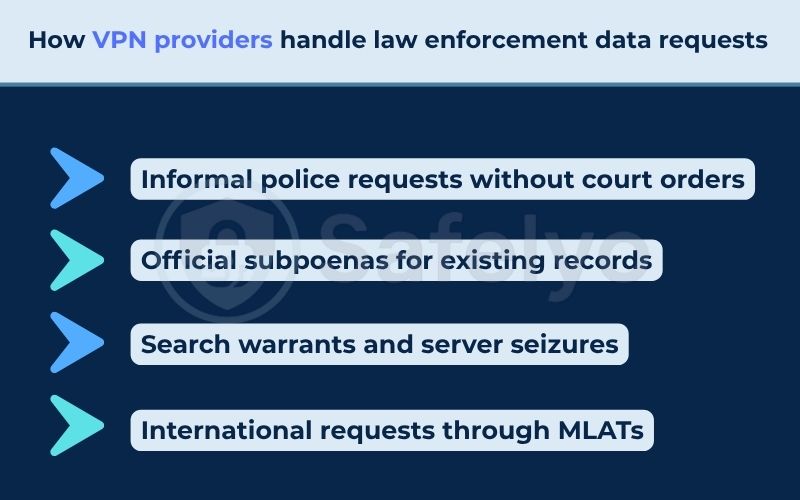
1.1 Informal police requests without court orders
Informal police requests have no legal power, so commercial VPN companies reject them right away. These requests usually arrive as casual emails or phone calls from detectives asking for subscriber details without a judge’s signature. Police are simply testing to see if the VPN will share data willingly.
Handing over customer data without a binding court order violates data privacy laws like the European Union’s GDPR, exposing the company to massive statutory fines. Standard protocol requires legal counsel to issue a formal rejection letter, demanding that officers present a valid court order.
1.2 Official subpoenas for existing records
A subpoena legally compels a company to surrender existing business records under penalty of perjury, though it cannot force engineers to create new tracking data. In an active investigation, prosecutors use subpoenas to demand every piece of identifiable information linked to an account.
When responding, a VPN provider claiming a no-logs policy cannot simply dismiss the demand. While the company may certify to the court that it possesses no traffic destinations or browsing records, it remains legally obligated to turn over any retained administrative data.
This routinely includes account registration timestamps, customer email addresses, and payment transaction identifiers, which investigators use to trace the subscriber through financial institutions.
1.3 Search warrants and server seizures
A search warrant gives police the legal right to enter a company’s property and take computer hardware after establishing probable cause before an independent judge. Judges only sign search warrants when investigators prove there is a reasonable basis to believe evidence of a crime sits on the servers. Police can visit offices or datacenters to seize hard drives, servers, and network routers.
Courts often add gag orders to these warrants, which stop the VPN from telling users about the raid. At this point, your privacy depends on hardware design: standard hard drives hold saved data, but RAM-only servers lose everything once officers pull the power cord.
1.4 International requests through MLATs
Police in one country can’t directly use their local court orders to demand data from a VPN based in another country without a Mutual Legal Assistance Treaty (MLAT). If the FBI wants data from a VPN based in Sweden, Switzerland, or Panama, they can’t simply send an American warrant. Instead, investigators must start an official treaty process through their home government.
The MLAT process follows four basic steps:
- Local investigators ask their country’s justice department to help.
- The home justice department sends the request to the host nation’s government.
- Host officials check if the action is considered a crime in both countries (dual criminality).
- If approved, a local court in the host country orders the VPN to share what it has.
This process costs governments a lot of money and takes months or even years. Because of that, countries only use it for major crimes like cyberattacks, human trafficking, or large-scale money laundering.
2. What user data can a VPN hand over in court?
In court, a VPN can only hand over the specific pieces of information it actually stores on its systems. This separates corporate compliance from technical capability: a provider can appear before a judge with full willingness to cooperate, but it cannot produce records that its infrastructure never recorded in the first place.
Depending on their technical architecture, the data VPNs can surrender falls into two distinct categories:
Network data that cannot be surrendered (for true no-logs VPNs):
- Browsing history and DNS queries: Modern servers run software compiled with logging permanently disabled at compile-time on stateless, diskless operating systems, causing session data to self-terminate when the connection ends.
- Real IP to assigned IP mappings: Systems discard incoming and outgoing connection pairings instantly from memory, leaving no historical translation logs.
- Shared IP allocation tables: Hundreds of users share identical outgoing server IP addresses simultaneously. Without saved port allocation or NAT mapping tables, investigators cannot match an external port back to an individual account.
Account data regularly surrendered (The account blindspot):
- Registration details: Active customer email addresses, account creation timestamps, and account subscription tiers.
- Payment identifiers: Transaction reference numbers, payment processor tokens, and subscription renewal dates.
A verified no-logs VPN can appear before a judge fully cooperative and willing to comply with the law, but its only truthful technical response is that the system simply does not store the requested network data.
If you want a clear definition of how providers classify user data under these rules, read our full breakdown of a no-logs policy.
3. Can a court force a no-logs VPN to spy on you tomorrow?
Yes, courts in many jurisdictions can legally issue prospective logging or wiretap orders that force a company to monitor a targeted account moving forward. While a judge cannot compel a provider to hand over past logs that were never saved, domestic laws can require engineers to capture targeted traffic starting from the date of the order.
This legal reality clashes directly with a no-logs setup. If served with a legally binding order under a gag mandate, an operator could theoretically be forced to inject packet-monitoring tools into live memory or mirror traffic upstream, even on a RAM-only server.
However, modern zero-log services rely on automated, tamper-evident deployment pipelines and regular independent audits, making secret modifications difficult to hide. When faced with an unavoidable legal demand to spy on its users, a reputable privacy provider will challenge the order in court or shut down its server operations in that jurisdiction entirely.
4. How police track VPN users through payment records
Police track VPN users through banks and payment companies by matching purchase times against billing databases. When a VPN confirms that it keeps zero connection logs, investigators don’t stop their search. Instead, they look at the payment method you used to buy your subscription.
Payment companies like Stripe and PayPal keep detailed records whenever you buy something online. These payment systems save:
- Your real name and home billing address.
- Your bank account details and transaction numbers.
- The real IP address you used when you checked out.
When investigators hit a dead end with server logs, they pivot from the VPN’s account database to the payment processor, subpoenaing Stripe or PayPal using the transaction ID or account timestamp tied to your subscription. Through this financial subpoena, officers can obtain your billing name, credit card details, and home IP address.
To avoid this risk, you can choose VPNs that use random account numbers without an email address, send cash in the mail, or pay with Monero (XMR). These payment options are completely legal ways to protect your privacy, but make sure to check your provider’s terms and follow your local tax laws.
5. Warrant canaries vs. transparency reports
A warrant canary is an early, legacy privacy experiment where a provider publishes a periodic note stating it hasn’t received secret police requests or gag orders. It relies on a legal rule against forced speech: the law might stop a company from talking about a secret warrant, but it usually can’t force the company to lie. Staff sign these notes with their private PGP security keys (which users verify using the company’s published public key) and update them on a regular schedule.
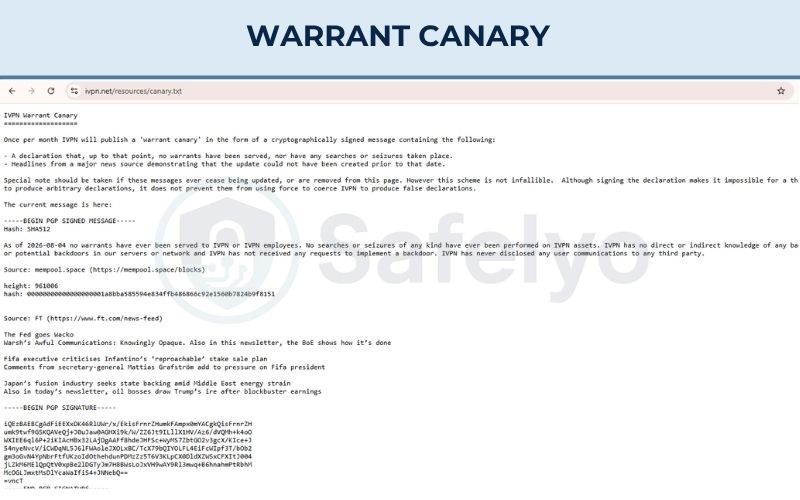
If the canary notice disappears or isn’t updated, users assume that the company received a secret order. But canaries have real weak points:
- Workers might forget to update the file on time, which creates false alarms.
- Courts might still try to force a company to keep the canary online.
- A missing canary doesn’t tell you what kind of data the police actually asked for.
Because of these weaknesses, this early experiment has largely been replaced by regular transparency reports backed by independent Big 4 accounting audits. A transparency report lists every legal inquiry a company receives from governments, courts, and copyright owners, showing the exact number of requests and confirming whether any data was shared.
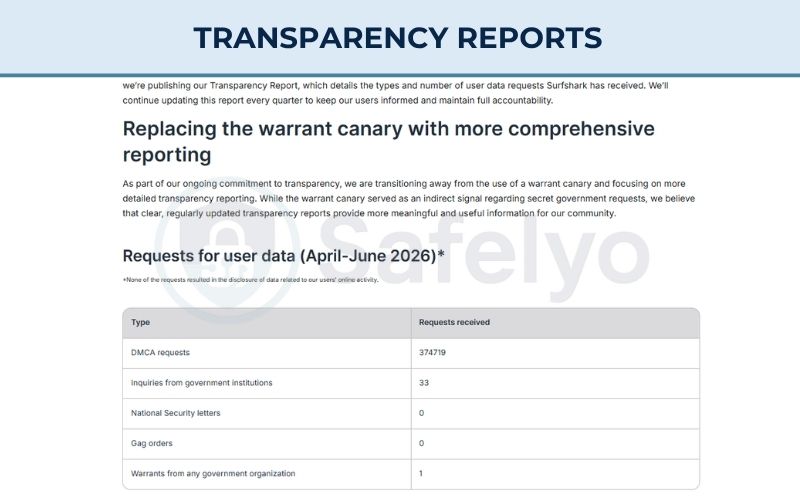
Brands like NordVPN have moved toward these verified reports to give users concrete, audited proof instead of relying on a passive canary. Published industry records show that criminal police requests make up less than 1% of all inquiries, while automated copyright complaints (DMCA) make up more than 99%.
6. RAM-only defense: How diskless servers stop physical raids
RAM-only servers protect your data during police raids because they run everything in temporary memory that wipes completely when the power goes out. When police enter a server room with a search warrant, the physical hardware determines whether they can recover your data.
6.1 Why traditional disk-based servers leave recoverable data
Standard hard drives and solid-state drives leave data behind in swap files, temporary folders, and unallocated storage blocks. Even if an engineer sets up a server to delete logs right away, standard operating systems still write temporary files to the disk. These background tasks leave hidden traces behind.
Police forensic teams can clone the entire drive to recover residual connection logs, swap file fragments, and plaintext configuration certificates left behind by legacy protocols like OpenVPN. If a server uses traditional storage drives, deleted data and encryption traces aren’t truly gone.
6.2 How RAM-only (diskless) architecture works
Diskless servers load their entire operating system directly into short-term memory (RAM) using a read-only setup. These servers don’t use local hard drives or flash storage, so the system can’t save permanent files. As soon as officers unplug the server from the rack, all electrical power drops, and the memory chips lose all data within seconds.
Keep in mind that renting servers from third-party datacenters still brings some risk. If datacenter workers tap the network cables outside the server rack, outsiders could monitor web traffic before it reaches the RAM-only hardware.
7. Real court cases that tested VPN no-logs claims
Real court records show whether a VPN truly keeps no logs, proving that real-world tests matter much more than marketing claims.
The table below outlines four major cases where federal agencies tested VPN privacy claims in real investigations:
| Provider | Jurisdiction | Hardware type | Court precedent | Verified outcome | Stored account data |
|---|---|---|---|---|---|
| Private Internet Access (PIA) | United States (5 Eyes) | Disk-based with /dev/null config (RAM-only since 2020) | Subpoenas from FBI (2016, 2018) | Zero logs produced; confirmed by federal court dockets | Email address, payment transaction ID |
| Mullvad VPN | Sweden (14 Eyes) | RAM-only diskless nodes | Physical search warrant (April 2023) | Zero data seized; Swedish police left empty-handed | Random 16-digit account token only |
| IPVanish (Former management) | United States (5 Eyes) | Traditional disk storage | DHS summons (May 2016) | Logged and surrendered source Comcast IP and timestamps | Complete user profile, billing records |
| PureVPN | Hong Kong (2017 case) / British Virgin Islands (Current) | Traditional disk storage | FBI investigative warrant (October 2017) | Surrendered connection logs linking suspect’s physical IPs | Email address, customer payment trails |
Looking closer at these real cases shows how different server designs hold up against actual federal investigations.
Please keep in mind that these court cases happened in the past and don’t guarantee how these services operate today. VPN companies often update their privacy policies, upgrade to diskless servers, or change corporate ownership over time. Don’t assume a provider that previously logged data still does so today, or that a service with a clean past record will stay safe without ongoing independent audits.
7.1 Court-proven integrity
Court cases involving Private Internet Access proved that the service kept no usable data for criminal investigators. In 2016, during an FBI criminal investigation into hoax online bomb threats sent by suspect Preston McWaters, federal agents subpoenaed PIA for IP connection records. Court affidavits confirmed that PIA had no records to share because it configured its network to dump all connection data straight to /dev/null.
The FBI sent another subpoena to PIA in 2018 during a major hacking case, and the company produced zero records once again.
In April 2023, six Swedish police officers raided the Gothenburg offices of Mullvad VPN with a search warrant linked to a German cybercrime case. Mullvad staff showed that the service doesn’t ask for emails or keep connection logs. After checking the systems, the officers saw there was no customer data to take and left without taking any equipment.
7.2 Marketing vs. reality
In May 2016, the US Department of Homeland Security (DHS) sent a legal summons to IPVanish during a criminal case. Even though IPVanish advertised a strict no-logs policy, its former owner, Highwinds Network Group, agreed to help investigators. Management set up a special system to log the suspect’s connection times and home Comcast IP address, then handed those records over to federal agents.
A similar case happened in October 2017 during the prosecution of cyberstalker Ryan Lin. PureVPN claimed that it never tracked user actions. However, an FBI arrest document revealed that PureVPN shared connection logs showing the suspect’s home and work IP addresses, which led directly to his arrest.
8. How to choose a VPN that can actually protect you legally
Choosing a safe VPN means looking at how the service builds its servers, who owns it, and how it handles real court cases.
Use this quick checklist to match a VPN with your personal privacy goals:
- If you want to keep your traffic private: Pick a provider that uses 100% RAM-only servers and has proven its zero-log claims in court or through independent audits by major accounting firms.
- If you don’t want payment records tied to your name: Pick a VPN that gives you an account without an email address, and pay with cash or Monero (XMR).
- If you worry about foreign government reach: Choose a company based in a country with strong privacy laws and no rules that force companies to save data.
- If you want regular updates: Pick a service that publishes regular transparency reports and signs its security updates with verified keys.
Before you sign up, check these four basic points:
- Jurisdiction: Make sure the company is based outside countries that force VPNs to save user data.
- Hardware: Check that all servers run entirely on diskless RAM.
- Audits: Look for regular security audits from trusted firms like Cure53, Deloitte, or PwC.
- Account privacy: Confirm that the company doesn’t ask for personal details when you register.
Always separate your real identity from your privacy tools. Don’t use your personal email or daily credit card when you buy a VPN.
9. FAQs
Can the FBI or police track an active VPN connection in real time?
Yes. Law enforcement agencies can identify active connections using traffic correlation techniques rather than breaking the underlying encryption. By comparing the timing and data packet volume leaving a user’s home network with the traffic entering a target website, investigators can statistically connect the user to the destination.
What happens to a VPN company if it refuses a valid court order?
A VPN company that refuses a valid domestic court order faces contempt of court proceedings, compounding financial fines, and potential asset freezes. Corporate officers may face criminal charges or arrest warrants, and authorities can legally seize local infrastructure to force compliance.
Does a warrant canary guarantee that a VPN is safe?
No. A warrant canary is an unverified signal rather than a technical safeguard. Providers can fail to update the canary due to routine administrative errors, and courts in certain jurisdictions can legally compel companies to leave the notice online under sealed gag orders.
Can police track a VPN user through their payment methods?
Yes, police often track VPN users by sending subpoenas directly to payment processors like Stripe, PayPal, or credit card companies. These payment services keep your real name, home billing address, and the IP address you used during purchase. Investigators then match the payment time with server records to find out who owns the account.
What is the difference between a warrant canary and a transparency report?
A warrant canary is a passive notice stating that a company has not received secret government orders. A transparency report is an active disclosure that itemizes the exact number, category, and outcome of legal requests and subpoenas received over a specific reporting period.
Can a VPN provider be forced to shut down instead of logging users?
Courts typically issue orders to enforce compliance rather than mandate a business shutdown. However, a provider can voluntarily choose to cease operations or withdraw its physical hardware from a specific country to avoid complying with a local data retention or surveillance order.
10. Conclusion
A VPN’s privacy depends on how the company sets up its network rather than what it claims in advertisements. Servers that run only on temporary memory lose their stored data whenever technicians turn them off. Because of this setup, a provider can follow a court order while having no activity logs or connection records to hand over.
Even so, a server cannot protect your identity if you buy a subscription with a personal credit card or an everyday email address. Knowing how VPN providers handle law enforcement data requests helps you pick services that back up their claims with independent audits and clear court records.
You can read more about tested server setups and privacy tools in the VPN Guides section on Safelyo.