
If you are trying to decide between NordLynx vs Lightway, the choice really comes down to how you use your devices every day. From our experience evaluating these technologies, Lightway is the superior choice for mobile battery efficiency and seamless network handovers. On the other hand, NordLynx delivers higher, more consistent download speeds and lower latency for heavy desktop use.
Both of these protocols were built from scratch to fix a major problem in the cybersecurity industry. Older protocols like OpenVPN are burdened by massive codebase bloat and latency issues, making them slow and battery-draining. To solve this, NordVPN exclusively developed NordLynx, while ExpressVPN engineered Lightway.
To help you cut through the marketing claims and find the best fit for your workflow, we have compiled our 2026 performance metrics and technical analysis into a clear breakdown below.
Key takeaways:
- NordLynx provides faster, more consistent download speeds and lower gaming latency across long and short distances.
- Lightway excels in battery efficiency and seamless network handovers for mobile users.
- Lightway natively supports TCP for bypassing rigid network firewalls, whereas NordLynx relies entirely on UDP.
- Both protocols integrate post-quantum cryptography (ML-KEM) to protect user data against future quantum computing threats.
1. NordLynx & Lightway explained
Developers engineered both protocols from the ground up to solve fundamental problems in computer networking. Older protocols like OpenVPN run on massive codebases containing hundreds of thousands of lines. This bloat creates significant VPN protocol overhead, resulting in battery drain and high latency.
NordLynx and Lightway utilize modern cryptographic standards and drastically smaller code footprints to route traffic faster. The table below outlines the core structural differences between the two technologies.
| Feature / Specification | NordLynx (NordVPN) | Lightway (ExpressVPN) |
|---|---|---|
| Architectural Base | WireGuard fork + Double NAT | Custom ground-up build (Rust) |
| Codebase Size | ~4,000 lines | ~1,000 – 2,000 lines |
| Primary Cryptography | ChaCha20 / Poly1305 | AES-256-GCM & ChaCha20 (via wolfSSL) |
| Post-Quantum Encryption | Yes (ML-KEM added in 2025) | Yes (ML-KEM native standard) |
| Transport Protocol | UDP only | UDP & TCP |
| Obfuscation / Stealth | No (Requires NordWhisper fallback) | Yes (Lightway TCP) |
| Open-Source Status | No (Proprietary NAT layer) | Yes (Fully audited) |
1.1. What is NordLynx?
NordLynx is NordVPN’s custom-built protocol designed to maximize connection speeds without compromising digital privacy. Instead of building an entirely new framework, NordVPN used the highly efficient, open-source WireGuard protocol as its foundation.
WireGuard is famous for its lightweight architecture, but it natively requires storing static IP addresses on the server. Because this logging requirement poses a severe privacy risk for zero-log VPN providers, NordVPN layered a proprietary Double NAT (Network Address Translation) system on top of it.
This innovative combination delivers the raw speed of WireGuard while ensuring no identifiable user data is permanently stored on the VPN servers. By maintaining a lean codebase of just 4,000 lines, NordLynx significantly reduces CPU load compared to legacy protocols.
This allows users to experience rapid connection times, extended device battery life, and seamless performance during high-bandwidth activities like 4K streaming or large file transfers.
1.2. What is Lightway?
Lightway is a custom VPN protocol engineered entirely from scratch by ExpressVPN to deliver a highly reliable, always-on networking experience. Instead of borrowing existing frameworks like OpenVPN or WireGuard, ExpressVPN developers wrote Lightway utilizing the thoroughly audited wolfSSL cryptography library.
To further maximize security, the entire protocol was recently rewritten using the memory-safe Rust programming language. This ground-up approach resulted in an incredibly lean protocol consisting of roughly 1,000 to 2,000 lines of code.
Because the footprint is so small, Lightway is specifically optimized for mobile devices and users who frequently travel. It allows for instant network reconnections, significantly lower battery consumption, and automatic obfuscation to bypass network censorship.
Furthermore, Lightway operates as a fully open-source project. This allows independent cybersecurity firms to audit the code regularly to mathematically verify its safety and performance claims.
2. Comparison table: NordLynx vs Lightway
Here is a quick summary of how NordLynx and Lightway compare across the most critical performance categories:
| Category | Winner | Summary / Reasoning |
|---|---|---|
| Speed & Throughput | NordLynx | NordLynx retains significantly higher and more consistent download and upload speeds across both local and long-distance routing. |
| Gaming Ping & Latency | NordLynx | NordLynx delivers consistently lower ping across all tested regions (41.67 ms to 179.33 ms), whereas Lightway suffers from massive local latency spikes (up to 119.67 ms). |
| Architectural Foundations | Lightway | Lightway utilizes a complete Rust rewrite, which provides superior memory safety and a smaller attack surface compared to a forked WireGuard base. |
| Cryptography & Future-proofing | Tie | Both protocols successfully implement Post-Quantum ML-KEM (Kyber) to protect against “Harvest Now, Decrypt Later” quantum computing attacks. |
| Mobile Handovers & Battery | Lightway | Lightway integrates ground-up coding and NAT heartbeats to preserve battery life and keep connections alive during active network transitions (e.g., Wi-Fi to 5G). |
| Restrictive Networks (Firewalls) | Lightway | Both require a manual settings change to bypass strict firewalls. However, ExpressVPN users only need to switch to Lightway’s built-in TCP variant, while NordVPN users must abandon NordLynx and switch to an entirely different protocol (NordWhisper). |
3. Speed & throughput benchmarks
OVERVIEW: NordLynx consistently outperforms standard Lightway UDP across both local and long-distance connections, delivering highly stable throughput capable of handling intense bandwidth demands on multiple devices simultaneously.
Winner: NordLynx
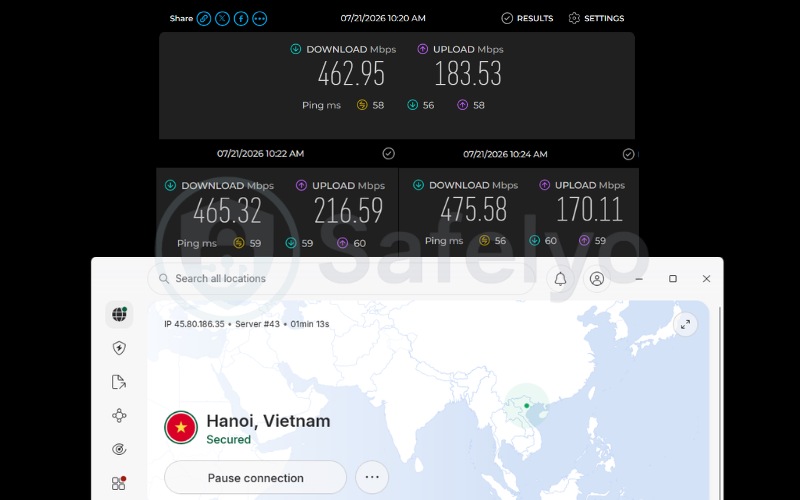
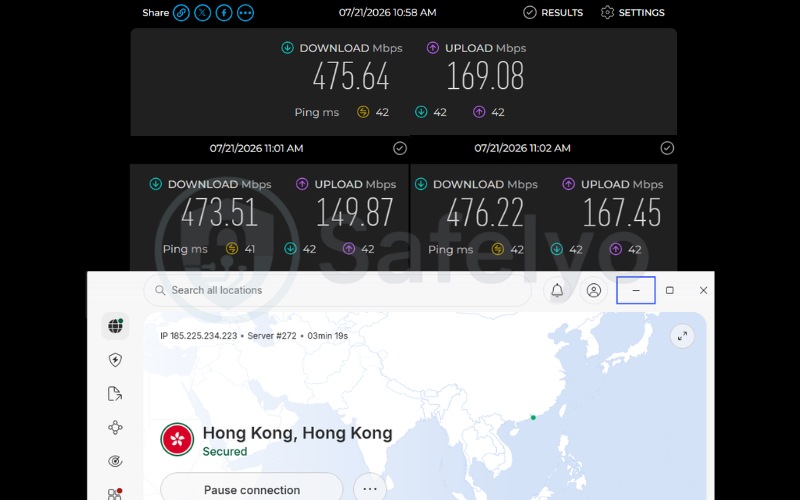
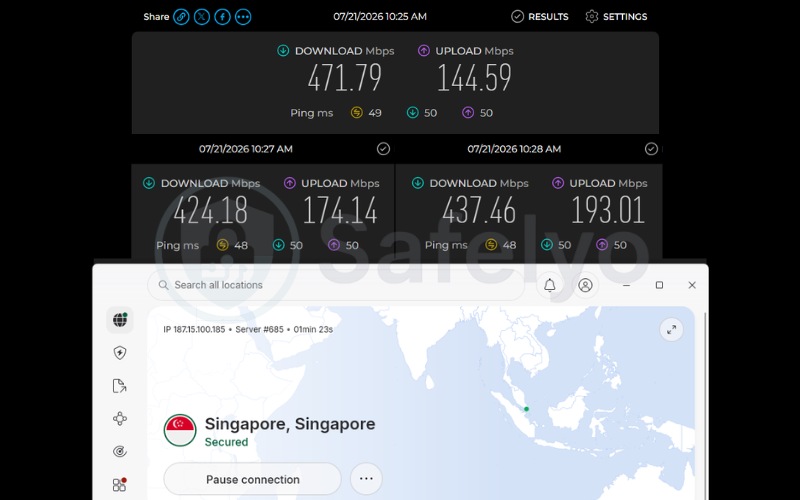
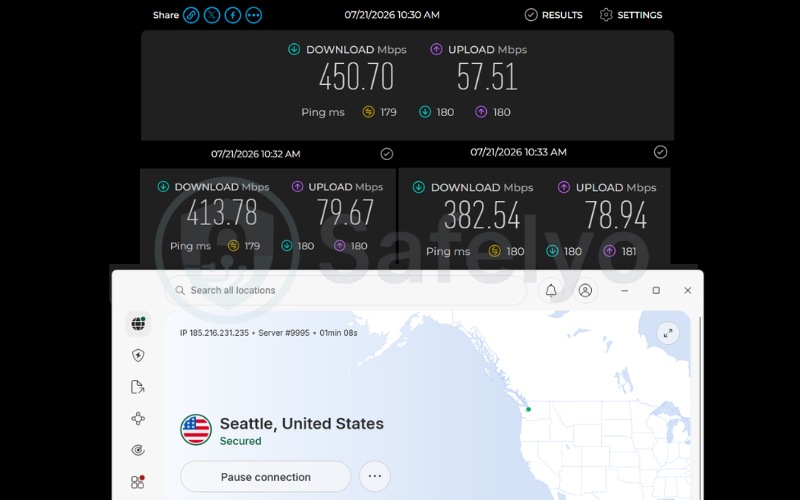
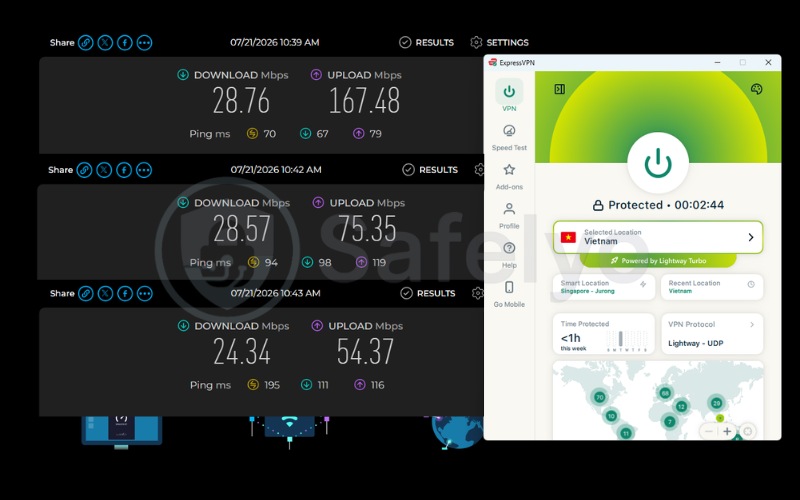
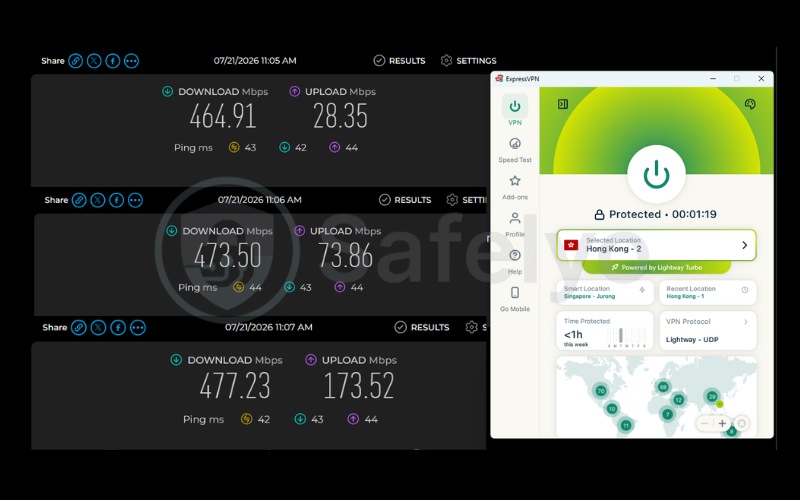
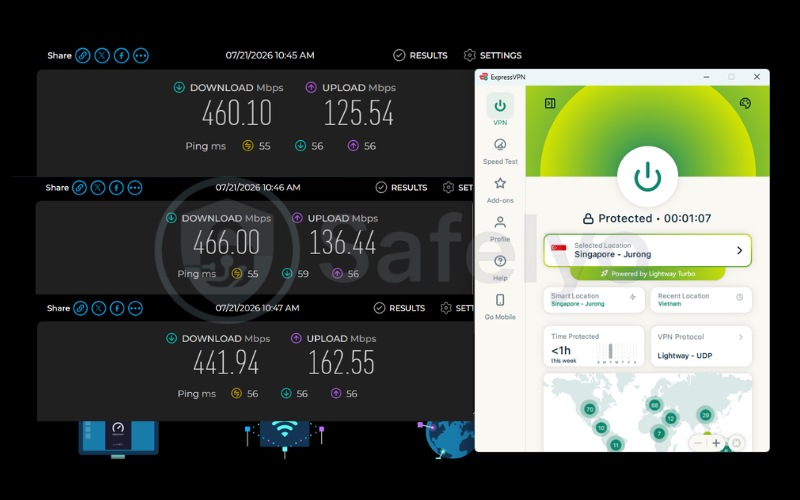
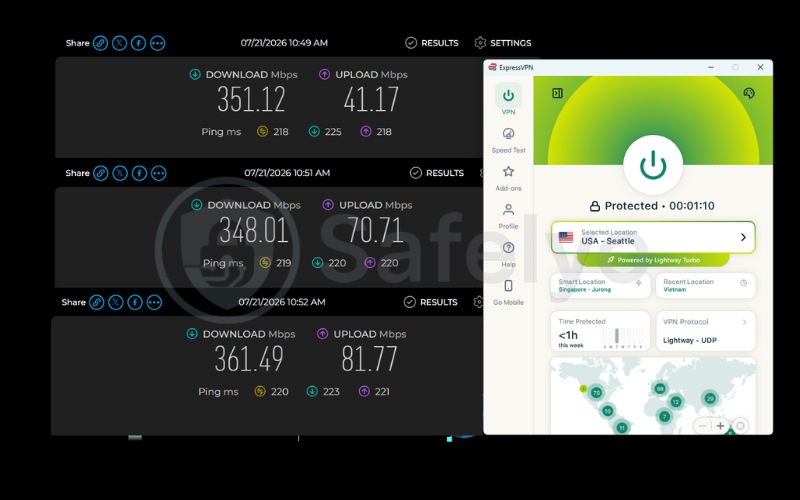
We conducted all speed tests on the exact same day, July 21, 2026, within a continuous timeframe. We tested one protocol immediately after finishing the other to ensure identical network conditions. We ran three consecutive tests per protocol for each selected region on a Windows 11 PC.
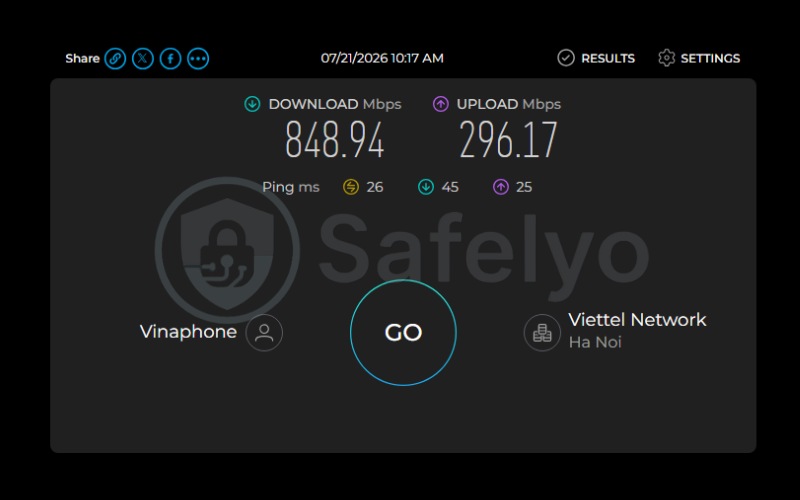
The baseline connection recorded 848.94 Mbps download and 296.17 Mbps upload. We tested one local region in Vietnam, two nearby regions in Singapore and Hong Kong, and one long-distance region in the US.
We deliberately tested a second nearby region in Hong Kong to investigate a specific anomaly. Lightway recorded an unusually low local speed in Vietnam, prompting the need to verify if the throttling issue persisted across other close-proximity Asian routing.
| Server Location | Protocol | Avg. Download (Mbps) | Avg. Upload (Mbps) | Avg. Ping (ms) |
|---|---|---|---|---|
| Baseline (No VPN) | None | 848.94 | 296.17 | 26.00 |
| Local (Vietnam) | NordLynx | 467.95 | 190.08 | 57.67 |
| Local (Vietnam) | Lightway UDP | 27.22 | 99.07 | 119.67 |
| Nearby (Hong Kong) | NordLynx | 475.12 | 162.13 | 41.67 |
| Nearby (Hong Kong) | Lightway UDP | 471.88 | 91.91 | 43.00 |
| Nearby (Singapore) | NordLynx | 444.48 | 170.58 | 48.33 |
| Nearby (Singapore) | Lightway UDP | 456.01 | 141.51 | 55.33 |
| Long-distance (US) | NordLynx | 415.67 | 72.04 | 179.33 |
| Long-distance (US) | Lightway UDP | 353.54 | 64.55 | 219.00 |
NordLynx maintained highly stable download speeds ranging from 444.48 Mbps to 475.12 Mbps across our tested Asian servers (Vietnam, Singapore, and Hong Kong). This provides more than enough bandwidth for 4K video streaming, heavy file downloads, and multi-player gaming simultaneously.
Even when routing traffic further away, the distant US server running NordLynx maintained a strong 415.67 Mbps download speed. This proves the NordVPN technology handles long-distance data transfers with minimal degradation.
In contrast, Lightway experienced a severe performance anomaly on the local Vietnam connection. The ExpressVPN routing plummeted to a mere 27.22 Mbps download, representing a massive drop from the 848 Mbps baseline. This unexpected throttling limits users to basic web browsing or 4K streaming on a single device.
However, the ExpressVPN protocol performed much better when routing traffic outside of Vietnam.
The connection speeds recovered significantly on the Singapore and Hong Kong servers, stabilizing at roughly 456 Mbps and 471 Mbps respectively. When evaluating long-distance routing, Lightway managed a respectable 353.54 Mbps on the US server.
While Lightway proved fast on these specific routes, NordLynx wins this category because it delivers reliable, high-speed throughput regardless of the server location.
4. Gaming ping & latency
OVERVIEW: NordLynx maintains much tighter latency control across varying distances, making it suitable for casual gaming and video conferencing, whereas Lightway suffers from unpredictable local ping spikes.
Winner: NordLynx
Latency, commonly referred to as ping, measures the exact millisecond delay between your physical click and the resulting on-screen action. A lower number means a more responsive connection, which is absolutely vital for interactive tasks.
NordLynx registered a highly consistent 41.67 ms in Hong Kong to 57.67 ms in Vietnam during our tests. Lightway achieved 43.00 ms in Hong Kong but spiked massively to 119.67 ms on the local Vietnam server.
Lightway also lagged behind at 219.00 ms on the long-distance US connection compared to NordLynx’s 179.33 ms.
The 41 ms to 50 ms latency range achieved by both protocols on optimal nearby servers ensures smooth casual gaming and video conferencing without noticeable input lag. Neither protocol hit the sub-20 ms threshold required for professional first-person shooter gaming on these routes.
Lightway’s 119.67 ms local ping falls squarely into the slow-paced gaming and web browsing bracket. This level of delay creates a noticeable hesitation between your commands and the server response, making it entirely unsuitable for fast-paced applications on that specific routing.
5. Architectural foundations: WireGuard fork vs. custom Rust build
OVERVIEW: While NordLynx patches WireGuard’s inherent privacy flaws with an intelligent secondary IP assignment system, Lightway’s modern Rust rewrite provides an inherently safer, fully audited software foundation.
Winner: Lightway
Understanding how these VPNs operate behind the scenes requires looking at their foundational code. The approach each provider took to build their protocol dictates everything from daily privacy maintenance to underlying vulnerability management.
5.1. NordLynx: Securing WireGuard with Double NAT
NordVPN built NordLynx on top of the WireGuard framework. The standard WireGuard framework naturally logs static IPs, creating a privacy risk for zero-log providers.
NordVPN solved this by engineering a custom Double NAT system. The Double NAT system assigns a shared burner IP to everyone on the server simultaneously.
The system then dynamically generates a second unique IP for the specific tunnel session. This means even if authorities physically seize a server, specific web traffic remains mathematically untraceable back to a single user account.
5.2. Lightway: The shift to Rust for memory safety
ExpressVPN took a fundamentally different structural approach. Lightway features a minimal footprint running on approximately 1,000 to 2,000 lines of code. This is significantly smaller than the 4,000 lines required by NordLynx.
The developer team executed a complete transition to a Rust codebase. This programming shift automatically eliminates human errors and memory-safety vulnerabilities associated with traditional C programming.
Removing these memory vulnerabilities drastically shrinks the attack surface and makes the protocol significantly easier for third parties to audit.
6. Cryptography & future-proofing (Q-Day)
OVERVIEW: Both protocols utilize highly efficient ciphers for mobile processors and have proactively integrated next-generation NIST standards to defeat quantum computing threats.
Winner: Tie
To fully appreciate this cryptographic resilience, it is necessary to examine the specific ciphers powering these connections. Both protocols utilize unique mathematical algorithms to balance device performance with cutting-edge data protection.
6.1. ChaCha20 vs. AES-256 efficiency
NordLynx operates entirely on the ChaCha20 cipher. This specific cryptographic algorithm requires significantly less CPU processing power than traditional AES encryption.
Lower processing demand directly benefits older smartphones by reducing heat generation and battery drain during extended sessions.
Lightway utilizes the FIPS 140-2 validated wolfSSL library.
This integration gives Lightway the advanced flexibility to switch automatically between AES-256-GCM and ChaCha20 depending on the specific device’s hardware acceleration capabilities. This dual-cipher approach optimizes the performance metric per device automatically.
6.2. Post-quantum protections (ML-KEM / Kyber)
Both providers recently integrated ML-KEM (Kyber) into their protocols. This specific mathematical upgrade protects your daily internet traffic against the imminent threat of quantum computing.
Right now, cybercriminals are capturing and storing encrypted data they cannot currently read, waiting for the day quantum computers become powerful enough to break standard encryption. The ML-KEM integration completely thwarts this “Harvest Now, Decrypt Later” strategy utilized by advanced threat actors.
If a malicious entity intercepts and stores your banking or communication data today, they will not be able to crack it open a decade from now. Both NordLynx and Lightway ensure your historical data remains permanently locked away.
7. Mobile network handovers & battery efficiency
OVERVIEW: Lightway’s proprietary network transitioning architecture prevents complete disconnections, delivering superior battery life and uninterrupted background application data for mobile users.
Winner: Lightway
Compared to legacy protocols like OpenVPN and IKEv2, both NordLynx and Lightway are incredibly lightweight and highly efficient at preserving your device’s battery life during continuous background operation. However, when it comes to mobile devices constantly switching between networks, Lightway has a distinct advantage.
When you step into an elevator and lose your Wi-Fi connection, standard protocols view this network drop as a complete failure. This forces your phone’s processor to continuously burn battery power as it tries to rebuild the VPN tunnel from scratch.
Lightway prevents this exhausting cycle by pausing the connection gracefully in an “Idle State.” While idle, it sends tiny NAT heartbeats to the server every few seconds to keep the session alive. This structural difference ensures the connection stays masked, allowing applications like WhatsApp to seamlessly sync and receive push notifications the exact moment your phone hands over to a 4G or 5G mobile network.
8. Restrictive networks & firewall evasion (TCP vs UDP)
OVERVIEW: Lightway is the clear winner for restrictive networks because it features a native TCP variant designed specifically for firewall evasion. While NordVPN can also bypass strict networks, it requires users to completely abandon NordLynx and switch to a different protocol (NordWhisper).
Winner: Lightway
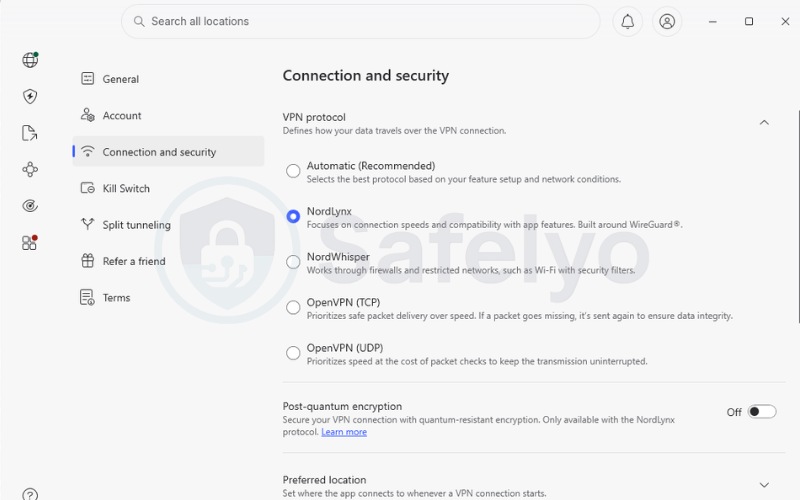
Deep Packet Inspection (DPI) analyzes the digital fingerprint of internet traffic to block specific protocols. Because NordLynx relies exclusively on UDP transport, which prioritizes speed over stealth, it struggles on restrictive corporate, hotel, or airport Wi-Fi networks where administrators actively block UDP traffic.
To maintain a connection on these rigid networks, Lightway allows users to effortlessly toggle to its built-in Lightway TCP variant. TCP mimics standard HTTPS web traffic, enabling the VPN to successfully punch through firewalls without triggering network alarms, all while keeping you on the Lightway architecture.
In contrast, NordLynx lacks native obfuscation. If you face connectivity blocks with NordVPN, you cannot use NordLynx at all. You must manually switch your app settings to the NordWhisper protocol to restore your access.
9. Troubleshooting common protocol errors
Even the most refined networking technologies occasionally encounter software conflicts or environmental blocks. When connections fail, applying precise system-level adjustments or utilizing built-in protocol toggles can quickly restore full functionality without requiring a complete application reinstall.
9.1. Fixing the “Failed to reach NordLynx adapter” error
Users operating the NordVPN application on Windows may occasionally encounter a “Failed to reach NordLynx adapter” error message. This issue typically occurs when the virtual network adapter experiences a software conflict or driver corruption, preventing the VPN tunnel from establishing a connection.
To resolve this failure, you must manually clear out the old tunnel drivers so the system can generate a fresh configuration. Follow this exact uninstallation path based on official documentation:
- Open Device Manager.
- Open the Network adapter section.
- Right-click the NordLynx tunnel and select Uninstall device.
- Open the Control Panel and select Uninstall a program.
- Select the NordVPN network TUN and uninstall it.
Reboot the PC immediately after these steps. You must then reinstall the specific TUN drivers directly via the application prompts to restore connectivity.
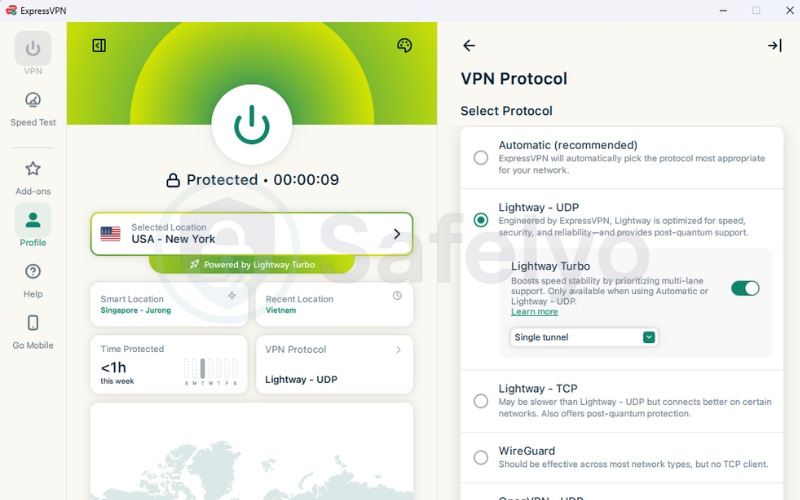
9.2. Toggling Lightway TCP for blocked networks
When traveling, you may find that the ExpressVPN application fails to connect on certain public networks. This happens because hotel and airport administrators often block standard UDP traffic to control bandwidth.
You can bypass this block and force Lightway through aggressive firewalls by manually changing the transport layer to TCP. Follow these specific steps within the client:
- Navigate to the ExpressVPN application’s Profile menu.
- Select the VPN protocol option.
- Select Lightway – TCP from the available list.
This explicit toggle mimics normal web traffic, ensuring uninterrupted connectivity on restrictive networks that block standard UDP traffic.
10. FAQs about NordLynx vs Lightway
Is NordLynx the best protocol?
It is a top-tier protocol for outright download speeds and local data transfer, but it lacks the native obfuscation found in Lightway. NordLynx is highly recommended for bandwidth-heavy tasks, but struggles on restricted networks.
Should I use TCP or UDP for my VPN protocol?
Always use UDP for faster streaming and gaming due to its low latency. You should only switch to TCP if your current network environment is actively blocking your connection, as TCP mimics standard web traffic to bypass restrictions.
Why doesn’t NordLynx support obfuscation?
Its foundational WireGuard architecture relies solely on UDP, which has a distinct, easily detectable digital signature. This makes native stealth highly difficult without adding secondary protocol layers, leaving it vulnerable to Deep Packet Inspection.
Is ExpressVPN Lightway open-source?
Yes, Lightway’s core codebase was open-sourced and published on GitHub. Furthermore, it has undergone multiple independent audits by firms like Cure53 to mathematically verify its security claims and memory safety.
11. Conclusion
Selecting the right technology depends entirely on your daily usage environment. NordLynx is the optimal choice for desktop users, heavy torrenting, and individuals seeking the top-tier performance expected from the Fastest VPNs on the market.
Its superior speed retention and consistent ping make it highly effective for stable home networks.
Lightway is the definitive choice for digital nomads, mobile users facing constant network handovers, and anyone routinely connecting to unforgiving public Wi-Fi. The memory-safe Rust architecture and native TCP flexibility ensure the connection survives aggressive network blocks.
To find the perfect fit for your workflow when evaluating NordLynx vs Lightway, you can test both protocols risk-free via their respective money-back guarantees before committing to a long-term plan.
Explore our full VPN Guides category on the Safelyo homepage for more performance tests.