
A RAM-Only VPN Server infrastructure is a diskless model that runs entirely on volatile memory, ensuring no user data or operating system files can be physically stored after the server loses power. For privacy-conscious users, the shift toward diskless architecture raises a critical question about true data safety.
To determine if diskless technology actually protects your digital footprint better than traditional encryption, we need to break down the mechanics of volatile memory. This guide explores the real-world engineering behind these servers to separate genuine security upgrades from marketing hype.
Key takeaways:
- RAM-only servers cannot store data permanently, drastically reducing the risk of data extraction during powered-off seizures.
- Unlike full-disk encryption (FDE), RAM-only servers eliminate the legal risk of governments subpoenaing decryption keys, as there is no persistent storage to decrypt.
- Volatile memory does not wipe instantly. Cold boot attacks using liquid nitrogen can preserve readable data in RAM for hours after power loss.
- Live-server raids on RAM-only infrastructure require automated watchdog timers to cut power and prevent data extraction.
- Top providers like ExpressVPN and Mullvad use read-only images and PXE booting to completely eliminate configuration drift across their networks.
1. What is a RAM-only VPN server?
A RAM-only VPN server is a specialized network computer that works entirely without a traditional hard drive. Standard servers save their data to a physical disk. A RAM-only server does not do this. It relies only on Random Access Memory (RAM) to run its operating system and handle your network traffic.
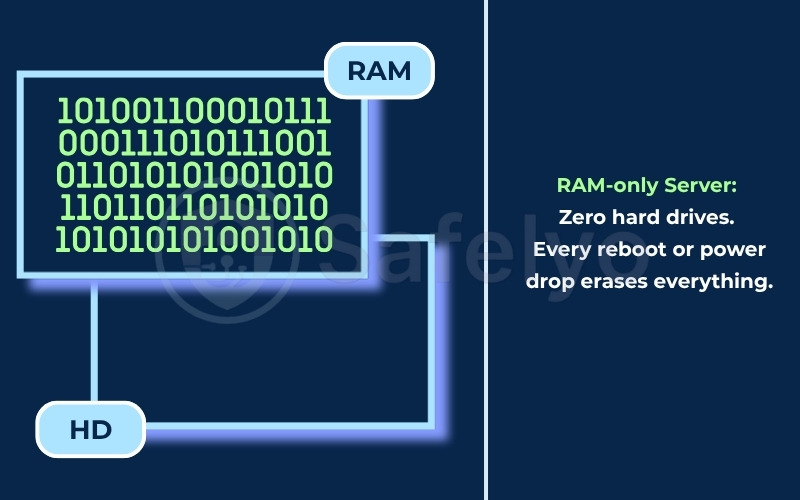
We must look at how standard servers work to fully understand this security upgrade. A regular server reads and writes active data logs straight to a physical hard drive when it turns on. This action creates a permanent trail of activity. This trail survives even after you turn the machine off.
Random Access Memory acts very differently. It is completely volatile. This means it needs a constant supply of electricity to hold any data. A diskless VPN server does not have a hard drive. Therefore, it must run its whole operating system, its VPN software, and your routing data directly inside this temporary memory space.
This setup fixes the big problem of permanent logging. When a diskless server turns on, it downloads a clean software image directly into RAM. The hardware physically forgets everything the exact moment it loses power. When the server restarts, it has a completely blank memory. This process ensures that no browsing history can survive a power cycle.
Pros
Eliminates the risk of persistent data storage during powered-off physical server seizures.
Ensures strict software consistency across the global server network by loading a fresh read-only image on every reboot.
Mitigates severe legal risks associated with coerced decryption keys typically used in full-disk encryption setups.
Cons
Requires significantly higher operational hardware costs and specialized engineering talent to maintain efficiently.
Relies heavily on a central provisioning network to boot properly, creating a potential single point of failure.
Remains vulnerable to live-server raids and active data extraction if automated power-cut defenses fail to trigger.
2. How diskless infrastructure works (the boot process)
Diskless infrastructure works by booting servers remotely over a secure network using a method called PXE booting. This process entirely skips the need for a local storage drive. Because there is no hard drive to load an operating system from, the server must fetch its software from a central, highly secure provisioning server upon startup.
The operating system functions as a cryptographically signed read-only image. This means the software cannot be modified, infected, or rewritten while the server is running.
Because these systems are highly specialized and designed to do only one job (routing VPN traffic securely), the custom Linux kernels used in these setups are extremely lightweight. For example, Mullvad’s custom Linux OS kernel weighs just over 200MB, allowing it to download and load into active memory swiftly.
A common misconception surrounding this technology is that RAM servers suffer from massive downtime for updates because they require constant rebooting to fetch new images. In reality, modern Linux architectures using a mechanism called tmpfs-as-root allow live updates to the RAM environment.
This structure allows network administrators to patch software vulnerabilities and update routing rules in real-time without executing a full system reboot. This balances maximum hardware security with continuous network uptime for the user.
3. RAM vs. Traditional Hard Drives (HDD/SSD)
Traditional hard drives (HDDs and SSDs) are engineered specifically for data retention and long-term storage. They write information onto physical magnetic platters or flash memory chips, creating a permanent record that survives all power cycles. If a server loses electricity, the data on these drives remains completely intact and readable the moment power is restored.
Random Access Memory (RAM) serves a fundamentally different purpose in computing architecture. It acts as a temporary, high-speed workspace for the processor and relies on a constant electrical charge to maintain its state. Because it is highly volatile, RAM automatically drops all stored data the moment the electrical current is interrupted.
This fundamental hardware difference creates completely different operational profiles for VPN providers. A traditional hard drive server permanently logs its operating system and routing tables to the disk, meaning administrators must use complex encryption layers to protect that data. By eliminating the hard drive entirely, diskless servers use RAM to ensure data destruction happens by default through the basic laws of physics.
Understanding this hardware baseline makes it much easier to evaluate how VPN providers secure their global networks. While some providers rely heavily on the physical amnesia of RAM, others attempt to secure traditional hard drives using advanced cryptography.
4. RAM-only vs. full-disk encryption (FDE): The security debate
While both technologies protect data at rest, RAM-only infrastructure provides a superior defense against legal coercion and physical server seizures. Full-disk encryption (FDE) perfectly protects data when a server is completely powered off and sitting quietly in a data center.
However, for the server to actually function and route traffic, the decryption keys must be actively loaded into RAM to read the hard drive. This makes both systems vulnerable during a live, powered-on state. The critical difference lies in what happens after a physical server is seized and unplugged by authorities.
| Security mechanism | RAM-only infrastructure | Full-disk encryption (FDE) |
|---|---|---|
| Storage medium | Volatile Memory (RAM) | Persistent Storage (HDD/SSD) |
| Data persistence | Erased automatically on power loss | Encrypted permanently on disk |
| Boot mechanism | PXE network boot (Read-only image) | Standard local disk boot |
| Live server vulnerability | Vulnerable (data exists in active memory) | Vulnerable (decryption keys loaded in RAM) |
| Legal coercion risk (Subpoena) | Immune (No hard drive data to hand over) | High (Provider can be forced to surrender the decryption key) |
Note: Full-disk encryption remains highly secure when implemented with advanced architectural safeguards. For instance, Proton VPN utilizes the Linux Unified Key Setup (LUKS) with AES-256 ciphers but strictly stores all decryption keys off-site. Combined with a verified no-logs policy and robust Swiss privacy jurisdiction, this infrastructure ensures that seizing a physical server yields no usable data or keys, offering comparable practical security while retaining local storage for non-personal diagnostic logs.
5. Threat modeling: What happens during a server raid?
To evaluate diskless architecture, we must analyze its performance during real-world physical and legal attacks, specifically powered-off server seizures, live-server raids, and cryogenic cold boot exploits. Each of these threat vectors exposes different vulnerabilities in how volatile memory retains or destroys user data under pressure.
5.1. Powered-off seizures and legal subpoenas for decryption keys
Because volatile memory physically cannot store data without continuous power, complying with a legal subpoena for server data is physically impossible. When a traditional server is seized, law enforcement or intelligence agencies can demand access to the physical hard drives.
If those drives are protected by standard full-disk encryption, the agency can serve the VPN provider with a gag order and legally compel the company to hand over the FDE decryption key. This forces the VPN provider into a dangerous corner where they must either break the law or betray their users’ privacy.
With RAM-only servers, the VPN provider literally has zero megabytes of hard drive data to hand over. Even if a court order demands the release of browsing logs or decryption keys, the technology itself prevents compliance. The data simply does not exist once the machine is unplugged from the wall.
This physical limitation is a vital defense against international surveillance. If you want to learn how global intelligence-sharing agreements can legally force companies to hand over data, exploring the Five Eyes, Nine Eyes, 14 Eyes alliances will help you build a stronger personal threat model.
5.2. Live-server seizures and watchdog timer defenses
If a server is seized while actively running, the routing logs, encryption keys, and user data exist in RAM as long as the machine has power. This means a live-server raid poses a genuine threat to diskless infrastructure, as attackers could theoretically plug into the server and extract active memory before pulling the plug.
To mitigate this live-state vulnerability, network engineers utilize automated defenses known as watchdog timers or dead-man switches. These are specialized server scripts that constantly monitor the physical chassis and network connection.
If the server is tampered with, opened, or if it is not successfully pinged over the secure network every few minutes, the dead-man switch triggers. This forces a hard power cut, instantly dropping electricity to the RAM modules and wiping the active memory before physical access can be gained by the raiding party.
5.3. The cold boot attack: Why RAM doesn’t wipe instantly
RAM modules suffer from a physical phenomenon known as data remanence, meaning the electrical memory bits fade predictably over time rather than disappearing instantly like a light switch. During highly sophisticated hardware exploits known as cold boot attacks, hostile agents unplug a server and immediately spray the RAM modules with liquid nitrogen or chemical freeze spray.
This rapid cryogenic cooling slows down the decay of the electrical charges. By freezing the memory, attackers buy themselves a critical window of minutes to several hours to extract the routing logs and decryption keys before the data becomes unreadable.
This physical reality debunks the common marketing myth that RAM wipes absolutely everything the very millisecond power is lost. Because of data remanence, automated power-cut defenses and strict physical data center security remain absolutely critical to ensuring data safety, even on diskless hardware.
6. Are RAM-only servers just a marketing gimmick?
RAM-only servers are absolutely not a gimmick. They solve the severe legal compliance issue of FDE key coercion and prevent configuration drift by ensuring all global servers load from the exact same read-only image every single time they boot.
However, one of the biggest myths surrounding diskless infrastructure is that it somehow improves your internet speed. During our hands-on speed tests comparing various VPN providers, we did not notice any measurable impact on raw bandwidth when switching between VPNs that use RAM-only servers and those that use traditional hard drives.
VPN routing speed bottlenecks are caused by network distance, server congestion, and CPU encryption overhead, not by the read and write speeds of the local storage medium. While the security benefits are massive, there are structural trade-offs to this technology.
Deploying and maintaining diskless infrastructure requires specialized engineering talent and hardware costs that can be 5 to 10 times higher than traditional HDD setups, which is why usually only premium VPN brands offer it. It also relies heavily on the central network infrastructure to download boot images upon startup.
This creates a potential single point of failure risk. If the provider’s central provisioning servers go offline, the individual VPN servers cannot fetch their operating systems to reboot. Ultimately, the privacy advantages far outweigh these operational hurdles for the end user.
7. Leading VPN providers with verified RAM-only architectures
To see how diskless architecture performs in production, we must examine the specific engineering implementations of the industry’s top providers. ExpressVPN utilizes its proprietary TrustedServer technology, Mullvad relies on stboot with TPM attestation, and brands like Surfshark and NordVPN operate massive 100% diskless global networks.
7.1. ExpressVPN’s TrustedServer technology: Reinstalling the software stack
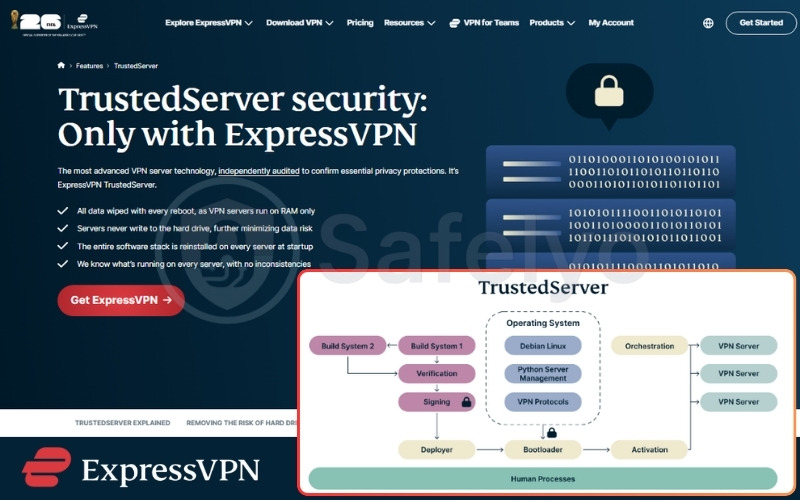
ExpressVPN utilizes its TrustedServer technology to reinstall the entire software stack and operating system on every server at startup. This increases consistency, meaning thousands of servers around the world load the exact same, up-to-date code when powered on.
To prevent data and potential intruders from persisting on the machine, the servers run entirely on volatile memory (RAM). What remains on the hard drive is a cryptographically signed read-only image containing the software needed for the server to boot.
ExpressVPN introduced a one-time bonus award of 100,000 USD in their bug bounty program specifically for the discovery of security issues within TrustedServer.
Furthermore, the technology has been independently audited twice, once by PwC and more recently by Cure53, to confirm essential privacy protections.
7.2. Mullvad’s stboot and TPM attestation: Hardware-enforced privacy
Mullvad applies its advanced System Transparency technology using a custom bootloader called stboot combined with TPM (Trusted Platform Module) attestation. The servers run entirely on RAM by downloading a cryptographically signed OS package from a highly secure provisioning server.
Because they have stripped out all unnecessary software, this custom Linux kernel weighs just over 200MB, guaranteeing the server is completely fresh, clean, and fast every time it reboots. The TPM attestation ensures that the hardware itself mathematically verifies the integrity of the operating system before it is allowed to handle any user traffic.
The effectiveness of this system was proven in the real world during a 2023 Swedish police raid on Mullvad’s headquarters. Law enforcement officers seized multiple machines in an attempt to acquire customer data, but they recovered zero actionable intelligence strictly because this diskless infrastructure held no persistent records.
7.3. Surfshark and NordVPN: Scaling 100% diskless networks
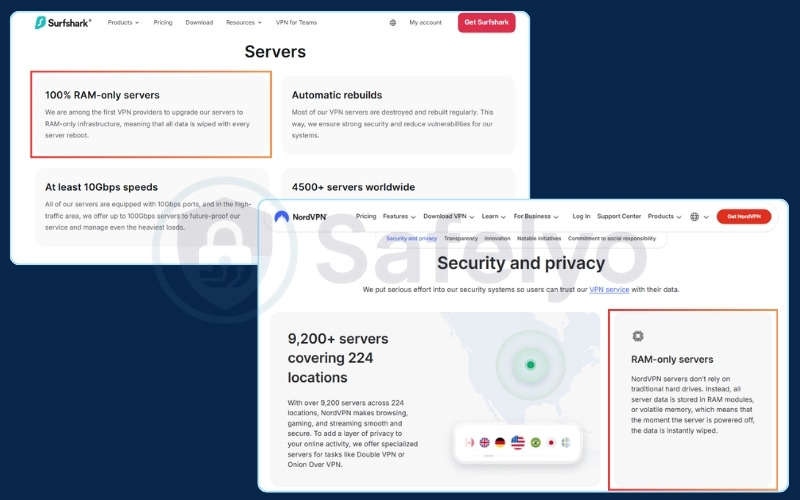
Operating a few diskless servers is relatively easy, but scaling this technology globally requires massive engineering resources. Surfshark successfully converted more than 3,200 servers across 100 different countries to a completely diskless infrastructure in 2020.
This massive overhaul proved that RAM-only networks could handle heavy consumer bandwidth demands without relying on traditional hard drives. Similarly, NordVPN utilizes an enterprise-scale RAM implementation to maintain software consistency and stringent privacy standards across its massive global network of thousands of servers.
Operating at this massive scale ensures that users connecting from any region, whether in highly censored countries or local neighborhoods, benefit from the exact same volatile memory protections without encountering legacy hardware risks or outdated configurations. These large-scale deployments set a new industry standard, forcing other premium competitors to abandon hard drives in order to remain competitive in the privacy space.
8. FAQs about RAM-only servers
Do all top VPNs use RAM-only servers?
No. While many leading brands like ExpressVPN, Surfshark, and NordVPN use diskless infrastructure, some highly reputable providers like Proton VPN actively choose full-disk encryption (FDE).
Do RAM servers wipe data instantly upon losing power?
No. Due to data remanence, the electrical bits in RAM fade over several minutes. This window can be extended significantly if an attacker uses chemical freeze sprays to cool the physical memory modules.
What is a cold boot attack on a VPN server?
A cold boot attack is a physical hardware exploit where law enforcement or hackers use liquid nitrogen to freeze RAM modules immediately after power loss. This preserves the volatile data long enough to extract decryption keys and routing logs.
Can a RAM-only server be hacked while it is running?
Yes. If a server is compromised while powered on, the data residing in its active memory is highly vulnerable to extraction. This is why strict no-logs policies are still mandatory regardless of the hardware structure.
Does a RAM-only server make my internet connection faster?
No. VPN speed is dictated by network congestion, physical server location, and CPU encryption processing. The read and write speeds of the local storage medium have virtually zero impact on your routing performance.
9. Conclusion
RAM-only VPN servers provide a mathematically and legally superior defense against server seizures and data subpoenas compared to traditional full-disk encryption. By removing the physical capacity to store data permanently, diskless servers protect users from the very real threat of coerced decryption keys.
Technology alone is insufficient without a strictly audited no-logs policy and a secure operating jurisdiction. To ensure your digital privacy remains intact, you must verify independent audits before trusting any infrastructure.
For more deep dives into protecting your digital footprint, explore the VPN Guides category on the Safelyo homepage.