
Is torrenting with a VPN legal in the US? Yes. Both the BitTorrent protocol and VPN technology are legal on their own. A VPN does not make downloading or sharing copyrighted material without permission lawful under U.S. copyright law; legality depends on the copyright status of the file and whether you have permission to share it.
Copyright holders identify torrent users by monitoring IP addresses inside public swarms, and a VPN changes how visible your connection is without changing what the law considers infringement. This guide covers what a VPN actually protects against, the leaks that can still expose your identity, the real consequences of getting caught, and how to torrent safely within the law.
Key Takeaways
- Both VPN technology and the BitTorrent protocol are legal in the United States.
- Whether a torrent download is lawful generally depends on the copyright status of the content, whether you have permission to use or distribute it, and the specific circumstances of the use.
- A VPN encrypts traffic and can hide your residential IP from the swarm. It does not turn copyright infringement into a legal act.
- For individual users, potential consequences can include ISP notices, settlement demands, or civil litigation. Criminal copyright infringement is a separate category governed by specific statutory requirements.
- A VPN can still expose identifying information if its connection drops without a kill switch or if IP or IPv6 traffic bypasses the VPN tunnel. DNS leaks can also expose DNS queries to the ISP.
1. Is torrenting with a VPN legal in the US?
Is torrenting with a VPN legal in the US? Both the tools and the protocol are legal. The content and the circumstances of its use determine whether the activity violates the law.
Using a VPN or the BitTorrent protocol is not, by itself, a copyright infringement. No federal statute prohibits ownership or use of either tool, and the legal issue generally depends on what content is shared or downloaded and whether the user has authorization to do so. The protocol is a neutral peer-to-peer technology. A VPN is a privacy tool that encrypts traffic and can mask IP addresses.
Under 17 U.S.C. § 501, anyone who violates the exclusive rights of a copyright owner may be an infringer. Using a VPN changes how visible the connection is. It does not alter the copyright status of the files or create legal permission.
| Criterion | Using BitTorrent Protocol | Using a VPN | Downloading copyrighted content without permission |
|---|---|---|---|
| Legality in the US | Generally legal (neutral technology) | Generally legal (privacy tool) | Can constitute copyright infringement |
| Legal basis | No law prohibits the network protocol itself | Not prohibited by copyright law | 17 U.S.C. § 501 |
| Effect when combined | Functions normally | Encrypts traffic and can hide residential IP | Infringement analysis remains the same; VPN only affects visibility |
A VPN can reduce the chance of identification but provides no legal immunity. The legal status of the activity depends on the content and the rights involved.
2. Is BitTorrent itself illegal? Technology vs. copyrighted content
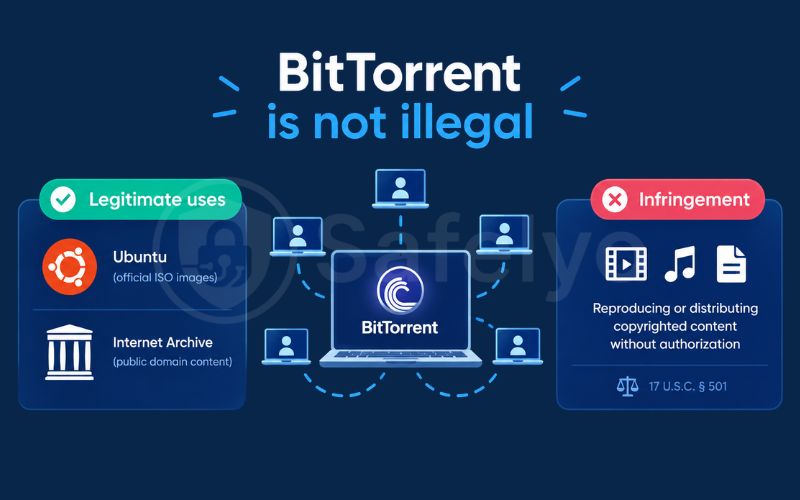
BitTorrent is not illegal. The protocol, developed by Bram Cohen in 2001, is a method for efficient peer-to-peer distribution of data. Legality turns on the content being transferred and the rights of the parties involved, not on the technology itself.
Legitimate uses are common. Canonical distributes Ubuntu ISO images via official BitTorrent trackers to reduce server load. The Internet Archive offers large public-domain collections of books, films, and audio recordings through BitTorrent.
Infringement occurs when a user reproduces or distributes a copyrighted work without authorization, as defined in 17 U.S.C. § 501. Courts have treated the protocol itself as a neutral tool rather than an inherently unlawful system. The legal question focuses on the exclusive rights of the copyright owner.
3. How copyright holders identify torrent users
Enforcement typically begins with monitoring. Agents or automated systems may join a swarm, record IP addresses associated with a particular file, and use WHOIS data to identify the internet service provider. An IP address generally identifies the internet connection or subscriber account, not necessarily the individual who performed the alleged infringement.
From there, rights holders may pursue different paths depending on the circumstances. These can include notices to the ISP, requests for subscriber information through legal process, settlement demands, or civil litigation.
4. What a VPN does and does not do for torrenting
A VPN improves network privacy but does not change the legal character of the content transferred. It only affects how visible the connection is to outside observers.
4.1. How a VPN protects network privacy
A properly configured VPN encrypts traffic between the device and the VPN server using the cryptographic protocols and ciphers supported by the service. Common modern implementations use ciphers such as AES-256 or ChaCha20. This makes it harder for the ISP to inspect the contents of the traffic and identify specific activity from packet contents alone.
Inside the swarm, peers generally see the VPN server’s IP address rather than the user’s residential IP. The ISP therefore has less ability to link the torrent activity directly to a household account through ordinary traffic analysis. This privacy benefit is separate from connection speed; understanding port forwarding vs. no port forwarding for torrenting explains why some VPNs feel slower for P2P even when privacy protection is identical.
4.2. Technical failures that can expose identifying information
Several technical failures can still expose identifying information:
- Dropped connection without a kill switch: Traffic may route over the normal network interface, and the residential IP can appear in the swarm if the VPN disconnects and the torrent client continues transferring.
- IPv6 leak: Some VPN services route only IPv4. Traffic can exit over the real IPv6 address and be recorded if the home network supports IPv6.
- DNS leak: DNS requests leave the VPN tunnel and go to the ISP’s resolvers, potentially exposing the domains being queried. This is different from an IP leak that places the residential address directly in the swarm.
These failures help explain why some users still receive notices despite using a VPN. Reliable kill-switch protection together with IP, DNS, and IPv6 leak protection reduces the risk.
5. What happens if you get caught torrenting copyrighted content
For individual users, potential consequences can include ISP notices, settlement demands, or civil litigation. Criminal copyright infringement is a separate category governed by specific statutory requirements.
5.1. ISP notices and settlement demands
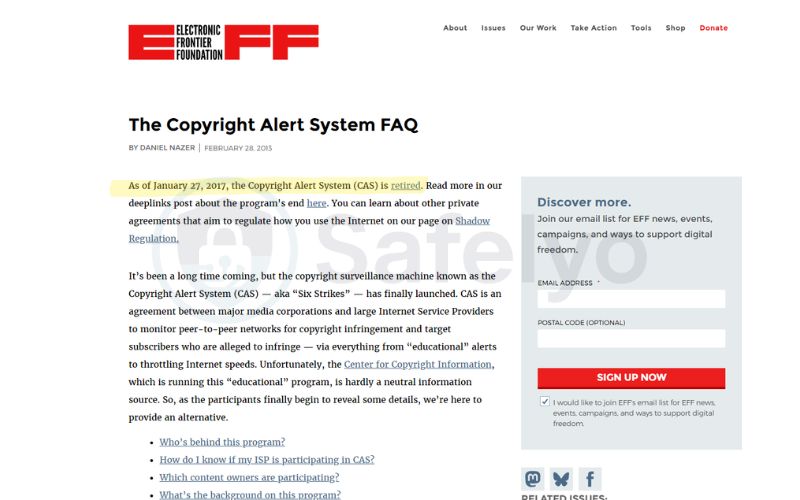
The industry-wide Copyright Alert System ended in January 2017. After that program ended, there is no longer a single industry-wide alert system of that kind. ISPs may instead handle alleged infringement under their own policies and applicable law.
Typical responses can include email or account-portal warnings that list the alleged file and ask the subscriber to stop the activity. Repeated notices may lead to temporary suspension, a required acknowledgment of the policy, or, in some cases, termination of service.
On March 25, 2026, the U.S. Supreme Court decided Cox Communications, Inc. v. Sony Music Entertainment (No. 24-171). The Court reversed the judgment against Cox, holding that Cox was not contributorily liable because it neither induced its users’ infringement nor provided a service tailored to infringement.
Rights holders may also send settlement demand letters seeking payment to resolve a claim without litigation. Amounts vary by case and rights holder.
5.2. Civil cases and criminal exposure
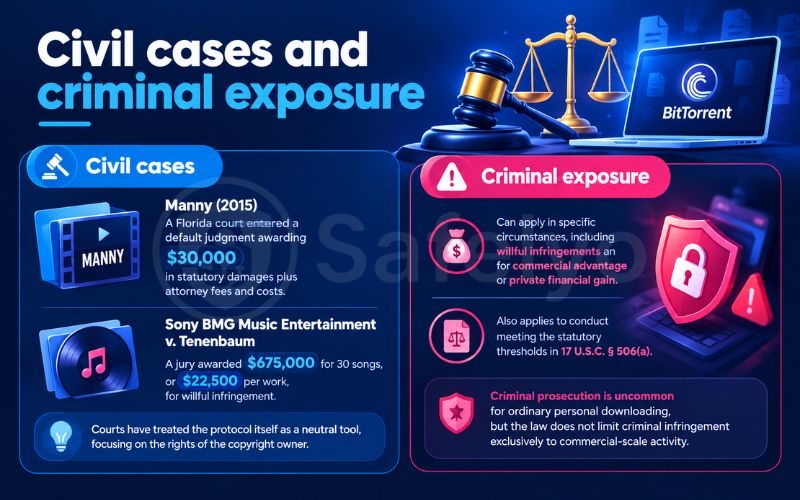
Courts have entered substantial statutory-damages awards in individual BitTorrent copyright cases. In a 2015 Florida case involving the documentary Manny, a court entered a default judgment awarding $30,000 in statutory damages plus attorney fees and costs. In Sony BMG Music Entertainment v. Tenenbaum (a peer-to-peer file-sharing case involving KaZaA rather than BitTorrent), a jury awarded $675,000 for 30 songs, or $22,500 per work, for willful infringement.
Criminal copyright infringement can apply in specific circumstances, including certain willful infringements committed for commercial advantage or private financial gain, as well as conduct meeting the statutory thresholds in 17 U.S.C. § 506(a). Criminal prosecution is uncommon for ordinary personal downloading, but the law does not limit criminal infringement exclusively to commercial-scale activity.
6. How to torrent legally and privately?
Legal torrenting is possible when the content is authorized. Users can use the protocol without crossing into infringement. Common lawful uses include official Linux distribution ISOs, public-domain and Creative Commons collections on the Internet Archive, and game or software updates distributed by the publisher via BitTorrent.
Practical steps that improve privacy for lawful activity include:
- Confirm you have the right to download and share the specific files.
- Bind the torrent client to the VPN network interface so traffic cannot leave the tunnel.
- Enable a kill switch before launching the client.
- Test for IP, DNS, IPv6, and WebRTC leaks while connected to the VPN.
These measures protect privacy for authorized content. They do not legalize unauthorized copyrighted material.
7. What to look for in a VPN for P2P sharing
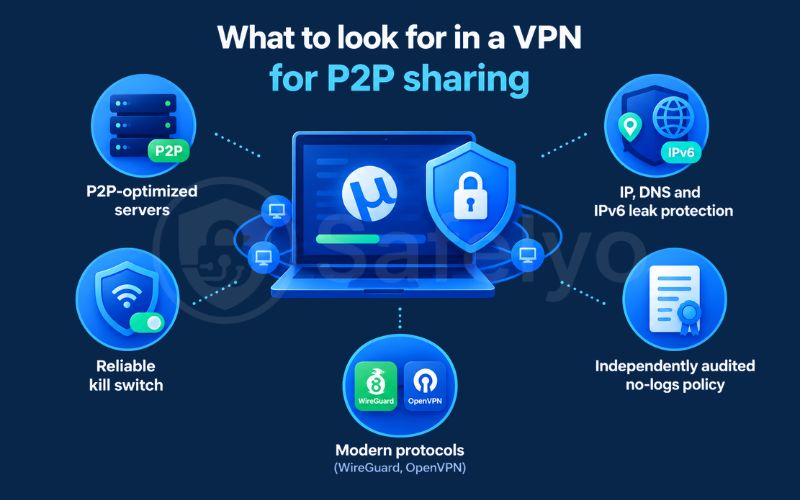
When choosing a VPN for peer-to-peer use, focus on features that address real technical risks rather than marketing claims. Useful criteria include:
- P2P-optimized servers: some providers restrict torrent traffic to specific servers only, so confirm support before connecting.
- Reliable kill switch: cuts all internet traffic the instant the tunnel drops, preventing fallback to the unprotected connection.
- IP, DNS, and IPv6 leak protection: three separate failure points; test each independently with tools like ipleak.net or dnsleaktest.com.
- Independently audited no-logs policy: a claim verified by a third party such as PwC, Deloitte, or Cure53 carries more weight than an unaudited one.
- Modern protocols (WireGuard, OpenVPN): both use current encryption standards; avoid providers still defaulting to outdated protocols like PPTP.
These elements reduce the chance that your real IP appears in a swarm while you transfer authorized content.
8. Frequently asked questions
Is it illegal to have a VPN in the USA?
No. No federal or state law prohibits private individuals from owning or using a VPN.
Do VPNs allow torrenting?
Many reputable VPNs permit P2P traffic on designated servers. Provider permission does not change copyright law.
Can an ISP tell if you’re torrenting with a VPN?
A properly configured VPN generally prevents the ISP from seeing the contents of your torrent traffic directly. The ISP can still see that you are connected to a VPN server and may observe connection times and overall traffic volume.
Is torrenting safe with a VPN?
A properly configured VPN with a kill switch and leak protection can significantly reduce the chance that your residential IP appears in a swarm. It does not make unauthorized copyrighted downloads legal.
Has anyone been sued for torrenting?
Copyright holders have filed civil lawsuits involving alleged BitTorrent infringement, often beginning with an IP address associated with the alleged activity.
Can you be tracked while torrenting with a VPN?
Your real IP can still be recorded if the VPN connection drops without a kill switch or if IP or IPv6 traffic bypasses the tunnel. DNS leaks can also expose DNS queries. A provider’s logging practices and response to legal requests also affect residual risk.
Is torrenting games illegal?
Torrenting a game you do not own or that the publisher has not authorized for redistribution can constitute copyright infringement. Official publisher-supplied torrents or open-source games are generally lawful.
Can law enforcement obtain information from a VPN provider?
Whether a VPN provider can provide useful information depends on the provider’s jurisdiction, applicable legal process, retention practices, and what records it actually maintains.
9. Conclusion
Is torrenting with a VPN legal in the US? The tools themselves (BitTorrent and VPN technology) are legal. The decisive factor remains whether the files being transferred are authorized by the copyright owner or otherwise permitted under applicable law.
A VPN can encrypt the connection and hide the residential IP from the swarm, but it cannot convert infringement into a lawful act. For anyone using BitTorrent, the practical approach is to stick to content you are entitled to share, configure the VPN and client carefully to limit leaks, and treat copyright compliance as the primary safeguard.
For help choosing and setting up a VPN that supports P2P traffic safely, see VPN guides from Safelyo and reviews for setup steps, leak testing, and provider comparisons. That combination of the right tool and the right habits supports both privacy and legal clarity.