
When setting up a VPN connection manually on Windows, you will often be asked to choose between L2TP/IPsec and SSTP. While both protocols provide encrypted VPN tunnels, they differ significantly in compatibility, firewall traversal, and network performance.
Although both are still supported in certain environments, they are now considered legacy VPN protocols. Understanding where each one performs well and where it falls short can help you choose the right option for your network. This guide compares L2TP/IPsec and SSTP across security, speed, firewall resistance, device compatibility, and real-world use cases to help you decide which protocol is the better choice in 2026.
Key takeaways
- Legacy protocol status: Both options are now considered legacy VPN protocols, having been largely surpassed by faster and more secure standards like WireGuard.
- L2TP compatibility advantage: L2TP/IPsec offers broad cross-platform compatibility, making it useful for manual configurations on older routers, macOS, and legacy enterprise gateways.
- SSTP firewall evasion: SSTP is highly optimized for Windows environments and excels at bypassing network firewalls by routing traffic through standard HTTPS port 443.
- Modern default recommendation: Unless restricted by older business hardware requirements, you should always choose modern protocols to ensure optimal speed, security, and battery efficiency.
1. Quick comparison of L2TP/IPsec and SSTP
Both protocols can create secure VPN connections, but they differ in how they encrypt traffic, communicate with networks, and handle restrictive firewalls. The table below summarizes the key differences before we examine each protocol in detail.
| Feature | L2TP/IPsec | SSTP |
|---|---|---|
| Encryption | IPsec encryption, commonly AES-256 | SSL/TLS-based encryption |
| Performance | Moderate due to encapsulation overhead | Moderate, may slow on unstable TCP networks |
| Firewall traversal | Limited, relies on UDP ports that may be blocked | Excellent, uses TCP port 443 |
| Platform support | Native on Windows, macOS, Android, routers | Native on Windows, limited support elsewhere |
| Best for | Cross-platform manual VPN connections | Windows users behind restrictive firewalls |
2. What is L2TP/IPsec and how does it work
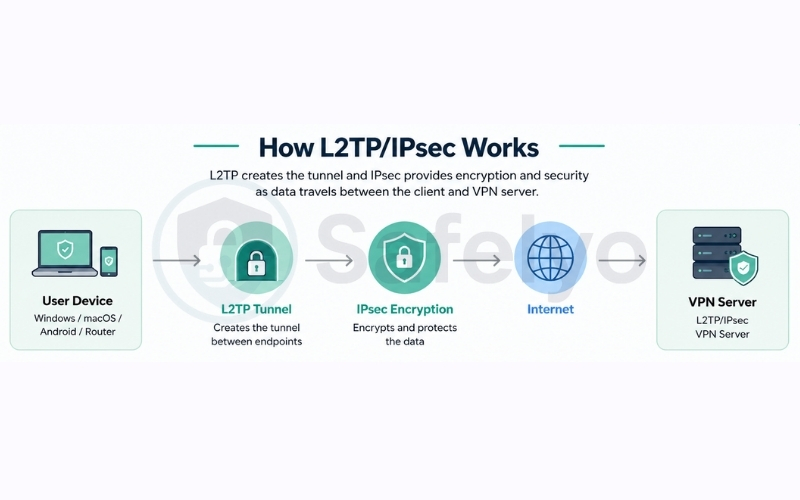
L2TP/IPsec combines two separate networking technologies to create an encrypted VPN tunnel. L2TP handles the tunneling process, while IPsec provides encryption, authentication, and data integrity protection.
On its own, Layer 2 Tunneling Protocol (L2TP) does not provide any encryption. Instead, it encapsulates network packets into a format that allows them to travel through an IP network between a device and a VPN server.
To protect this tunneled traffic, L2TP is paired with Internet Protocol Security (IPsec). IPsec encrypts the encapsulated data and verifies its integrity using modern mechanisms such as AES-256 encryption. This helps prevent unauthorized access or modification while data travels across the internet.
3. What is SSTP and how does it work
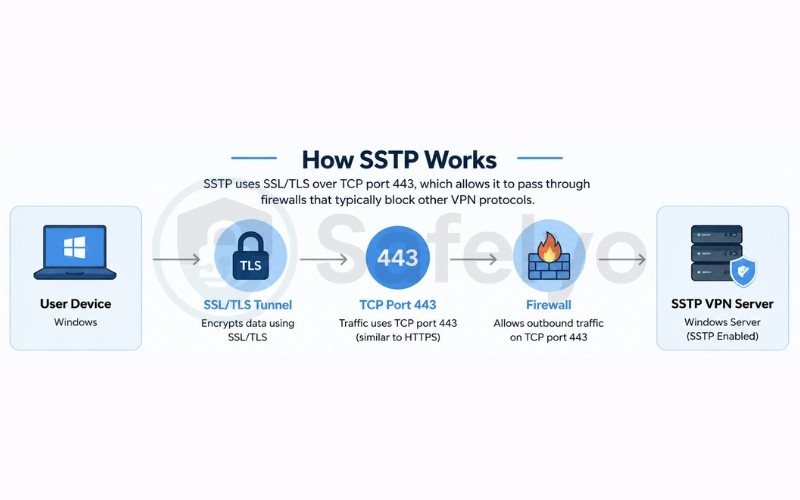
Secure Socket Tunneling Protocol (SSTP) is a Microsoft-owned VPN protocol designed for secure remote access. It creates an encrypted VPN tunnel by transmitting traffic through an SSL/TLS connection, providing strong encryption and improved firewall traversal.
SSTP operates similarly to HTTPS connections by using TCP port 443. Since this port is commonly used for secure web traffic, this makes SSTP more likely to pass through restrictive networks compared with protocols that rely on less common ports.
The protocol uses SSL/TLS-based encryption to protect transmitted data and authenticate the VPN server. SSTP is natively supported on Windows systems, while third-party clients provide limited support for other platforms such as Linux and Android.
4. L2TP/IPsec versus SSTP: The head-to-head technical battle
Comparing these two protocols requires looking beyond their basic features and understanding how their underlying architectures affect security, performance, firewall traversal, and compatibility.
The table below provides a quick breakdown of how they compare across key categories to help you understand their relative strengths.
| Category | Winner |
|---|---|
| Security | Tie |
| Firewall traversal | SSTP |
| Speed | Slight advantage: L2TP/IPsec |
| Compatibility | L2TP/IPsec |
4.1. Security and encryption standards
Both protocols can provide strong data protection when configured with modern cryptographic settings. The main difference is not their ability to encrypt traffic, but the security framework they use.
L2TP depends on IPsec to provide encryption, authentication, and integrity protection because L2TP itself does not secure data. SSTP, on the other hand, uses SSL/TLS to establish an encrypted tunnel between the VPN client and server.
When properly configured with modern encryption algorithms such as AES-256, both protocols offer reliable protection against unauthorized access. However, their different architectures influence compatibility, deployment, and network behavior.
4.2. Bypassing firewalls and network blocks
Network compatibility is often the biggest practical difference between these two protocols. The ports and transport methods they rely on determine how easily they can operate behind restrictive networks.
L2TP/IPsec typically uses UDP ports 500 and 4500 for VPN communication. Some corporate networks, public Wi-Fi providers, or restrictive firewalls may block these ports.
SSTP uses TCP port 443, the same port commonly used by HTTPS traffic. This allows SSTP connections to blend more naturally with regular web traffic, making it more likely to work on restrictive networks.
4.3. Speed and overall network performance
A common misconception is that L2TP/IPsec encrypts data twice. In reality, it uses a double encapsulation process. L2TP creates the tunnel structure, and IPsec encrypts the transmitted data, adding additional processing overhead.
SSTP faces a different limitation because it operates over TCP. On networks with high packet loss or instability, TCP-based tunneling can sometimes experience TCP-over-TCP issues, where retransmissions from both layers reduce performance.
In general, neither protocol matches the efficiency of modern VPN protocols such as WireGuard, but real-world speeds depend heavily on server distance, network quality, and device hardware.
4.4. Device compatibility and native support
Platform compatibility is one of the biggest differences between these two legacy VPN protocols. The better choice often depends on which devices you need to connect. L2TP/IPsec has broad native support across Windows, macOS, Android, and many routers, making it convenient for manual VPN configurations.
SSTP is primarily designed for Windows environments and has native support in Microsoft operating systems. Other platforms may require third-party clients with varying levels of compatibility.
5. When should you choose L2TP/IPsec?
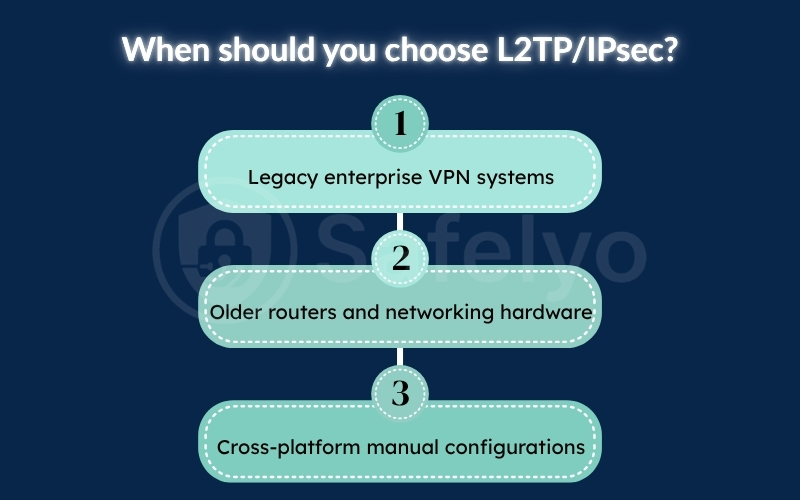
Despite being considered a legacy VPN protocol, L2TP/IPsec still has practical uses in specific situations where compatibility is more important than performance. You may consider using this protocol in the following scenarios.
Legacy enterprise VPN systems
Many older business networks were built around IPsec-based VPN infrastructure. If you need to connect to an existing VPN gateway that does not support newer protocols such as WireGuard or OpenVPN, L2TP/IPsec may still be a necessary option.
Older routers and networking hardware
Some older routers and network appliances include built-in support for L2TP/IPsec but lack compatibility with newer VPN technologies. In these cases, L2TP/IPsec can provide a convenient way to configure secure VPN connections without replacing existing hardware.
Cross-platform manual configurations
If you need a VPN protocol with built-in support across multiple operating systems, L2TP/IPsec remains a practical choice. Windows, macOS, Android, and many routers support manual L2TP/IPsec configurations without requiring additional VPN software.
6. When should you choose SSTP?
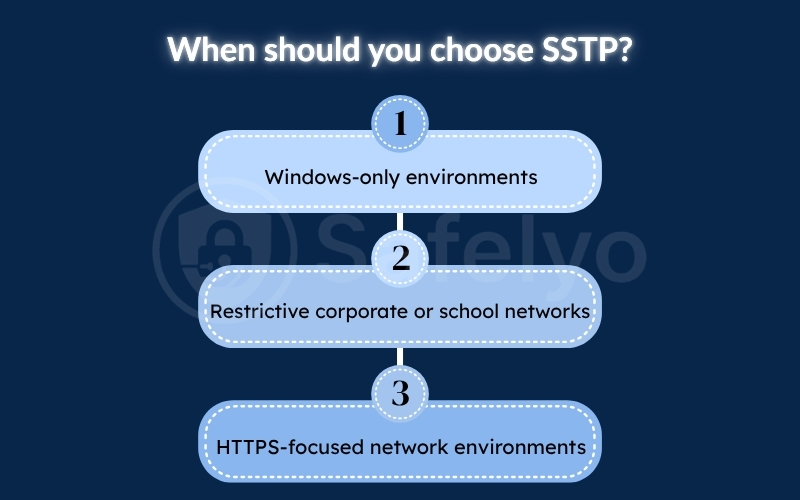
SSTP is primarily designed for Microsoft environments and specific network conditions where firewall compatibility is important. You may consider using SSTP in the following situations.
Windows-only environments
If your devices are mainly running Windows, SSTP provides a convenient native VPN experience. Windows includes built-in support for SSTP connections, allowing users to configure the protocol without installing additional VPN clients.
Restrictive corporate or school networks
Some networks restrict VPN traffic by blocking less common VPN ports and protocols. Because SSTP operates over TCP port 443, the same port used by HTTPS traffic, it is more likely to work on networks with strict firewall rules.
HTTPS-focused network environments
In environments where outbound traffic is limited primarily to standard web ports, SSTP can be a practical option. Its use of SSL/TLS over TCP 443 allows it to operate similarly to regular HTTPS-based communication.
7. Why Windows users often choose between these two protocols
Windows users frequently find themselves choosing between L2TP/IPsec and SSTP because of how Microsoft built these protocols into its operating system history. Both options offer a built-in, clientless setup that does not require downloading external software.
- Native integration in the Windows network stack
Microsoft built native support for both options directly into the Windows network connection wizard. This means you can open your system settings, enter your credentials, and establish a secure tunnel without installing third-party applications.
For users on highly restricted corporate machines where IT administrators block the installation of external software, this native integration is incredibly valuable. It allows you to maintain network privacy using the operating system’s built-in tools.
- SSTP, a proprietary Microsoft heritage
Because Microsoft developed SSTP, they optimized it specifically to run on the Windows platform. It integrates smoothly with Windows Active Directory services, making it a highly popular choice for enterprise network administrators.
While L2TP/IPsec is also natively supported, configuring it often requires editing registry keys to work behind NAT routers. SSTP completely avoids these configuration hurdles, offering a much smoother out-of-the-box experience for Windows users.
8. The 2026 reality check: Modern alternatives to legacy protocols
While understanding legacy options is important, the reality of 2026 networking is that both L2TP/IPsec and SSTP are slowly being phased out. Modern protocols offer significantly better security, faster speeds, and much easier configuration.
- The rise of modern VPN protocols
While L2TP/IPsec and SSTP remain useful in specific legacy environments, most modern VPN services have moved toward newer protocols designed for better speed, efficiency, and reliability.
WireGuard has become one of the most widely adopted modern VPN protocols due to its lightweight architecture, streamlined codebase, and strong performance. Compared with older protocols, WireGuard typically offers faster connection speeds, lower latency, and reduced battery consumption on mobile devices.
OpenVPN remains another popular choice because of its flexibility, strong security reputation, and ability to operate over both UDP and TCP connections. Its TCP mode can be particularly useful in restrictive network environments where other VPN protocols may struggle.
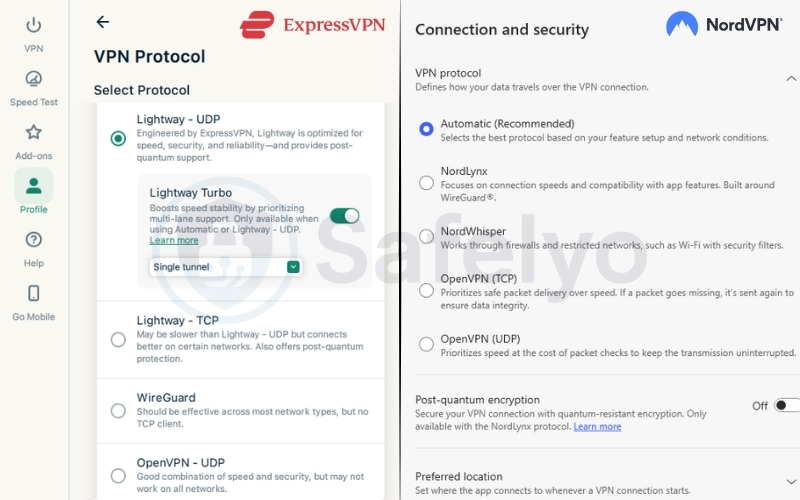
Many VPN providers have also built their own protocols based on modern technologies. For example, NordLynx vs Lightway represents a comparison between two proprietary solutions: NordLynx, which is based on WireGuard technology, and Lightway, which was developed by ExpressVPN for faster connections and smoother network transitions.
Compared with legacy protocols like L2TP/IPsec and SSTP, modern solutions such as WireGuard, OpenVPN, NordLynx, and Lightway provide better efficiency, easier configuration, and a more optimized VPN experience for everyday users.
- When to completely avoid legacy options
Unless you are bound by older corporate hardware requirements, you should avoid configuring new manual connections using L2TP/IPsec or SSTP. Their outdated design makes them vulnerable to network blocking and slower than modern tunneling technologies.
Most premium providers in 2026 now offer highly optimized applications that run WireGuard natively. Switching to a modern service ensures you receive the best possible speed and security without the hassle of manual configuration.
9. Frequently asked questions
Which is faster: L2TP/IPsec or SSTP?
In many situations, L2TP/IPsec can be slightly faster than SSTP because it avoids TCP-based tunneling. However, real-world speeds depend on server distance, network stability, encryption settings, and device hardware.
Can I use SSTP on a Mac?
No. macOS does not include native SSTP support. To use SSTP on a Mac, you need a third-party VPN client that supports the protocol.
Is L2TP/IPsec still secure in 2026?
Yes, L2TP/IPsec can still provide strong security when configured with modern IPsec encryption. However, L2TP itself does not encrypt traffic, so its protection depends entirely on the IPsec layer.
Why does L2TP/IPsec fail on public Wi-Fi?
Some public Wi-Fi networks block the UDP ports required by L2TP/IPsec, including ports 500 and 4500. When these ports are restricted, the VPN connection may fail to establish.
Does Android support L2TP/IPsec manual configuration?
Support varies depending on the Android version and device manufacturer. Many users now prefer dedicated VPN apps or newer protocols such as IKEv2 because manual L2TP/IPsec configuration is less common on modern devices.
Is SSTP proprietary to Microsoft?
Yes. Microsoft developed SSTP as a proprietary VPN protocol. Although its specifications are publicly available, the protocol remains primarily associated with Windows environments.
Can I use L2TP/IPsec or SSTP to unblock Netflix?
While technically possible, these legacy protocols are not commonly used for modern streaming. VPN providers typically rely on newer protocols and optimized server infrastructure for better streaming performance.
Which protocol is better for online gaming?
Neither L2TP/IPsec nor SSTP is ideal for gaming because encryption overhead can increase latency. Modern protocols such as WireGuard are generally better optimized for low-latency connections.
10. Conclusion
Choosing between L2TP/IPsec and SSTP comes down to your specific device ecosystem and network restrictions. While L2TP/IPsec offers better cross-platform compatibility for older hardware, SSTP remains a highly effective choice for Windows users trying to connect through strict network firewalls.
However, both options are legacy protocols that modern, more efficient technologies have largely surpassed. To learn how to secure your network using faster and more secure protocols, check out our comprehensive tutorials in the VPN Guides category at Safelyo.