
Every time you connect to a VPN, browse an HTTPS website, or send a secure message, your device must encrypt data instantly. If this mathematical process is inefficient, your internet connection can feel slower, and your phone battery may drain faster.
Understanding what ChaCha20 is helps explain how modern apps solve this exact problem. This algorithm provides fast data protection on devices that lack specialized encryption hardware. It helps keep your daily communications confidential without sacrificing network speed, making it an important part of modern digital privacy.
Key takeaways:
- ChaCha20 is a symmetric stream cipher that uses a strong 256-bit key.
- In modern network protocols, it is usually paired with Poly1305 to form ChaCha20-Poly1305.
- It performs exceptionally well in software, especially on devices without AES hardware acceleration.
- The WireGuard VPN protocol uses ChaCha20 with Poly1305 for fast encryption and authentication.
- The biggest implementation risk for this cipher is nonce reuse.
1. What is ChaCha20?
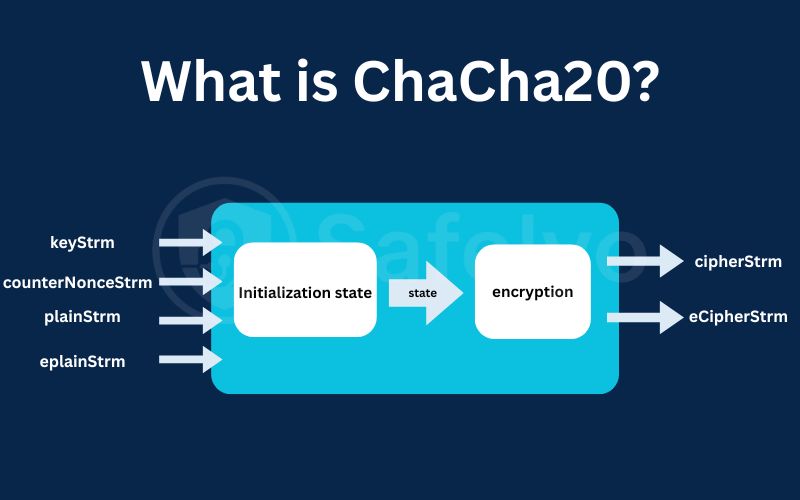
ChaCha20 is a symmetric stream cipher designed to secure digital communications. It uses a single 256-bit secret key to generate a continuous, pseudo-random sequence of bytes known as a keystream. This keystream is then combined with plaintext data to produce encrypted ciphertext.
The number “20” in its name represents the twenty mathematical rounds the algorithm uses to mix and transform data. This multi-layered process makes it computationally infeasible to reverse the resulting ciphertext without the original secret key.
Designed by renowned cryptographer Daniel J. Bernstein, ChaCha20 was created as an improvement over the earlier Salsa20 algorithm. Today, its strong security margin and high software performance have made it widely used in modern internet security protocols.
2. How ChaCha20 encryption works in simple terms
While the underlying mathematics is complex, the basic process is highly efficient. ChaCha20 takes your readable data, mixes it with a specialized secret key, and produces scrambled text that attackers cannot read without the correct key.
The following table breaks down the core elements that make this transformation possible.
| Component | Simple meaning | Why it matters |
|---|---|---|
| Key | Secret value | Protects access to the data |
| Nonce | Number used once | Prevents repeated keystrokes |
| Counter | Block number | Helps generate each keystream block |
| Keystream | Pseudo-random byte stream | Mixed with plaintext to create ciphertext |
2.1. Key, nonce, and block counter
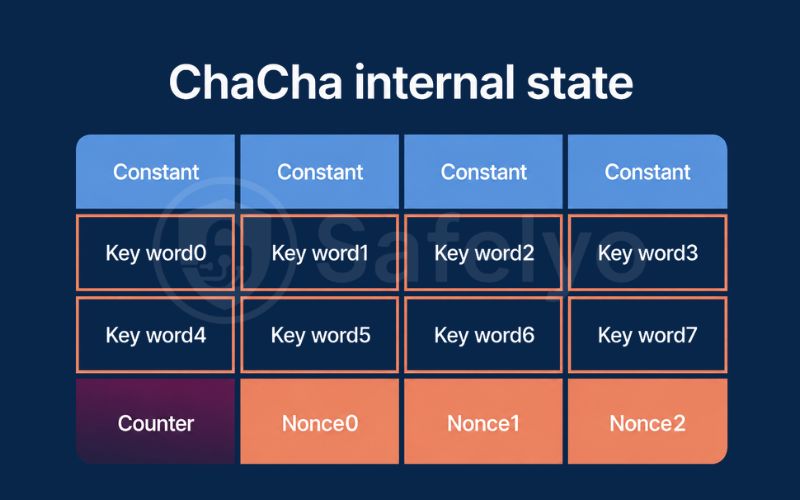
To begin encrypting, the cipher first builds its internal state using three specific ingredients. It requires a 256-bit secret key, a unique numerical value called a nonce, and a sequential block counter.
The key provides the secret material for encryption, while the nonce and counter help ensure that ChaCha20 generates a different keystream block for each part of the message. As long as the same nonce and counter are not reused with the same key, the output remains unique for that encryption process.
2.2. Creating the keystream and using XOR
Once the initial state is set, the algorithm generates a continuous flow of pseudo-random bytes called a keystream. This keystream is then combined with your actual data using a fundamental mathematical operation called XOR, short for exclusive OR.
When the keystream and your plaintext are XORed, they produce unreadable ciphertext. To access the original data, the receiver uses the same key and nonce to generate the same keystream, then reverses the XOR process to recover the plaintext.
2.3. The ARX core operations
Unlike some encryption algorithms that rely on complex lookup tables, ChaCha20 is built around simple mathematical functions. It uses only Addition, Rotation, and XOR operations, collectively known as the ARX design.
Because it avoids lookup-table-heavy operations, the ARX core allows ChaCha20 to run exceptionally fast in software. This design also helps reduce certain timing-attack risks, making the cipher efficient and practical across mobile devices, routers, and processors without dedicated AES hardware acceleration.
3. ChaCha20-Poly1305: Why ChaCha20 alone is not enough
While the base algorithm is excellent at hiding private information, simply scrambling data does not guarantee a safe internet connection. Modern cybersecurity requires more than confidentiality to protect your data against active network attacks.
You must also verify that your encrypted message was not maliciously altered while traveling to its final destination. This is why modern protocols usually pair ChaCha20 with Poly1305.
3.1. Confidentiality versus authentication
A standalone stream cipher can provide data confidentiality, meaning that anyone intercepting your web traffic sees only unreadable ciphertext. However, confidentiality alone does not prove that the message stayed unchanged during transmission.
An active attacker may try to modify bits inside the ciphertext, corrupt the payload, or interfere with how the receiving application processes the message. If the receiver decrypts altered data without first verifying its authenticity, the application may reject the data, behave unexpectedly, or expose itself to protocol-level risks.
To solve this problem, developers pair ChaCha20 with a cryptographic authenticator called Poly1305. Poly1305 generates an authentication tag that works like a tamper-evident seal for encrypted data packets. If an attacker changes even a single bit of the encrypted message, the authentication check should fail. The receiver can then reject the altered packet instead of trusting corrupted or manipulated data.
3.2. Authenticated encryption with associated data explained
When these two cryptographic tools operate together, they form the ChaCha20-Poly1305 construction. The Internet Engineering Task Force standardized this combination in RFC 8439 for use in modern network security protocols.
This pairing creates a system known as Authenticated Encryption with Associated Data, or AEAD. In simple terms, AEAD protects both the secrecy and the integrity of data.
ChaCha20 encrypts the main message to protect confidentiality, while Poly1305 verifies that the encrypted data and associated metadata have not been tampered with. This unified approach helps prevent manipulation attacks and ensures that the receiver can detect whether sensitive data was changed in transit.
4. ChaCha20 vs AES-256: Which encryption is better
When evaluating modern encryption standards, you will often see ChaCha20-Poly1305 compared with AES-256-GCM. Both are widely trusted when implemented correctly, but they are designed to perform best in different hardware environments.
The table below breaks down the primary technical differences to help you understand where each option shines.
| Factor | ChaCha20-Poly1305 | AES-256-GCM |
|---|---|---|
| Cipher type | Stream cipher plus authenticator | Block cipher in GCM mode |
| Key size | 256-bit | 256-bit |
| Best performance | Software-only devices, mobile devices, routers, and IoT | CPUs with AES-NI or hardware acceleration |
| Common use cases | WireGuard, TLS, and mobile-friendly encryption | TLS, traditional VPNs, and enterprise systems |
| Main implementation risk | Nonce reuse | Poor implementation, side-channel risk, and bad key handling |
| User takeaway | Excellent for modern VPN protocols like WireGuard | Still excellent on modern desktop and server hardware |
4.1. Security comparison
Cryptographers widely trust both ChaCha20-Poly1305 and AES-256-GCM when they are implemented correctly. In practical terms, the average attacker is far more likely to exploit poor implementation, weak key management, leaked credentials, or outdated protocols than to break either algorithm directly.
That distinction matters because strong encryption does not automatically make a system secure. A secure setup also depends on proper key generation, safe nonce handling, reliable cryptographic libraries, and a well-designed protocol. For stream ciphers such as ChaCha20, one of the most serious implementation risks is nonce reuse with the same secret key.
4.2. Performance and hardware acceleration
The biggest operational difference is performance across different hardware environments. Many modern desktops, laptops, and servers include AES-NI or similar hardware acceleration, allowing AES-GCM to run extremely fast.
However, some mobile devices, home routers, embedded systems, and older processors may not have strong AES hardware acceleration. In these software-only environments, the simple ARX design of ChaCha20 can perform very efficiently because it relies on fast CPU-friendly operations: Addition, Rotation, and XOR.
This is why ChaCha20 is often preferred in protocols that need strong encryption across many device types. It can deliver fast, consistent performance without depending on dedicated AES hardware.
4.3. Which one matters more for VPN users
As an everyday VPN user, you usually do not need to manually choose between ChaCha20 and AES-256. Both can provide strong protection when used inside a modern, well-implemented VPN protocol.
Instead of focusing only on the cipher name, pay attention to the broader security setup. A trustworthy VPN app should use modern protocols, safe key exchange, authenticated encryption, leak protection, and well-maintained infrastructure.
For most users, choosing a reputable VPN provider that supports WireGuard or another modern protocol is the practical way to benefit from ChaCha20 automatically. The goal is not to chase one “perfect” algorithm, but to use a secure protocol stack that is implemented correctly from end to end.
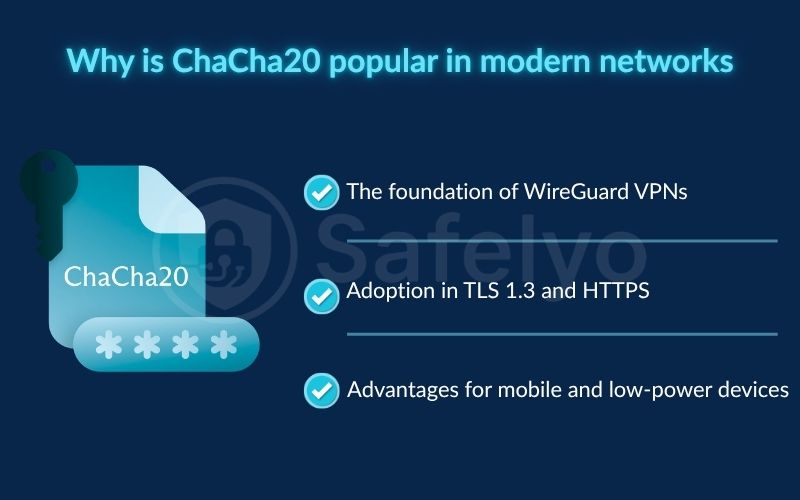
5. Why is ChaCha20 popular in modern networks
Since its introduction, ChaCha20 has become widely used in modern security protocols because it offers a strong combination of software performance, security, and implementation simplicity. It is especially valuable in environments where devices do not have dedicated AES hardware acceleration.
Instead of trying to replace AES everywhere, ChaCha20 gives protocol designers another efficient option. This is why you now see ChaCha20-Poly1305 in VPN protocols, HTTPS connections, mobile-friendly security systems, and other modern network applications.
5.1. The foundation of WireGuard VPNs
WireGuard is one of the most modern VPN protocols used today. According to its official documentation, WireGuard uses ChaCha20 for symmetric encryption and Poly1305 for authentication through an AEAD construction.
This design helps WireGuard keep its cryptographic setup simple, fast, and consistent across different devices. Because ChaCha20 performs well in software, WireGuard can deliver strong encryption without relying on dedicated AES acceleration.
For VPN users, this matters because it can help create a smoother experience on mobile phones, laptops, routers, and other devices. The result is not just strong encryption, but a protocol design that is practical for everyday private browsing.
5.2. Adoption in TLS 1.3 and HTTPS
When you browse a secure website, your connection is protected by Transport Layer Security, or TLS. In TLS 1.3, the cipher suite TLS_CHACHA20_POLY1305_SHA256 is included as a recommended option that compliant applications should implement.
This makes ChaCha20-Poly1305 an important part of modern HTTPS security. It gives browsers and servers a fast authenticated-encryption option, especially useful when one side of the connection does not have efficient AES hardware acceleration.
In practice, this means ChaCha20-Poly1305 can help maintain secure and efficient encrypted connections across a wide range of devices, from powerful servers to lightweight mobile hardware.
5.3. Advantages for mobile and low-power devices
Not every device has a high-end processor with dedicated cryptographic hardware. Older smartphones, budget Wi-Fi routers, embedded systems, and many smart home devices may have limited processing power or weaker AES acceleration.
Because ChaCha20 relies on the simple ARX design of Addition, Rotation, and XOR, it can process encrypted data efficiently through software alone. This helps reduce processing overhead in environments where AES-GCM may not perform as well without hardware support.
For users, that efficiency can translate into more stable VPN performance, smoother HTTPS browsing, and better energy efficiency in some mobile or low-power environments. The exact benefit depends on the device, operating system, and implementation, but ChaCha20 remains a strong choice when fast software-based encryption is needed.
6. Is ChaCha20 encryption safe to use
The short answer is yes, when it is implemented correctly. ChaCha20 and ChaCha20-Poly1305 are widely used in modern security protocols because they combine strong encryption with efficient software performance.
However, even a strong cipher can fail if it is integrated into software incorrectly. Real-world security depends not only on the algorithm but also on key management, nonce handling, cryptographic libraries, and the surrounding protocol design.
6.1. Why correct implementation matters
From a cryptographic standpoint, ChaCha20 is considered a strong modern stream cipher. RFC 8439 defines ChaCha20 with a 256-bit key, a 96-bit nonce, and a 32-bit block counter and also defines the combined ChaCha20-Poly1305 AEAD construction for authenticated encryption.
Still, the cipher alone does not make an entire system secure. If developers use weak random number generation, mishandle keys, reuse nonces, truncate authentication tags, or rely on unsafe library functions, the surrounding system can become vulnerable.
A strong cipher also cannot protect users from compromised devices, malware, phishing, leaked passwords, or poorly designed applications. This is why secure software needs both strong cryptography and careful engineering.
6.2. The danger of reusing a nonce
One of the most serious implementation risks for ChaCha20 is nonce reuse. In RFC 8439, the nonce is explicitly required to be unique for each invocation with the same key, and the ChaCha state description says the nonce must not be repeated for the same key.
This requirement matters because ChaCha20 is a stream cipher. If the same key and nonce are reused, the algorithm can generate the same keystream more than once. That can seriously weaken confidentiality by exposing relationships between plaintext messages.
In some situations, nonce reuse may allow attackers to recover parts of the original data, especially if they know or can guess part of one message. This is why correct nonce handling is a core security requirement when implementing ChaCha20.
6.3. Clarifying myths about hashing and RSA
Many beginners confuse different cybersecurity tools, but ChaCha20 is designed for reversible data encryption. It is not a password hashing algorithm, so it should not be used to store user passwords.
For password storage, use dedicated password hashing or password-based key derivation algorithms such as Argon2id, bcrypt, scrypt, or PBKDF2, depending on the security requirements and platform. OWASP recommends using modern, adaptive password hashing approaches instead of reversible encryption for password storage.
ChaCha20 also does not replace asymmetric cryptography such as RSA, ECDSA, EdDSA, or Diffie-Hellman-based key exchange. In modern protocols, asymmetric cryptography is usually used for authentication and key agreement, while fast symmetric algorithms such as ChaCha20 or AES protect the actual data after session keys are established.
For example, TLS 1.3 removed static RSA key exchange and uses modes such as DHE/ECDHE or PSK for key establishment, while certificate-based authentication can use digital signatures. After the handshake creates traffic keys, the connection uses symmetric AEAD algorithms such as AES-GCM or ChaCha20-Poly1305 to protect application data.
7. ChaCha20 variants and related terms
Cryptographers sometimes create related cipher variants to solve specific performance, nonce-management, or security-margin problems. ChaCha20 is the standard twenty-round version most commonly discussed in modern network security, but it belongs to a larger family of related algorithms.
Understanding these related terms helps you avoid confusion when you see names like Salsa20, XChaCha20, ChaCha8, or ChaCha12 in technical documentation.
7.1. Salsa20 vs ChaCha20
While both algorithms share the same cryptographic lineage, several design updates make the newer variant better suited to many modern network-security use cases. The table below outlines the core differences between these two closely related ciphers.
| Technical feature | Salsa20 | ChaCha20 |
|---|---|---|
| Release year | Designed in 2005 | Published in 2008 |
| Creator | Daniel J. Bernstein | Daniel J. Bernstein |
| Core structure | ARX-style stream cipher | Modified ARX-style stream cipher |
| Diffusion per round | Strong original design | Improved diffusion per round |
| Software speed | Very fast | Often very fast, depending on the implementation |
| Modern adoption | eSTREAM portfolio and historical use | Standardized as ChaCha20-Poly1305 for IETF protocols and used in TLS and WireGuard |
Daniel J. Bernstein originally designed the Salsa20 family of stream ciphers in 2005 and submitted it to the eSTREAM project. It introduced a software-friendly design built around fast Addition-Rotation-XOR operations, laying important groundwork for later ARX-based stream ciphers.
Bernstein later published ChaCha as a variant of Salsa20 designed to improve diffusion per round while preserving efficient software performance. In practical terms, ChaCha20 became the version most users encounter today because ChaCha20-Poly1305 was standardized for IETF protocols and is used in modern systems such as TLS and WireGuard.
7.2. XChaCha20 explained
XChaCha20 is an extended-nonce variant of ChaCha20. Instead of the 96-bit nonce used by the IETF ChaCha20-Poly1305 construction, XChaCha20 uses a 192-bit nonce.
The main benefit is safer nonce management. A longer nonce greatly reduces the chance of accidental nonce collisions when nonces are generated randomly, especially in long-running or large-scale systems. The IETF XChaCha draft describes this as providing similar guarantees to the original construction, but with a much lower probability of nonce misuse.
However, XChaCha20 is not the default construction used in TLS 1.3 or WireGuard. For most VPN and HTTPS users, the standard term they will see is still ChaCha20-Poly1305.
7.3. ChaCha8 and ChaCha12
ChaCha8 and ChaCha12 are reduced-round variants of the ChaCha family. They use fewer mixing rounds than ChaCha20, which can improve performance but also reduce the security margin.
| Technical feature | ChaCha8 | ChaCha12 |
|---|---|---|
| Number of rounds | 8 rounds | 12 rounds |
| Relative speed | Faster than ChaCha12 and ChaCha20 | Faster than ChaCha20, usually slower than ChaCha8 |
| Security margin | Lower than ChaCha12 and ChaCha20 | Higher than ChaCha8, lower than ChaCha20 |
| Primary use case | Specialized performance-sensitive systems | Specialized systems that want a speed and security-margin balance |
| Mainstream VPN and HTTPS use | Not the usual default | Not the usual default |
ChaCha8 represents the more aggressive reduced-round option. Because it runs only eight rounds, it can be faster than the standard twenty-round version, but it also has a smaller security margin. For this reason, it is generally not the conservative default for mainstream VPN or HTTPS encryption.
ChaCha12 is a more balanced reduced-round option. It performs more internal mixing than ChaCha8 while still using fewer rounds than ChaCha20. This can make it useful in specialized systems where performance is important and the reduced security margin is acceptable.
For everyday readers, the key takeaway is simple: when a VPN, browser, or modern security protocol says it uses ChaCha20-Poly1305, it normally refers to the standard twenty-round ChaCha20 construction paired with Poly1305 authentication, not ChaCha8 or ChaCha12.
8. Should you choose ChaCha20 for your VPN
For most everyday users, you do not need to manually choose ChaCha20 or configure individual cipher suites. The practical way to benefit from this encryption is to use a reputable VPN app that supports WireGuard or a WireGuard-based protocol.
WireGuard uses ChaCha20 for symmetric encryption and Poly1305 for authentication, which is why many modern VPN apps can deliver fast, software-friendly protection across phones, laptops, routers, and other devices.
VPN providers such as NordVPN with NordLynx, Surfshark, and Proton VPN support WireGuard or WireGuard-based technology. Instead of adjusting cryptographic settings yourself, simply enable WireGuard when available and let the VPN app handle the encryption setup correctly.
9. Frequently asked questions
Is ChaCha20 better than AES?
It depends entirely on your device’s hardware capabilities. AES-256 is superior on modern computers equipped with dedicated AES-NI hardware acceleration, whereas ChaCha20 is significantly faster on mobile phones, tablets, and budget routers lacking specialized processing chips.
Is ChaCha20-Poly1305 secure?
Yes, it is incredibly secure. By combining data encryption with cryptographic authentication, it provides complete data confidentiality and integrity, making it a trusted standard for global tech companies and online financial transactions.
Does WireGuard use ChaCha20?
Yes, the WireGuard protocol relies exclusively on this specific stream cipher for symmetric encryption and uses Poly1305 to handle packet authentication. This streamlined cryptographic design is a primary reason why WireGuard is so much faster than older VPN protocols.
Can ChaCha20 be cracked?
No, there are currently no known practical attacks that can break this algorithm. With a 256-bit key size, brute-forcing the encryption is computationally impossible using modern global computing power.
Is ChaCha20 quantum-resistant?
It is not a post-quantum public-key algorithm, meaning it does not handle asymmetric key exchanges. However, as a symmetric 256-bit cipher, it maintains a massive security margin against generic quantum search attacks like Grover’s algorithm, keeping it highly secure against known quantum threats.
Is ChaCha20 used in HTTPS?
Yes, it is officially supported in the modern TLS 1.3 standard used to secure web traffic. It acts as an essential, high-speed fallback for web browsers communicating with servers that cannot handle heavy AES encryption efficiently.
Is ChaCha20 good for file encryption?
Yes, its fast software processing speeds make it an excellent choice for encrypting local files. It allows you to lock and unlock large files quickly without causing significant system lag on your computer or mobile device.
Is ChaCha20 the same as ChaCha20-Poly1305?
No, they are different tools. ChaCha20 is a stream cipher used exclusively for data encryption, while Poly1305 is an authenticator. When combined, they form an authenticated encryption system (AEAD) that protects both confidentiality and data integrity.
Is ChaCha20 safe for passwords?
No, it is a reversible encryption algorithm, which is highly unsafe for storing passwords. You must use one-way hashing functions like Argon2, bcrypt, or scrypt to protect user credentials securely.
Should I use an online ChaCha20 encryption tool?
Only use them for basic educational testing. You must never paste real passwords, private keys, or API tokens into online web tools, as these third-party websites can easily log and expose your sensitive data.
10. Conclusion
Understanding what is ChaCha20 helps explain why modern network protocols can deliver strong encryption without slowing down many everyday devices. Its efficient software-based design makes it especially useful for VPNs, HTTPS connections, and mobile-friendly security systems where dedicated AES hardware acceleration may not be available.
However, ChaCha20 works best when it is implemented correctly and paired with proper authentication, such as ChaCha20-Poly1305. For everyday users, the practical takeaway is simple: choose trusted apps, modern VPN protocols like WireGuard, and security tools that handle encryption safely in the background.
To keep improving your online privacy and reduce your digital risks, explore more beginner-friendly guides in Privacy & Security Basics category of Safelyo.