
Think of AES-256 encryption as the ultimate digital safe for your online life, a powerful standard that locks down your private data, making it unreadable to anyone without the exact mathematical key.
In an era where personal information is constantly targeted, understanding the technology that protects you isn’t just a bonus; it’s essential. Whether you are banking online, sending a private message, or connecting to public Wi-Fi via a VPN, this specific encryption standard is your strongest line of defense. This guide will demystify what is AES-256 encryption, how it scrambles your data, and why top cybersecurity tools rely on it to keep you safe in 2026.
Key Takeaways
- The gold standard: AES-256 is a symmetric block cipher trusted by governments, banks, and the military to protect top-secret data.
- How it works: It processes your data through 14 complex mathematical rounds of substitution and permutation to create unbreakable ciphertext.
- Quantum resistance: With a key length of 256 bits, it is widely considered future-proof against upcoming quantum computing attacks.
- VPN integration: Premium VPNs pair AES-256 with protocols like GCM to secure your web traffic on public networks without sacrificing streaming speeds.
1. What is AES-256 encryption?
The Advanced Encryption Standard (AES) is a symmetric block cipher that utilizes a massive 256-bit key to convert readable plaintext into unreadable ciphertext. It is currently the highest encryption level available and serves as the undisputed gold standard for global data protection.
The US National Institute of Standards and Technology (NIST) adopted this algorithm in 2001 to replace the aging Data Encryption Standard (DES). The older 56-bit system had become woefully vulnerable to brute force guessing, forcing the government to seek a much stronger replacement.
After a massive public competition, the Rijndael cipher created by two Belgian cryptographers emerged victorious. Today, this sophisticated standard performs 14 computational rounds of substitution and permutation to scramble data blocks, making it virtually impenetrable to current computing methods.
Because it is mathematically unbreakable, the National Security Agency (NSA) officially approved AES-256 to protect classified and top-secret government information. It has since become the trusted industry benchmark for securing premium VPN tunnels, password managers, and messaging apps globally.
2. How does AES-256 encryption actually work?
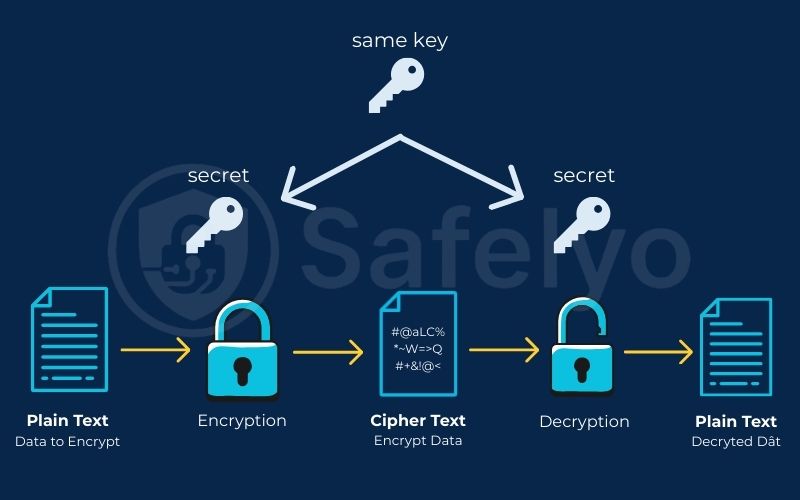
To understand the intricacies of this protocol, we must look at how it transforms plain text into an unreadable cipher. The process relies on a sophisticated substitution-permutation network that scrambles your data through multiple computational rounds.
2.1. The digital safe analogy
Imagine your most sensitive personal information, such as passwords, private messages, and bank details, as a collection of priceless jewels. Encryption is the process of putting these jewels into a digital safe and locking the door with a mathematical key.
Once locked, the contents are instantly scrambled into an unreadable mess of gibberish called ciphertext. To any hacker who intercepts your files without permission, your valuable data looks like complete, indecipherable nonsense.
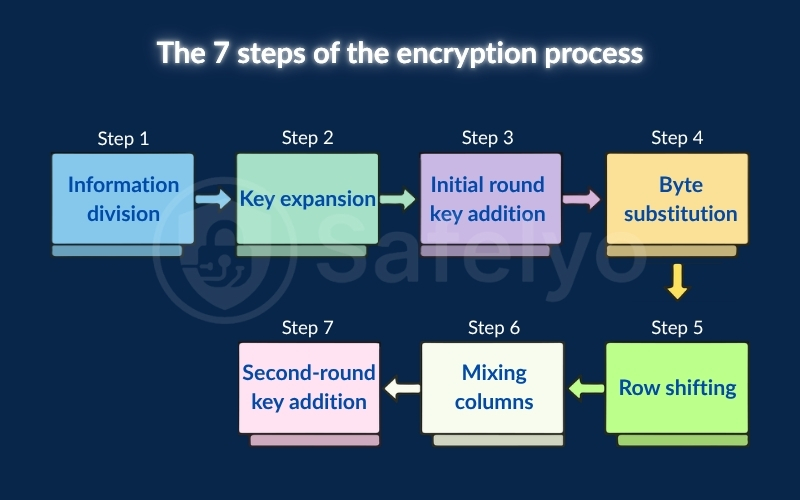
2.2. The 7 steps of the encryption process
When using a 256-bit key, the algorithm performs 14 computational rounds on your data. To understand how it creates an unbreakable ciphertext, let’s break down the exact seven steps involved in the operation:
- Step 1: Information division. The first step is dividing the information into blocks. Because AES uses a 128-bit block size, it divides the data into 4×4 columns, each containing exactly 16 bytes.
- Step 2: Key expansion. The algorithm creates multiple new “round keys” from your original first key. It heavily relies on the Rijndael key schedule to generate these keys for the upcoming computation passes.
- Step 3: Initial round key addition. Before the main scrambling begins, the algorithm inserts the initial round key into the data that has just been subdivided into the 4×4 blocks.
- Step 4: Byte substitution. In this crucial step, each byte of data is substituted with a completely different byte of data using a predefined mathematical lookup table.
- Step 5: Row shifting. The algorithm then proceeds to shift the rows of the 4×4 arrays. Bytes on the second row are shifted one space to the left, on the third row two spaces, and so on.
- Step 6: Mixing columns. To further obscure the original information, the algorithm uses a pre-established matrix to mix the 4×4 columns of the data array vertically.
- Step 7: Second-round key addition. The algorithm adds another round key to the block and then repeats the process from Step 4. For AES-256, this intensive cycle repeats for 14 total rounds.
2.3. Symmetric encryption explained
AES operates as a symmetric key cipher, meaning the exact same secret key is used for both encryption and decryption. Because it relies on a single shared key rather than an asymmetric two-key system, it requires significantly less computational power.
This efficiency makes symmetric systems incredibly fast and perfect for heavy internal workloads. It allows your devices to secure large file transfers, live video streams, and daily internet browsing seamlessly without experiencing any noticeable lag.
3. Is AES-256 encryption crackable by hackers
When security experts discuss “breaking” a cipher, they are usually referring to a brute-force attack. It is natural to wonder if modern hackers with advanced hardware can bypass this digital safe, but the mathematics prove that the threat level is virtually non-existent.
3.1. The brute force math problem
A brute-force attack involves a computer systematically trying every single possible key combination until it successfully guesses the correct password. For a 256-bit key, a hacker would have to try an astronomical 2256 distinct combinations.
To put this vast number into perspective, if you commanded the fastest supercomputer on Earth to try every combination, it would take millions of years to accomplish. Experts frequently note that the energy required to power a computer for that long would exceed the total thermodynamic output of the sun.
Therefore, when cybersecurity firms state that this algorithm is uncrackable, it is not a marketing exaggeration. For all practical, real-world scenarios today, attempting to break this specific encryption method by brute force is mathematically impossible.
3.2. AES-256 versus quantum computing
The only theoretical threat to this encryption standard is the rapid development of quantum computing. Modern quantum machines use Grover’s algorithm, which could potentially halve the effective security of symmetric ciphers, turning a 256-bit key into a 128-bit equivalent threat level.
However, even if a mature quantum computer halves its strength, 128 bits of security still provides an unbreakable defense against current cyber threats. Because it retains this massive security buffer, industry experts consider AES-256 to be highly quantum-resistant and the safest long-term choice for data protection.
4. AES-128 versus AES-256: Which standard do you need
When choosing security tools, you will often see both of these encryption versions offered. The primary functional difference between them is the length of the secret key and the number of computational rounds used to scramble your information.
While both standards provide exceptional protection, your choice depends on balancing maximum performance with ultimate long-term security. The table below cuts through the marketing hype to compare their real-world specifications directly.
| Feature or Metric | AES-128 | AES-256 |
|---|---|---|
| Key Size | 128 bits | 256 bits |
| Encryption Rounds | 10 computational rounds | 14 computational rounds |
| Security Level | Extremely secure | Top secret government standard |
| Performance Impact | Extremely fast (lower CPU usage) | Fast (slightly higher CPU usage) |
| Best Use Case | Everyday browsing and smart devices | Highly sensitive data and premium VPNs |
Security and brute force resistance
Both algorithms are practically uncrackable by modern computers. A 128-bit key is complex enough to protect everyday consumer data securely. However, a 256-bit key requires significantly more computational power to generate, providing a massive defensive shield against sophisticated, state-sponsored cyberattacks.
Performance speed and hardware overhead
Because AES operates as a symmetric encryption cipher, both versions process data extremely efficiently. However, the 128-bit version requires fewer processing rounds, making it slightly faster and noticeably better at preserving battery life on older smartphones and low-power smart home routers.
Future-proofing and threat mitigation
Data breaches cause irreparable damage to personal and corporate reputations. Upgrading to a 256-bit framework provides a vital contingency plan. Its massive key size is designed specifically to withstand the future emergence of quantum computers, ensuring your private data remains completely locked for decades.
The final verdict: Which should you choose
If your priority is squeezing out the absolute maximum internet speed for competitive online gaming or utilizing older devices, then AES-128 is the most efficient and secure choice. It handles heavy media streaming effortlessly while keeping your digital identity completely safe.
Conversely, if you demand absolute peace of mind against all current and theoretical cyber threats, you must select AES 256. It is the mandatory security benchmark for premium privacy applications, making it the undisputed gold standard for protecting your daily online life in 2026.
5. Why top VPNs rely on AES-256 encryption
When you evaluate a premium privacy tool for your daily use, its encryption standard is the most critical factor. The world’s top security providers exclusively build their networks around the 256-bit algorithm because it guarantees absolute digital anonymity in highly hostile environments.
5.1. Securing data in transit on public networks
Whenever you connect to a free public Wi-Fi hotspot at a coffee shop or airport, your unencrypted data is entirely visible. Local hackers routinely monitor these open networks, hoping to intercept your passwords, credit card numbers, and private chat messages effortlessly.
A premium VPN utilizes 256-bit encryption to scramble your internet traffic before it ever leaves your device. This heavy military-grade defense ensures that even if a cybercriminal successfully intercepts your data packets mid-air, the contents remain completely unreadable and securely locked.
5.2. Preventing ISP surveillance and bandwidth throttling
Internet service providers actively monitor your daily browsing history and frequently throttle your bandwidth if they detect heavy video streaming. Because this algorithm creates a mathematically unbreakable tunnel, your ISP cannot see the specific websites you visit or the files you download.
By masking your actual network activity, your provider is forced to treat all your traffic equally. This prevents them from applying artificial speed limits, ensuring that your 4K Netflix streams and large peer-to-peer downloads process quickly and without frustrating buffering interruptions.
5.3. Advanced protocols: AES-256-GCM vs AES-256-CBC
Modern VPN providers have also optimized how they apply this encryption to maximize your internet speed. Many legacy systems used the Cipher Block Chaining (CBC) mode, which processed data blocks slowly and sequentially, often resulting in noticeable network lag.
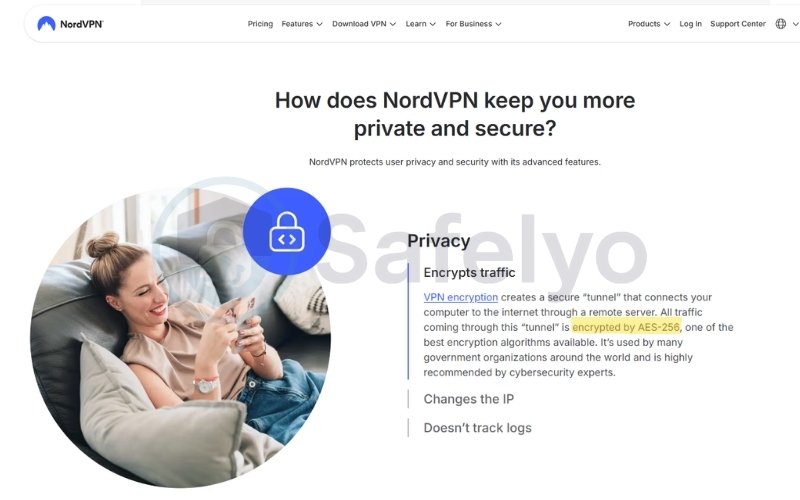
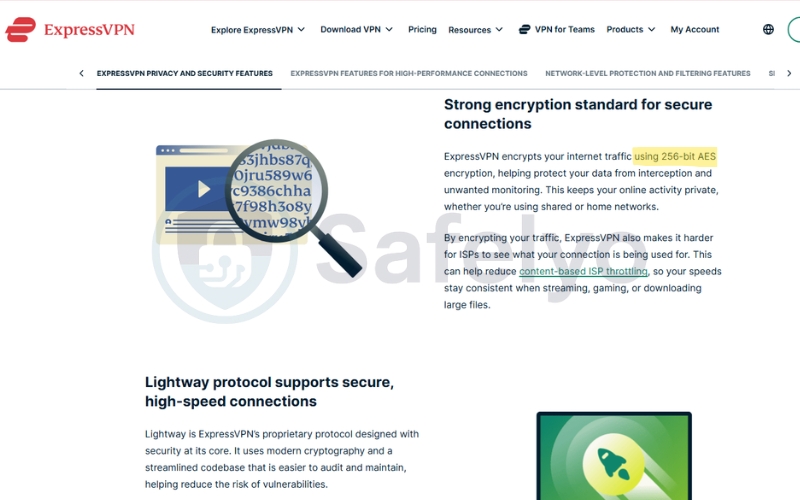
Today, elite providers like NordVPN and ExpressVPN use the superior Galois/Counter Mode (GCM). This advanced mode encrypts and authenticates your data simultaneously in parallel rather than sequentially. This massive efficiency upgrade ensures your secure connection remains incredibly fast for real-time multiplayer gaming.
6. Where else do you use AES-256 every day
You might think that top secret cryptographic mathematics is reserved exclusively for government intelligence agencies and high-tech espionage. In reality, you interact with this powerful algorithm thousands of times a day, silently protecting your digital life without you ever noticing.
- Secure messaging apps
When you send a text or a photo through modern communication platforms like WhatsApp or Signal, your messages are secured. These applications rely on this exact 256-bit standard to facilitate their end-to-end encryption, guaranteeing that only the recipient can read your private conversations.
- Password managers
Security applications like 1Password and NordPass use this algorithm to construct the impenetrable digital vault where you store your credentials. Your master password acts as the unique 256-bit key, ensuring that even if the company’s servers are breached, hackers cannot view your saved passwords.
- Online banking and HTTPS websites
Every time you log into your digital banking portal or see the small padlock icon in your browser address bar, this algorithm is active. It works alongside the TLS protocol to scramble your sensitive financial data and credit card numbers during checkout, keeping your online shopping completely secure.
7. Frequently asked questions
What does military-grade encryption mean?
It is primarily a marketing phrase used by software companies to indicate they use the 256-bit encryption standard. It gained popularity because the United States National Security Agency officially approved this specific key length for protecting classified, top-secret government intelligence files.
Who invented AES encryption?
It was developed by two highly skilled Belgian cryptographers named Vincent Rijmen and Joan Daemen during the late nineties. Their submission, originally called the Rijndael cipher, won a rigorous public competition hosted by the US National Institute of Standards and Technology to replace older, vulnerable security protocols.
Does AES-256 slow down internet speed?
All security protocols introduce a slight processing overhead, but on modern computers and smartphones, the speed reduction is practically unnoticeable. Modern processors include specialized hardware acceleration built directly into the microchip to handle these complex mathematical operations incredibly fast without causing network lag.
Can my internet provider bypass AES-256?
No, it is mathematically impossible for your internet service provider to bypass or decipher this level of encryption. When you use a secure VPN tunnel, your provider only sees that you are transmitting scrambled, unreadable data packets, ensuring your exact browsing history remains completely hidden from their surveillance.
Are brute-force attacks effective against AES-256?
Absolutely not. A brute-force attack involves hackers using powerful computers to guess every single possible key combination sequentially. Because a 256-bit key has more possible combinations than there are atoms in the universe, it would take the world’s fastest supercomputers billions of years to crack it.
Does AES-256 drain my smartphone battery?
While encrypting and decrypting data requires CPU processing power, modern mobile devices are specifically built to handle this workload efficiently. Smartphone processors feature dedicated hardware acceleration that manages AES algorithms seamlessly, ensuring your VPN runs smoothly in the background without causing severe battery drain.
Is AES-256 safe from quantum computing attacks?
Yes, cybersecurity experts currently consider AES-256 to be highly quantum-resistant. While future quantum machines might weaken older cryptographic standards, the massive key size of this specific algorithm provides a permanent security buffer that protects your data against tomorrow’s most advanced computational threats.
8. Conclusion
Understanding exactly what is AES-256 encryption reveals why it remains the ultimate mathematical shield for our modern digital lives. By scrambling your private data through fourteen complex computational rounds, this symmetric block cipher provides a powerful defense that is computationally infeasible to break using current technology.
While this standard protects everything from secure messengers to online banking, managing your keys is just as critical. To build a strong foundation of knowledge and protect your digital devices, explore our detailed tutorials in the Privacy & Security Basics category at Safelyo today.