
We hear a lot about encryption, the process of locking our data away in a digital safe. But what happens next? Decryption is the process of converting encrypted data (ciphertext) back into readable information (plaintext) using a cryptographic key and algorithm.
As a cybersecurity analyst, I’ve noticed people are often fascinated by encryption, the unbreakable lock. But true digital security is a complete cycle. Understanding what is decryption is just as crucial because a lock is only as good as the process for opening it safely. It’s the moment of truth where your data is either securely revealed to you or remains useless code.
Key takeaways:
- Decryption is the process of converting ciphertext back into plaintext.
- It is the counterpart to encryption, completing the cycle of a protected connection.
- It always requires a decryption key and a specific decryption algorithm.
- It’s a fundamental process for legal compliance and security in your VPN, password manager, and messaging apps.
Your data’s security relies on both a strong lock and a secure key. Let me demystify the art of unlocking digital secrets and show you how decryption works to keep your information safe.
1. What is decryption?
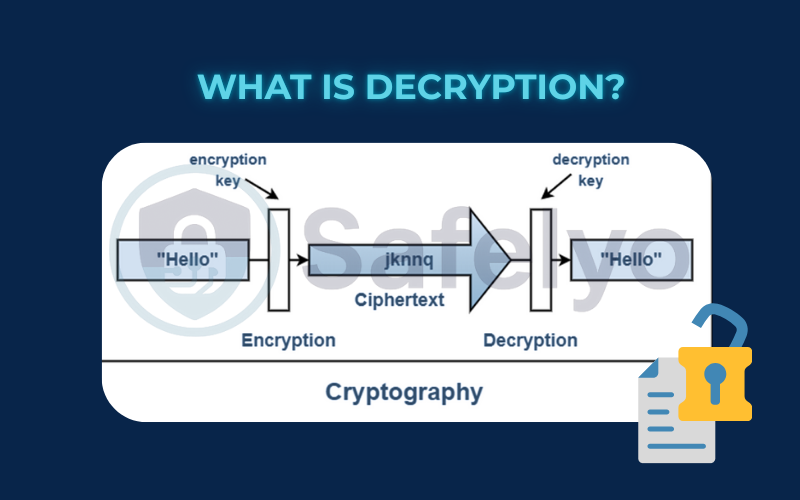
Decryption is the fundamental cryptographic process of converting previously encrypted data back into its original, human-readable form. It is the direct mathematical inverse of encryption, designed to allow authorized parties or computer systems to recover and utilize protected information safely.
To understand this easily, imagine sending a secret message in a locked box:
- Plaintext: Your original, readable message (e.g., “Meet me at noon”).
- Encryption: Placing the message inside a secure lockbox and snapping the lock shut.
- Ciphertext: The locked box itself. To anyone who intercepts it, the content is scrambled and completely unreadable (e.g., “Xq$#fG&jK”).
- Decryption: Your friend is using the correct key to open the box, restoring the scrambled ciphertext into the readable plaintext message.
Without possessing the specific decryption key, the protected data typically remains completely undecipherable. This strict access control mechanism ensures that only the intended recipient can successfully unlock and read the sensitive files or communications.
2. The components of a successful decryption process
Restoring protected information is not a simple one-step action. It requires a highly coordinated interaction between specific cryptographic elements to ensure the data is unlocked safely and accurately.
- Ciphertext (The locked data)
Ciphertext represents your information while it is in its secure, unreadable state. It is the scrambled output created by the initial encryption process and looks like random gibberish to anyone who intercepts it during transmission or storage.
- Decryption algorithms
These are the complex mathematical rule sets, such as AES or RSA, used to reverse the scrambling process. The algorithm dictates exactly how the data must be rearranged and processed to return the ciphertext to its original structure.
- Decryption keys
A decryption key is a secret string of characters that acts as the physical “key” to open the mathematical lock. The algorithm requires this specific key to authorize the reversal process, ensuring that only the holder can successfully restore the plaintext.
3. How does decryption actually work
The process of turning scrambled text back into readable information happens in a strict logical sequence. Your device hardware and security software handle these complex mathematical steps automatically in the background to restore your files.
- Step 1: Receiving the encrypted data
The process initiates when your computer or application retrieves protected data from storage or a network sender. At this initial stage, the information arrives entirely as ciphertext, which looks like a jumbled string of unreadable characters to the system.
- Step 2: Applying the algorithm and decryption key
Next, your system applies a predefined decryption algorithm, which acts as the exact mathematical inverse of the original encryption method. The system then introduces the specific decryption key into this algorithm to initiate the reversal process securely.
- Step 3: Generating the readable plaintext
With the correct key in place, the algorithm successfully reverses the data scrambling process. This final action converts the ciphertext back into its original plaintext form, allowing the authorized recipient to access and read the information normally.
4. Encryption vs. Decryption: Two sides of the same coin
As you can see from our lockbox analogy, encryption vs. decryption aren’t opposing forces. They are two essential halves of a single, secure process. One cannot exist meaningfully without the other. When I’m evaluating the security of an app, I’m not just looking at how strong its encryption is but also how securely it handles decryption.
Here’s a simple breakdown of their relationship:
| Aspect | Encryption (Locking) | Decryption (Unlocking) |
|---|---|---|
| Purpose | To protect data from advanced persistent threats by making it unreadable to unauthorized parties. | To make encrypted data readable again for authorized parties. |
| Input | Plaintext (readable data) | Ciphertext (scrambled data) |
| Output | Ciphertext (scrambled data) | Plaintext (readable data) |
| Requirement | An encryption key & algorithm | A decryption key & decryption algorithm |
| Analogy | Putting a message in a lockbox and snapping the lock shut. | Opening the lockbox with the correct key to read the message. |
| Direction | Turns something useful into something secret. | Turns something secret back into something useful. |
Thinking about ciphertext vs. plaintext is the easiest way to remember the difference. Encryption creates a ciphertext, and decryption reveals the original plaintext. They are the start and end points of a secure data journey.
5. The two types of keys: Symmetric vs. Asymmetric decryption
Not all locks and keys are created equal. In the world of cryptography, there are two fundamental methods for locking and unlocking our secret box. Understanding the difference between them is key to appreciating how modern security tools, from VPNs to secure messaging apps, actually work.
5.1. Symmetric decryption (the identical key)
This is the simplest method to understand. In symmetric encryption, the very same key is used to both lock and unlock the box.
- Here’s how it works: You place your message inside the box, lock it, and send it to your friend. A new problem appears when you try to get the key to them safely. You must deliver a matching key through another protected route. If someone intercepts it, they can open the box.
- The Trade-off: The main challenge is secure key distribution. However, the performance impact is low as the process is extremely fast.
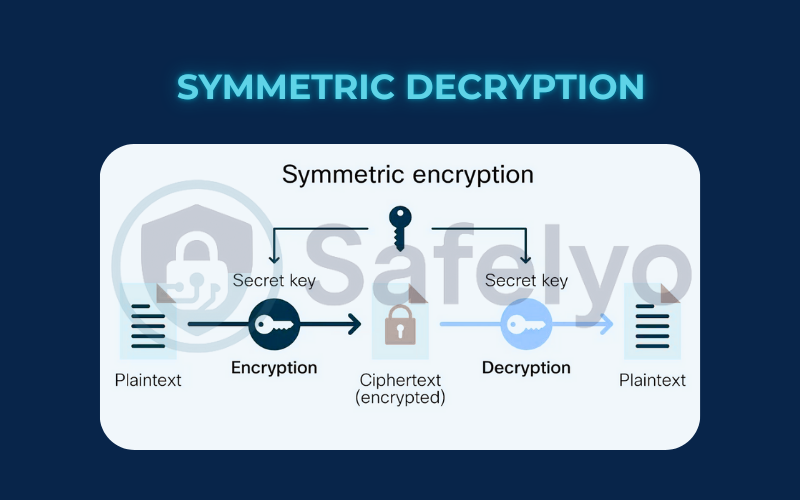
Used For: This speed makes it perfect for encrypting large amounts of data quickly. It’s the core technology behind the powerful AES encryption used in your VPN and for protecting the files on your hard drive.
5.2. Asymmetric decryption (the two-key system)
This is a much more clever and elegant solution to the key-sharing problem. In what’s also known as public-key cryptography, your friend has two keys that work together as a mathematical pair:
A public key, which is like an open padlock. They can give this padlock to anyone in the world without any risk. A private key is the one-of-a-kind key that can open that specific padlock. They guard this key with their life.
- How it works: You want to send your friend a secret message. You ask for their public padlock, use it to lock your box, and send it off. Once that padlock is snapped shut, the only thing in the entire world that can open it is their unique private key. You never had to share a secret key.
- The Trade-off: This process is more complex and therefore slower than the symmetric method.
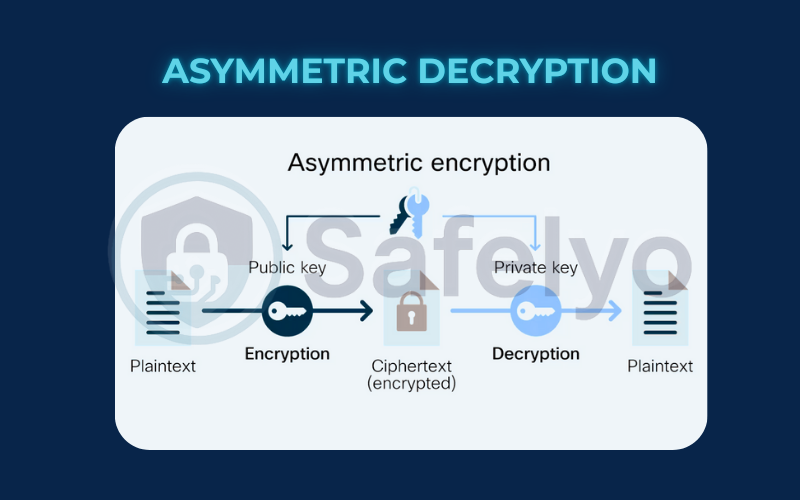
Used For: Its incredible security for establishing connections makes it the backbone of the internet. It’s used to establish a secure connection when you visit an HTTPS website, and it relies on the RSA algorithm. It’s also employed in messaging apps like Signal to achieve perfect forward secrecy by securely exchanging symmetric keys for each session.
5.3. Symmetric vs asymmetric decryption
Here’s a quick summary of the symmetric vs. asymmetric decryption approaches:
| Feature | Symmetric Decryption (One Identical Key) | Asymmetric Decryption (Two-Key System) |
|---|---|---|
| Keys Used | One shared secret key for both encryption and decryption. | A public key to encrypt and a separate private key to decrypt. |
| Speed | Very fast. Ideal for large amounts of data. | Slower. Best for small amounts of data, like sharing keys. |
| Key Management | Difficult. Securely sharing the secret key is the main challenge. | Easier. The public key can be shared openly without risk. |
| Primary Use | Bulk data encryption (VPN traffic, file encryption). | Secure key exchange, digital signatures, and start secure sessions. |
6. How does decryption power your daily cybersecurity tools
Decryption isn’t just a theoretical concept; it is the hidden engine powering the security applications you rely on every day. Here is how this process works in practice to keep your digital identity safe.
6.1. Password managers (Local decryption)
When you use a secure password manager, your stored credentials are saved on cloud servers as a single, heavily encrypted block of ciphertext.
- How it works: When you enter your correct master password, your device localizes this input to generate the unique decryption key. The app then performs the decryption locally on your device, revealing your plaintext passwords.
- Why it matters: Because the decryption happens on your local hardware, even the password manager company never possesses the key to view your saved login details.
6.2. Virtual private networks (VPNs)
Virtual private networks rely heavily on symmetric encryption to protect your daily browsing from Internet Service Provider (ISP) surveillance.
- How it works: Before any data leaves your device, your VPN app encrypts it. Once this ciphertext reaches the remote VPN server, the server uses a matching symmetric key to perform the decryption process, allowing it to read and safely forward your web request.
- Why it matters: This continuous cycle of encryption and decryption ensures that no third party on the local network can intercept and read your web traffic.
6.3. HTTPS and secure web browsing
Every time you visit a secure website with a padlock icon in your browser, a complex cryptographic exchange occurs in the background.
- How it works: Your browser and the web server perform an initial secure handshake to agree on a session key. The web server then sends scrambled data, which your browser instantly decrypts using that specific session key.
- Why it matters: This invisible process allows you to safely read articles, enter credit card details, and log in to bank accounts without exposing your data to network monitors.
6.4. End-to-end encrypted messaging (e.g., Signal or WhatsApp)
End-to-end encryption ensures that your private conversations remain private, relying on a combination of asymmetric and symmetric methods.
- How it works: Messages arrive on your phone as unreadable ciphertext. Your messaging application utilizes the private key stored securely on your device to execute the final decryption, converting the data back into readable text.
- Why it matters: Because only the sender and receiver hold the necessary keys, no intermediary, not even the messaging platform’s servers, can decrypt and read your private texts.
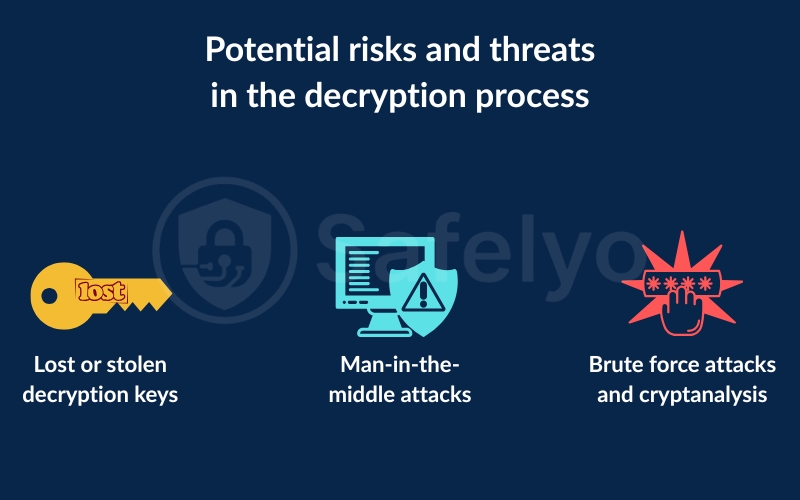
7. Potential risks and threats in the decryption process
While cryptographic algorithms are mathematically highly secure, the overall process still faces significant vulnerabilities. Most modern cybersecurity breaches occur not because the algorithm failed but because attackers exploited weaknesses in how the secret keys are managed or transmitted across networks.
- Lost or stolen decryption keys
The most common vulnerability in this security model lies in human error regarding key management. If you lose your private key, your data generally remains locked forever, similar to a lost cryptocurrency wallet. Conversely, if a hacker steals your active key, they bypass the algorithm entirely and access your files effortlessly.
- Man-in-the-middle attacks
During active network transmission, bad actors can intercept the communication pathway between the sender and receiver. In a man-in-the-middle attack, the hacker attempts to steal the session keys or secretly downgrade the security protocol. This allows them to unlock and read sensitive data while it travels over public internet connections.
- Brute force attacks and cryptanalysis
When hackers cannot steal the key directly, they may attempt to guess it using massive computational power. A brute force attack involves running specialized software to try millions of key combinations per second. While modern AES standards resist these methods, older algorithms remain highly vulnerable to advanced cryptanalysis.
8. Real-world examples of forced decryption
Understanding how experts force their way into locked data highlights the incredible power of cryptography. History and modern cybersecurity are filled with fascinating examples where breaking a complex code changed the course of events or saved critical corporate files.
8.1. Cracking the Enigma code in WWII
During the Second World War, the Allied forces faced the highly complex military Enigma machines. Cryptanalysts at Bletchley Park, building on earlier work by Polish mathematicians, developed specialized machines like the Bombe to identify daily settings.
This massive collaborative effort successfully unlocked intercepted communications to provide crucial intelligence. Many historians agree that this specific cryptanalysis breakthrough helped shorten the global conflict significantly and saved countless lives.
8.2. Ransomware data recovery tools
Modern cybercriminals use malicious software to lock personal files and demand heavy payment for the unlocking keys. However, victims can often look for specialized ransomware data recovery tools to unlock their hijacked files safely without paying the ransom.
Most successful recovery efforts exploit implementation mistakes, leaked keys, or operational weaknesses rather than defeating the cryptography itself. If researchers discover these specific flaws, they often develop free recovery tools for the public.
These specialized programs allow affected businesses and individuals to successfully unlock their hijacked files safely. This ensures victims can recover their sensitive digital data without ever paying the criminal’s ransom demands.
9. FAQ about decryption
What is the difference between encryption and decryption?
Encryption is the process of scrambling readable plaintext into unreadable ciphertext to secure it. Decryption is the exact reverse operation, turning that scrambled ciphertext back into its original, readable plaintext format using a specific key.
What is the difference between decryption and decoding?
Decoding converts data from one standard format to another (such as translating Morse code into English or binary data into a playable video file) using publicly available rules without any secret parameters. Decryption specifically requires a secret cryptographic key to unscramble data that has been intentionally hidden.
What happens if I lose my decryption key?
If you lose your private decryption key and have no backup, your encrypted data becomes permanently inaccessible. Because modern algorithms are incredibly secure, there are no administrative backdoors or master reset switches to recover your files.
Can something be decrypted without the correct key?
For industry-standard algorithms like AES-256, it is mathematically impossible to decrypt the data within a reasonable timeframe without the key. Attackers must rely on finding software vulnerabilities, stealing the key, or using brute force to guess weak passwords rather than breaking the core mathematics.
Will quantum computers be able to decrypt our current data?
Yes, this is a legitimate future concern known in cybersecurity as the “harvest now, decrypt later” threat. Future quantum computers running advanced algorithms (like Shor’s algorithm) could theoretically break current public-key cryptography (like RSA). This risk has prompted the global security community to actively develop and transition to quantum-resistant (post-quantum) cryptography today.
10. Conclusion
Understanding what is decryption reveals the true foundation of modern digital privacy. Even the most complex mathematical padlocks are useless if your secret keys are compromised by simple human error, weak passwords, or poorly secured software.
Protecting your digital identity requires utilizing tools that handle these complex mathematical transformations securely in the background. Premium applications ensure your private keys are isolated and stored safely to prevent unauthorized access to your personal files.
Taking control of your digital footprint starts with building a solid foundation of knowledge. To learn more about securing your daily browsing habits and choosing the right cryptographic tools, explore the Privacy & Security Basics category at Safelyo today.