
If you use WhatsApp, Signal, or iMessage, you’ve likely noticed a small notification pop-up mentioning ‘end-to-end encryption.’ But what is end-to-end encryption exactly, and how does it actually protect your personal conversations from hackers?
As cybersecurity researchers at Safelyo, we regularly audit these messaging protocols. In this guide, we will break down the mechanics of how this technology secures your data while exploring the critical privacy limits you still face in 2026.
Key Takeaways
- What is end-to-end encryption? End-to-end encryption is an advanced communication method that scrambles your data so that only the sender and the intended receiver can read the messages.
- Total privacy: It actively prevents your internet provider, malicious hackers, and even the application developers themselves from accessing your private texts.
- Hidden vulnerabilities: While it robustly protects the content of your messages, it still leaves your metadata exposed, revealing who you talk to and your network location.
- The ultimate setup: Combining this secure messaging technology with a premium virtual private network completely hides both your conversation data and your true digital identity.
1. What is end-to-end encryption?
End-to-end encryption (E2EE) is a secure communication method that encrypts data on the sender’s device and decrypts it only on the recipient’s device. Under this protocol, internet providers, hackers, and even the app developers themselves cannot intercept or read your private conversations.
In an E2EE system, intermediate messaging servers act purely as blind digital couriers. They transport your data across the internet but never possess the cryptographic keys required to unlock and read it.
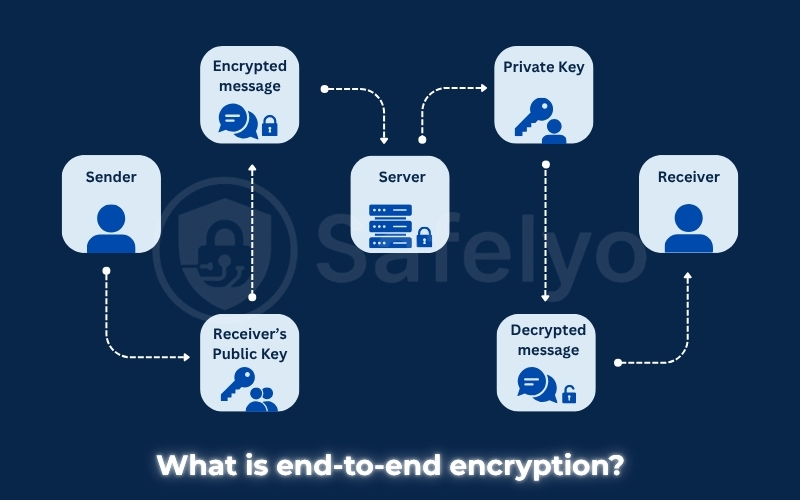
To understand this, imagine sending a physical message inside a heavy steel box. Your recipient sends you an open padlock (their public key) to snap the box shut. Once locked, the box travels through the postal system. While couriers know exactly where to deliver it, only the recipient holds the unique physical key (their private key) that can open that padlock. Even if a third party intercepts the box, they cannot pry it open.
2. How does end-to-end encryption work?
Understanding complex cryptographic algorithms can quickly become overwhelming for everyday internet users. To understand how your phone executes this digital security behind the scenes, let’s look more closely at the mechanics of the keys that open the steel box we mentioned earlier. This process relies on a clever cryptographic concept called asymmetric encryption.
2.1. Key generation and distribution
The process begins with both you and your contact generating a pair of cryptographic tools: a public key and a private key. Your public key acts like an open padlock that you share freely with anyone who wants to communicate with you. Conversely, your private key is your personal secret unlocking tool that remains hidden deep inside your specific smartphone or computer.
2.2. The encryption and transmission process
When someone sends you a message, their device uses your public key to lock the text inside the digital box. This rapid encryption occurs instantly on their phone, transforming readable plaintext into unreadable ciphertext before the data even reaches the internet.
The scrambled data packet then travels through various telecom networks. Even if intercepted, no one can decipher the encryption without the recipient’s private key.
2.3. Decryption and message integrity
When the locked box finally reaches your device, your application uses your unique private key to unlock it. The software decrypts the text instantly, converting it back into its original readable form so you can view it clearly on your screen. Because the intermediate servers never possess your private key, your conversation remains impenetrable during transit. This ensures both confidentiality and integrity, meaning the message has not been altered in transit.
3. How E2EE differs from other encryption methods
Different cryptographic methods are engineered for different security purposes. The table below provides a quick comparison of the five most common encryption types to help you understand where and how your data is protected.
| Encryption Type | State Protected | Midpoint Decryption | Primary Use Case |
|---|---|---|---|
| E2EE | In transit | No | Private messaging and emails |
| TLS | In transit | Yes (At server endpoint) | Secure web browsing (HTTPS) |
| DARE | At rest | No | Hard drives and cloud databases |
| Link Encryption | In transit | Yes (At each network node) | Satellite and telecom lines |
| P2PE | In transit | Yes (Re-encrypted at terminal) | Retail payment processing |
While this table provides a useful high-level overview, each cryptographic method has unique technical nuances. Let’s analyze how these specific security models compare directly to end-to-end encryption.
3.1. E2EE vs. Transport Layer Security (TLS)
TLS secures your data as it travels between your web browser and a website server. However, once the data arrives, the service provider decrypts it and can read your information in clear, readable plaintext on their endpoint.
Conversely, E2EE bypasses the provider completely. Because only the final recipient has the private key required for decryption, no intermediate service provider can decode your messages during transit or on the server.
3.2. E2EE vs. data at rest encryption (DARE)
E2EE focuses entirely on securing active data as it moves across networks. In contrast, DARE secures inactive data stored physically on hard drives, mobile devices, and backup server databases.
This means that if a physical server is stolen, DARE prevents unauthorized users from accessing the stored files. E2EE, on the other hand, protects files only during transmission from one device to another.
3.3. E2EE vs. link encryption
E2EE encrypts data once at the source and decrypts it only at the final destination. On the other hand, link encryption is typically used for specific physical data paths, like satellite or telecom lines.
This difference is critical; link encryption decrypts and re-encrypts your data at every single connection node along the route. This potentially exposes your communication to intermediaries at those specific points, whereas E2EE never decrypts in transit.
3.4. E2EE vs. point-to-point encryption (P2PE)
While E2EE strictly encrypts and decrypts data once from start to finish, P2PE operates on a multi-stage model. It is heavily used in retail payment networks to secure credit card data during transactions.
P2PE allows the encrypted card data to be decrypted at a specific merchant terminal, encrypted once more, and then safely routed to the payment processor. E2EE never allows this intermediate decryption to occur.
4. Key benefits of end-to-end encryption
Deploying E2EE is about much more than just ticking a compliance box. At Safelyo, our security audits show that properly implemented E2EE is one of the most effective ways to defend digital rights and secure high-value business assets.
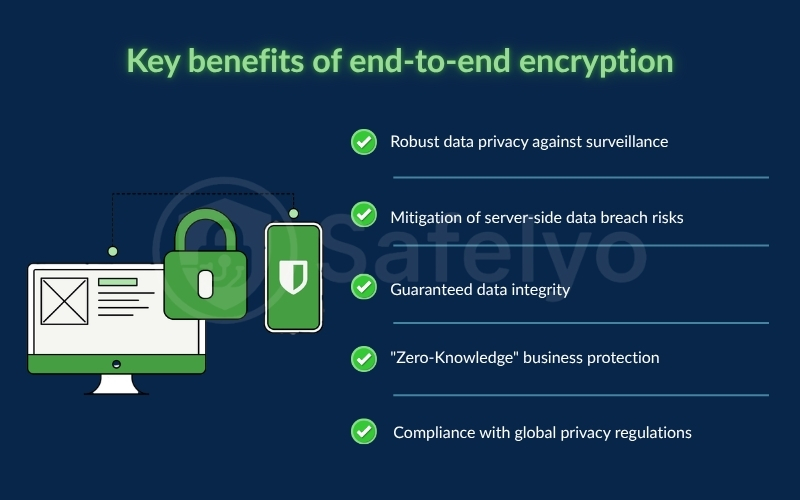
- Robust data privacy against surveillance
This architecture provides strong protection against unauthorized interception by ISPs, data brokers, and government surveillance systems. Because the decryption keys reside solely on your devices, third parties cannot easily read your personal files or profile your digital habits.
This privacy is crucial for defending free speech and safeguarding journalists, whistleblowers, and citizens. It allows individuals to share ideas and communicate with confidence, without fear of undue censorship or political targeting.
- Mitigation of server-side data breach risks
In standard networks, a compromised database exposes all stored, unencrypted messages. With E2EE, even if a service provider’s physical servers are breached in a massive hacking campaign, the stolen data remains completely scrambled and useless to the attackers.
This model shifts the target; hackers must execute highly difficult, targeted device-level attacks on individual endpoints rather than compromising a centralized database to harvest millions of accounts at once.
- Guaranteed data integrity (tamper prevention)
E2EE guarantees data integrity through cryptographic checks. If an attacker intercepts and alters a packet in transit, the decryption process fails on the recipient’s device. The message corrupts instantly, alerting both parties to the tampering attempt.
- “Zero-Knowledge” business protection
By adopting a “Zero-Knowledge” architecture, companies avoid the liability of hosting readable user data. Because the provider never holds the decryption keys, they cannot be legally forced to hand over cleartext customer information they do not possess.
- Compliance with global privacy regulations
E2EE helps businesses meet strict global data privacy mandates. Implementing this secure protocol makes it significantly easier to conform to rigorous, legally binding standards such as GDPR, HIPAA, and CCPA by keeping sensitive information permanently scrambled.
5. The limitations and challenges of end-to-end encryption
Despite its robust security benefits, this protocol is not a complete shield against all online privacy threats. Implementing and using this technology comes with significant practical challenges and critical security limitations you must consider.
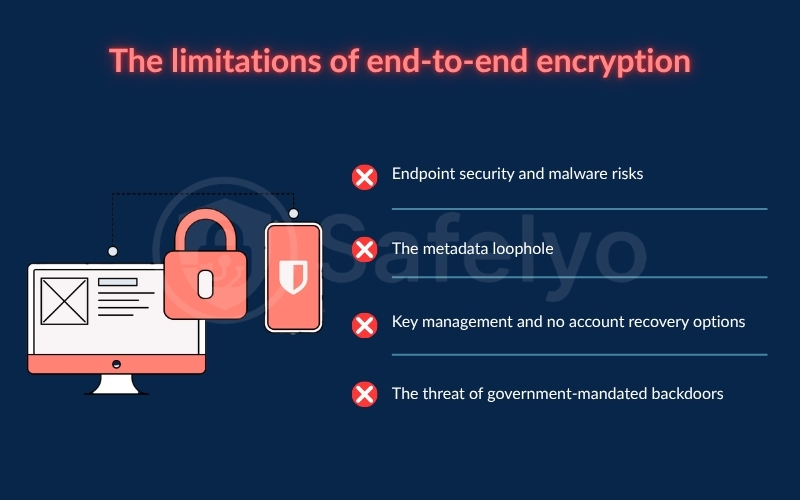
- Endpoint security and malware risks
This protocol only secures your data while it is actively in transit across networks. Once a message reaches its destination, any threat infiltrating the recipient’s device, such as spyware, keyloggers, or physical theft, can easily compromise the decrypted information.
- The metadata loophole
While E2EE scrambles the actual content of your message, it leaves your communication metadata completely exposed. Adversaries and network monitors can still easily track who you are talking to, when you are active, and your real IP address.
- Key management and no account recovery options
Because the service provider never holds your cryptographic keys, there is no administrative backup system. If you lose your private key or break the device where it is stored, you lose access to your encrypted data permanently with zero recovery options.
- The threat of government-mandated backdoors
Strong encryption is under constant pressure from law enforcement and government agencies seeking to prevent illegal activities. This has led to debates surrounding ‘backdoors’, intentional security weaknesses built into applications to allow authorized access. Cybersecurity experts warn that any backdoor created for authorities can ultimately be discovered and exploited by malicious hackers, threatening privacy for all users.
6. Do VPNs use end-to-end encryption
At Safelyo, we frequently receive messages from readers who confuse virtual private networks with end-to-end encrypted software. While both technologies utilize heavy cryptography to scramble data, they are designed to solve completely different security problems in your personal privacy stack.
6.1. The difference between VPN encryption and E2EE
A VPN secures your network connection by encrypting all traffic traveling from your device to a remote server. This is a client-to-server model, meaning your data is decrypted at the VPN server endpoint before it is forwarded to the public web.
Conversely, E2EE secures your data directly between the two communicating endpoints, completely bypassing any server decryption. This is a client-to-client model, which ensures that no third-party server ever holds the mathematical power to decode your secure payload.
6.2. Why combining a VPN with E2EE is the ultimate privacy setup
Our cybersecurity team highly recommends combining these two security layers to build a highly resilient digital shield against interception for your daily activities. While E2EE completely protects the actual content of your private messages, it still leaves your communication metadata exposed to local monitors.
By running a premium VPN alongside your encrypted messenger, you effectively cover this dangerous metadata loophole. The VPN masks your real IP address and local ISP, making it impossible for network monitors to see who you are communicating with or when you are online.
7. How to enable end-to-end encryption on popular apps
While applications like Signal and WhatsApp utilize this security protocol by default, other major platforms require you to turn it on manually. Here are the simple steps to secure your private conversations on Telegram and Facebook Messenger immediately, along with an update on Instagram’s latest protocol changes.
7.1. Telegram
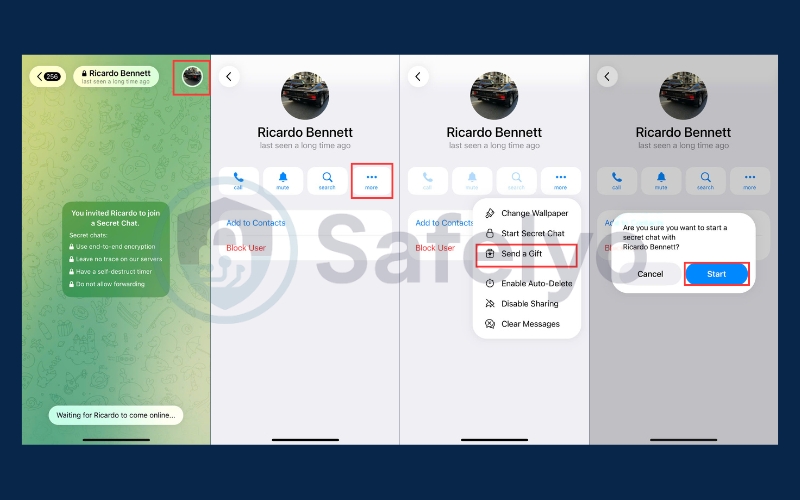
Telegram does not secure standard chats from start to finish automatically. You must manually initiate a specialized secret chat to ensure your messages remain unreadable to outside observers.
- Step 1: Open the profile of the contact you want to message privately.
- Step 2: Tap the profile icon in the corner
- Step 3: Tap the three dots icon (More options) located below their profile picture.
- Step 4: Select Start Secret Chat to establish a secure, private communication session.
7.2. Instagram
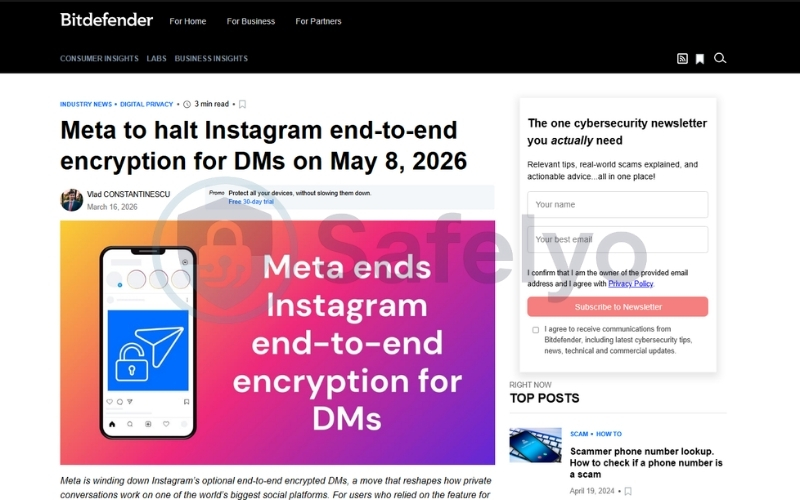
While Instagram previously supported optional end-to-end encrypted chats, Meta permanently removed E2EE support from Instagram DMs on May 8, 2026, citing low user adoption. Users seeking end-to-end secure messaging are now encouraged to use WhatsApp.
7.3. Facebook Messenger
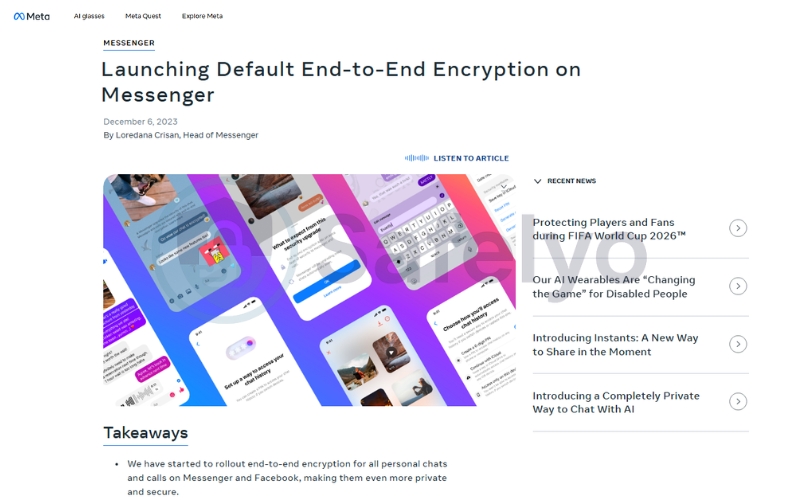
Facebook Messenger now uses end-to-end encryption (E2EE) by default for most personal chats, meaning your messages and calls are protected automatically. However, you can still verify that encryption is active for a specific conversation.
8. FAQs about end-to-end encryption
Can hackers break end-to-end encryption?
With current computing technology, it is mathematically impossible to brute force or crack modern E2EE algorithms. However, hackers can bypass this defense entirely by infecting your endpoint device with malware to steal your data before it is encrypted.
Does Telegram use end-to-end encryption?
No, Telegram does not enable this secure protocol by default for standard cloud chats. To protect your conversations from start to finish, you must manually initiate the “Start Secret Chat” feature within the specific contact’s profile settings.
Is online banking end-to-end encrypted?
No, financial institutions rely on standard transit encryption like TLS instead of E2EE. Banks require their application servers to decrypt and read your transaction data to successfully process money transfers, prevent fraud, and maintain financial compliance.
Can Apple read my iMessages or FaceTime calls?
No. iMessage and FaceTime utilize robust E2EE. In fact, Apple secured iMessage with PQ3, a cutting-edge post-quantum cryptographic protocol designed to protect messages against future decryption by quantum computers.
However, Apple can still access your legacy data if you use standard iCloud backups. To keep your decryption keys strictly on your devices, you must manually enable Advanced Data Protection in your iCloud settings
Does Zoom use end-to-end encryption for meetings?
Zoom offers E2EE as an optional feature, but it is not enabled by default for standard video conferences. You must manually activate the E2EE setting in your web portal before a meeting starts; this will temporarily disable certain features, such as cloud recording.
Can an administrator monitor my encrypted chats on a work device?
Yes, they can. Even if an application uses properly implemented E2EE, company-owned devices often have mobile device management (MDM) software or keyloggers installed. This software can capture your messages directly from your screen before the encryption process even occurs.
9. Conclusion
Understanding what is end-to-end encryption helps you identify exactly how your private messaging data is secured in transit. While E2EE serves as the strongest shield for the actual content of your conversations, it still leaves your system metadata and real IP address exposed to network monitors.
To achieve complete digital anonymity, you must cover these dangerous connection loopholes. We recommend pairing your encrypted messengers with a premium secure tunnel; explore our expert tutorials in the VPN Guides at Safelyo to reclaim total control over your digital footprint today.