
Whenever you connect to a secure wireless network or load a streaming application, you rely on invisible cryptographic locks. Many users see these technical acronyms and naturally wonder what AES-128 encryption actually means for their digital safety.
This comprehensive guide strips away the confusion to reveal the exact mathematics behind this global security standard. We will explore its fascinating history and explain how this specific algorithm actively defends your data against modern cyber threats in 2026.
Key Takeaways
- What is AES-128 encryption? AES-128 encryption is a symmetric block cipher that uses a single 128-bit key to scramble readable data into unreadable text through ten mathematical rounds.
- Optimal Performance: Because it requires fewer processing rounds than its larger variants, it provides an exceptional balance between elite security and high system speed.
- Everyday Protection: Its low processing overhead makes it the global standard for securing Wi-Fi networks, mobile messaging apps, and VPN tunnels.
- Quantum Threat: While it remains computationally infeasible to break today, experts are actively monitoring the future capabilities of quantum supercomputers.
1. What is AES-128 encryption?
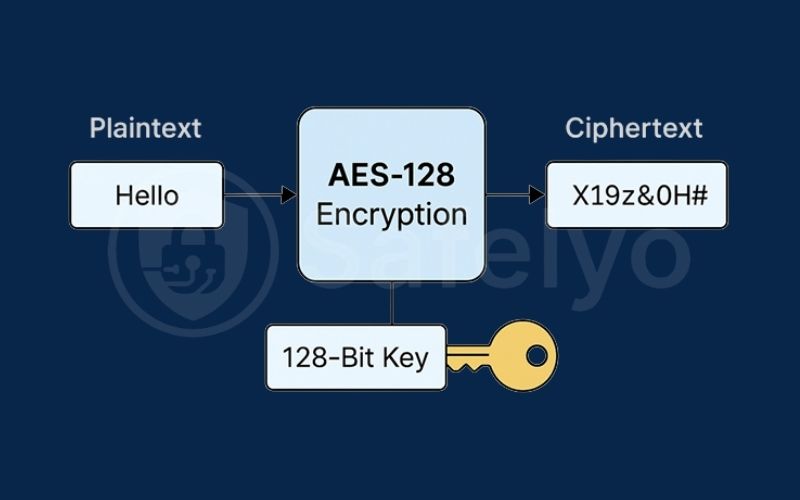
AES-128 (Advanced Encryption Standard 128) is a symmetric-key standard that uses a 128-bit secret key to convert readable plaintext into unreadable ciphertext. As a block cipher, it processes information in fixed 128-bit blocks through ten rigorous rounds of cryptographic transformations.
This specific protocol is widely implemented because it delivers an exceptional balance between high-level security and processing performance. Its relatively low computational overhead makes it ideal for securing Wi-Fi networks, VPN connections, and mobile messaging platforms without draining device resources.
Given the astronomical number of possible key combinations, this algorithm is considered computationally infeasible to break with current technology. It is officially approved for protecting sensitive government information and remains deeply trusted by cybersecurity professionals worldwide.
2. A brief history: From DES to the AES
To understand why AES-128 remains so important today, it helps to look at its origins. In 1977, the Data Encryption Standard (DES) became the primary encryption standard used by governments, financial institutions, and businesses to protect sensitive information.
However, as computing power increased throughout the 1990s, DES’s 56-bit key became increasingly vulnerable to brute-force attacks. In 1998, the Electronic Frontier Foundation demonstrated this weakness by cracking a DES-encrypted message in less than three days.
Recognizing the need for a stronger encryption standard, the National Institute of Standards and Technology (NIST) launched an international competition in 1997 to identify a secure and efficient successor. Cryptographers from around the world submitted candidate algorithms for evaluation.
Among the finalists was Rijndael, a cipher developed by Belgian cryptographers Joan Daemen and Vincent Rijmen. After extensive public review and testing, Rijndael was selected for its strong security, excellent performance, and flexibility across diverse computing environments.
In 2001, NIST officially adopted Rijndael as the Advanced Encryption Standard (AES) through FIPS 197. Today, AES remains one of the world’s most widely used encryption standards, protecting everything from Wi-Fi networks and VPN connections to cloud services and government systems.
3. How AES-128 encryption works step by step
To the average internet user, data security looks like digital magic, but it actually relies on a highly predictable mathematical sequence. To make this process easier to understand, we have simplified the core steps of AES-128 below.
3.1. The concept of symmetric keys and block ciphers
This specific security standard operates as a symmetric algorithm, meaning it uses the same encryption key to both encrypt and decrypt the information. Both the sender device and the receiving server must securely possess this shared key to communicate.
Furthermore, it is classified as a block cipher. Instead of encrypting your data one single bit at a time, the algorithm groups your readable plaintext into fixed blocks of 128 bits. It then processes each block individually through the entire mathematical cycle.
3.2. The ten rounds of cryptographic transformation
Once the data is divided into manageable blocks, the algorithm runs the information through distinct cycles known as encryption rounds. Each round applies a strict sequence of structural changes, helping maximize confusion and resistance to cryptanalytic attacks.
- Step 1: Key expansion and initial round. The algorithm expands the original 128-bit encryption key into eleven separate round keys. Before the first official round begins, the system performs an initial AddRoundKey operation that combines the plaintext with the first round key.
- Step 2: SubBytes transformation. In this phase, the algorithm substitutes every single byte of your data with a completely different byte using a predetermined lookup table. This introduces non-linear confusion, making it extremely difficult for attackers to identify meaningful patterns.
- Step 3: ShiftRows operation. The newly substituted bytes are arranged into a grid where the algorithm systematically shifts the rows to the left. This structural scrambling ensures that the data is spread evenly across the block to destroy any traces of the original formatting.
- Step 4: MixColumns transformation. The algorithm then applies a complex mathematical function to mix the data vertically within each column. This process provides massive cryptographic diffusion, spreading the data further across the entire 128-bit block.
- Step 5: Add Round Key. Finally, the unique round key generated during the expansion step is mathematically added to the current grid. The entire process then repeats for ten full rounds, with the final round skipping the column mixing step to produce the ciphertext.
3.3. The avalanche effect
One of the most important security properties of AES-128 is the avalanche effect. If you change a tiny detail in the input, even a single bit, the algorithm produces a dramatically different ciphertext output.
This unpredictable behavior prevents attackers from predicting how changes in the plaintext affect the encrypted result. It is the core reason why this standard remains incredibly secure against advanced structural analysis and hacking attempts.
4. Where is AES-128 used in everyday life?
While military-grade cryptography sounds like a tool reserved for top-secret government facilities, you interact with this algorithm constantly. Because it strikes the perfect balance between robust security and low processing power, it is embedded in almost every modern digital device.
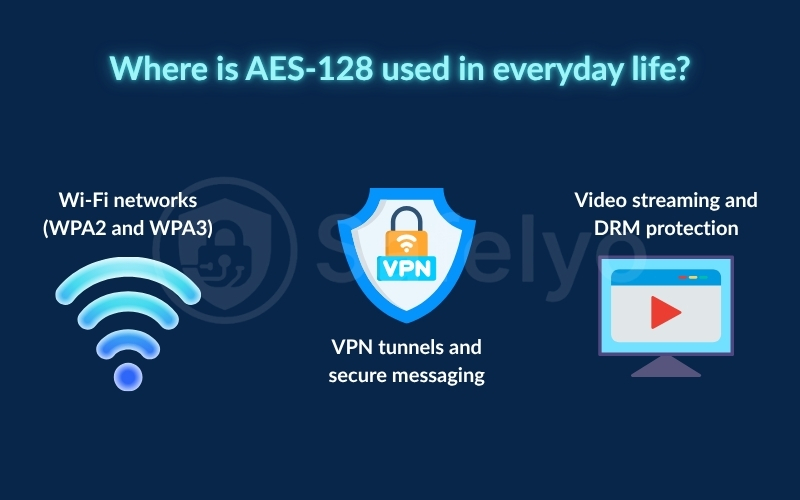
- Wi-Fi networks (WPA2 and WPA3)
Every time you connect your smartphone to a home router or a public coffee shop network, AES-128 goes to work. It serves as the core encryption standard behind WPA2 and modern WPA3 wireless security protocols.
This algorithm scrambles the data traveling between your device and the router through the air. This essential security layer ensures that local hackers sitting on the same network cannot intercept your passwords or monitor your private browsing history.
- Video streaming and DRM protection
Major entertainment platforms like Netflix, Amazon Prime, and VdoCipher heavily rely on this algorithm for Digital Rights Management (DRM). They use it to securely encrypt their vast video libraries before broadcasting the content over the internet.
Because AES-128 requires very little processing overhead, it can decrypt high-definition video files in real-time without causing frustrating buffering issues. This protects the streaming platforms against digital piracy while maintaining a smooth, high-quality viewing experience for paying subscribers.
- VPN tunnels and secure messaging
When you use end-to-end encrypted messaging applications like WhatsApp, this symmetric block cipher often operates in the background. It locks your private texts and voice calls instantly, ensuring no third-party network monitors can read your conversations.
Similarly, many premium Virtual Private Networks (VPNs) offer AES-128 as a highly efficient encryption option. It is widely favored by mobile users who want to protect their public Wi-Fi connections while maximizing their daily smartphone battery life.
5. AES key sizes explained: 128 vs. 192 vs. 256-bit
While all three variations of the Advanced Encryption Standard share the same mathematical foundation, they differ in key length, computational rounds, and common use cases. The comparison table below outlines these technical variations side by side.
| AES Version | Key Length | Rounds | Common Use Cases |
|---|---|---|---|
| AES-128 | 128 bits | 10 | Wi-Fi networks, consumer VPNs, and messaging apps |
| AES-192 | 192 bits | 12 | Specialized enterprise and compliance environments |
| AES-256 | 256 bits | 14 | Highest AES security level for sensitive government data |
Mathematical complexity and key space
The difference in key sizes represents an exponential scale in overall security margins. Because key space increases exponentially, a 256-bit key offers 2¹²⁸ times more potential combinations than a 128-bit key.
Attempting to brute-force a 128-bit key is computationally infeasible. Breaking this key would require an astronomically large amount of computing power far beyond any existing or foreseeable technology.
Why is AES-192 uncommon?
Although AES-192 offers a logical middle ground, it is relatively uncommon in real-world deployments. Most software developers and organizations choose the other two options instead.
They typically implement AES-128 for its high performance efficiency or leap straight to AES-256 for maximum security. This leaves the 192-bit version underutilized with very few practical advantages in the industry.
Performance overhead and hardware acceleration
While larger key sizes introduce a modest computational overhead, the real-world performance difference is often completely negligible. Modern processors feature built-in hardware acceleration to optimize these heavy calculations.
Taps like Intel AES-NI, AMD AES, and ARM Cryptography Extensions handle these processes directly on the chip. In isolated cryptographic benchmarks, AES-128 can be noticeably faster than AES-256, but this speed gap is practically imperceptible on modern consumer devices.
Government standards and security margins
Historically, U.S. government guidance allowed AES-128 to protect many categories of sensitive information, reflecting its exceptionally strong security properties. This standard is still widely utilized across both public and private sectors.
Today, AES-256 is often preferred for the most sensitive government and long-term security applications. This preference exists simply because it provides a much larger theoretical security margin against emerging decrypting systems.
6. AES-128 vs. other encryption standards
While the Advanced Encryption Standard is the most popular choice today, it is not the only cryptographic algorithm in existence. Understanding how it compares to older legacy systems and alternative architectures is essential for evaluating your overall data security.
- Legacy standards: DES and 3DES
Developed in 1977, the Data Encryption Standard (DES) was the global benchmark for decades. However, its small 56-bit key size eventually became highly vulnerable, and modern computers can now crack it in under a single day.
Triple DES (3DES) was designed as a temporary fix by running the DES algorithm three times consecutively. While more secure, its three-step process is slow and highly inefficient, leading the National Institute of Standards and Technology to formally deprecate it.
- Alternative architectures: RSA
Unlike the symmetric structure of AES, Rivest-Shamir-Adleman (RSA) is an asymmetric algorithm. It uses a mathematical pair of keys (public and private) to secure data rather than a single shared key.
Because asymmetric math is highly resource-intensive, RSA is too slow for encrypting large bulk files. Instead, organizations use it for secure key exchange and digital signatures, while AES-128 handles the actual high-speed payload encryption.
7. Is AES-128 still secure in 2026?
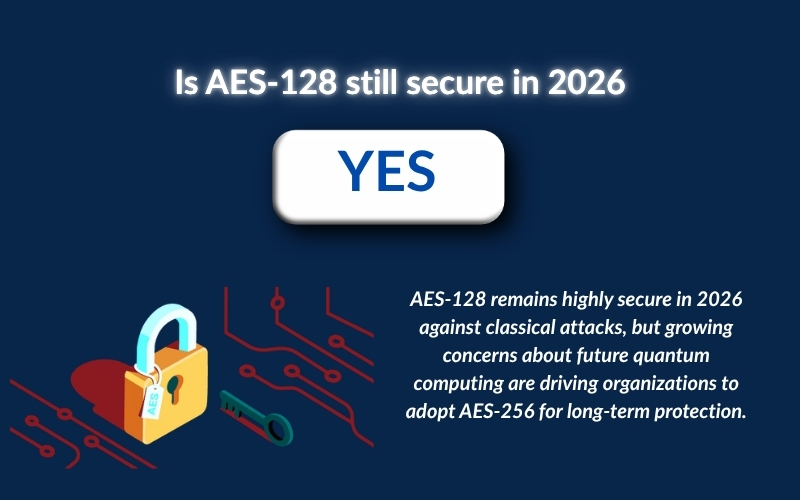
With rapid advancements in artificial intelligence and supercomputing hardware, many users wonder if a standard established in 2001 can survive modern threats. The short answer is yes, but the long-term reality requires a deeper understanding of emerging cryptographic technologies.
- The reality of brute-force attacks
A brute-force attack involves hackers systematically guessing every single possible key combination to unlock your data. Against weak passwords, this method is highly effective, but against a 128-bit key, the mathematics tell a completely different story.
With 2¹²⁸ possible combinations, even the most powerful network of modern supercomputers would require billions of years to guess the key correctly. Therefore, attacking the underlying algorithm remains computationally infeasible using current technology, keeping your data entirely safe from modern brute-force tactics.
- The quantum computing threat
The only credible theoretical threat to this standard comes from the impending arrival of powerful quantum computers. Cybersecurity experts are particularly concerned about Grover’s algorithm, a quantum technique designed to accelerate brute-force search attacks exponentially.
This specific algorithm can theoretically halve the effective key length of symmetric ciphers, reducing a 128-bit key to just 64 bits of quantum security. Because 64 bits is considered highly vulnerable, a mature quantum computer could potentially crack this encryption in a reasonable timeframe.
While practical quantum machines capable of this feat do not exist yet, the threat of “harvest now, decrypt later” campaigns is driving a major industry shift. To protect sensitive data against future decryption, enterprises are increasingly adopting 256-bit keys to future-proof their security infrastructure.
8. Why key management matters more than key length
A common misconception in digital security is focusing entirely on the size of the encryption algorithm. In reality, the mathematical framework is rarely the weakest link in your corporate or personal network security chain.
8.1. The reality of modern cyberattacks
Hackers do not waste time or computing power trying to break computationally infeasible mathematics. Instead, they focus entirely on exploiting human error through phishing scams or stealing poorly protected user passwords.
If a malicious actor successfully tricks an employee into handing over their credentials, they bypass the encryption completely. Once they possess the secret unlocking key, the mathematical strength of the underlying algorithm becomes entirely irrelevant.
8.2. Secure storage and hardware modules
Generating a secure key is useless if you leave it exposed on a public server. Enterprise networks often utilize Hardware Security Modules to isolate their cryptographic keys physically from the main network.
These specialized physical devices act as digital vaults for the keys themselves. This architecture ensures that even if a hacker successfully breaches the main software servers, they cannot extract the physical keys needed to read the data.
8.3. The importance of key rotation
Cybersecurity experts also rely heavily on continuous key rotation to limit potential data breaches. This practice involves retiring old passwords and generating fresh encryption keys on a strict administrative schedule.
By changing the active keys regularly, administrators drastically minimize the amount of data exposed if a single key is eventually compromised. This proactive management strategy is far more effective for long-term security than simply upgrading to a larger key size.
9. FAQs about AES-128 encryption
Is AES-128 symmetric or asymmetric?
It is a symmetric block cipher. This means it uses a single secret key to perform both the initial data encryption and the final decryption process. Both communicating parties must possess this shared key for the security transfer to function correctly.
Can AES-128 be hacked?
Currently, it is considered mathematically and computationally infeasible to break using any existing modern technology. Hackers do not break the underlying algorithm; instead, they steal the secret keys through phishing attacks, malware, or by exploiting weak server management protocols.
Why is AES-128 faster than AES-256?
The speed difference directly relates to the number of mathematical processing rounds required. The 128-bit version processes data through 10 rounds, while the 256-bit version requires 14 rounds. Fewer cryptographic cycles mean your device uses less CPU power, resulting in slightly faster data transfers.
Why did AES replace DES?
The older Data Encryption Standard used a tiny 56-bit key that became entirely too weak against advancing computer processing power. The National Institute of Standards and Technology adopted the Advanced Encryption Standard to provide a vastly larger key space and a much stronger mathematical defense.
Does AES-128 drain smartphone batteries?
No, it is actually highly optimized for modern mobile devices. Its lightweight ten-round architecture requires minimal CPU processing power to encrypt your data. This efficiency significantly extends your daily battery life while keeping your wireless connections totally secure.
10. Conclusion
Understanding exactly what is AES-128 encryption reveals why it remains the absolute workhorse of global cybersecurity in 2026. By striking an elegant balance between low processing overhead and an astronomically secure mathematical framework, it provides the perfect foundation for protecting our daily digital lives against unauthorized access.
While future quantum computers may eventually force a shift toward larger key sizes, this algorithm remains practically unbreakable today. To see how top providers implement this powerful technology to keep you safe, explore our expert reviews in the Privacy & Security Basics category at Safelyo and secure your digital footprint today.