
When your startup has five remote employees, a standard security router provides more than enough protection. However, when thousands of workers access your corporate database globally, you need a dedicated enterprise solution to prevent your system from crashing. If you are exploring what is a VPN concentrator our Safelyo cybersecurity experts will explain exactly how this powerful control center secures massive remote workforces efficiently.
Key Takeaways
- Direct Answer: A VPN concentrator is a specialized networking device that authenticates, encrypts, and manages thousands of simultaneous remote connections to a central corporate network.
- The Ultimate Gatekeeper: It acts as a highly secure checkpoint at the edge of your private network, ensuring only authorized users gain access to internal company files.
- Hardware and Software Forms: These control centers are available as dedicated physical appliances or as modern virtualized software running on cloud servers.
- Built for Enterprise Scale: Unlike a personal security application, this tool is specifically engineered for large businesses, healthcare systems, and universities requiring controlled connectivity.
1. What is a VPN concentrator?
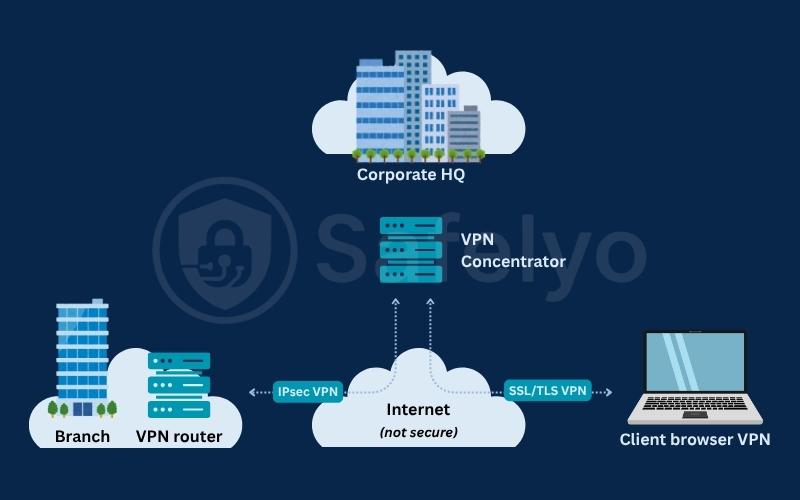
A VPN concentrator is a dedicated hardware or software device that authenticates and manages thousands of simultaneous encrypted connections. You can picture it as a massive secure toll booth where every single lane represents a private tunnel for a remote employee entering the company network.
This powerful device sits at the edge of your corporate network, acting as an impenetrable checkpoint for inbound traffic. Unlike a standard router that simply moves data around, this specialized tool handles the heavy lifting of deep encryption processing and user authentication.
By acting as a central control hub, it instantly decrypts incoming traffic, applies strict security policies, and routes data to the correct internal servers. This ensures safe and controlled connectivity for massive global workforces without crashing your main enterprise network.
2. Types of VPN concentrators and top providers
When planning a network upgrade, administrators must choose between physical appliances and virtualized software. Understanding these deployment options and knowing the top industry brands is critical for balancing your budget with your specific corporate needs.
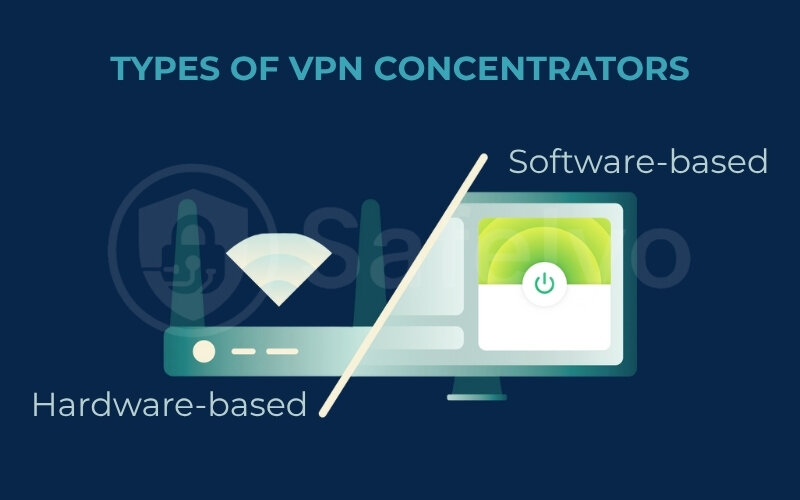
2.1. Hardware-based VPN concentrators
These are dedicated physical appliances sized specifically for the number of secure connections your business requires. They feature dedicated cryptographic processors optimized exclusively for heavy encryption workloads and terminating tunnels.
Hardware models are the traditional choice for massive enterprises demanding absolute maximum network performance. While they offer unmatched stability, they require a significant upfront financial investment to install inside your corporate server rack.
2.2. Software-based and open-source concentrators
Organizations with tight budgets can deploy software-based solutions on their existing servers or utilize cloud virtual machines. There are various open-source projects available that allow you to configure your own secure system entirely from scratch.
While these virtual solutions eliminate expensive hardware costs, they demand extensive technical expertise. Configuring an open-source control center manually is often incredibly tedious and difficult, making it impractical for teams without dedicated network engineers.
2.3. The most popular VPN concentrator brands
The enterprise network security market features several major technology brands that cater to specific business requirements. The best provider for your company depends entirely on your internal operational scale and budget.
- Cisco Meraki: This company is one of the top producers in the industry. Their devices are surprisingly simple to configure and serve as an ideal solution for extremely large corporate environments.
- ShoreTel: This brand is highly favored by enterprise telecommunication teams. They provide specialized capabilities for establishing secure telephone networks and effortlessly encrypting internal IP phones.
- Aruba: This provider offers highly practical networking tools for modern enterprises. Their hardware excels at seamlessly connecting distributed remote users back to your central company infrastructure with minimal latency.
3. How does a VPN concentrator work?
Unlike a standard security router, this device is specifically engineered to authenticate users, manage encryption keys, assign IP addresses, and maintain thousands of encrypted tunnels simultaneously. It serves as the ultimate high-capacity command post for your corporate network.
When remote employees access the network, the concentrator manages the entire cryptographic workload automatically. Safelyo networking experts have outlined the complete technical connection flow below to demonstrate how this hardware secures massive enterprise traffic.
3.1. The step-by-step connection flow
Understanding the exact sequence of events helps clarify why this hardware is so critical for enterprise security. Every single time a remote worker logs in, the system executes a rapid series of automated checks to guarantee absolute data protection.
- Step 1: Connection request. A remote device attempts to access the corporate network by sending an initial secure request over the public internet.
- Step 2: Authentication. The concentrator strictly verifies user identities using multi-factor authentication or digital certificates to block rogue endpoints.
- Step 3: Key exchange. The device negotiates cryptographic parameters and manages encryption keys to establish a highly secure communication pathway.
- Step 4: IP assignment. The concentrator assigns a unique internal IP address, making the remote laptop appear physically connected to the local office.
- Step 5: Data transfer. All outgoing traffic is wrapped in an encrypted payload, ensuring sensitive company data remains completely invisible to outsiders.
- Step 6: Routing. The hardware decrypts incoming packets and seamlessly forwards the clean data to the correct internal server or database.
3.2. Supported encryption protocols
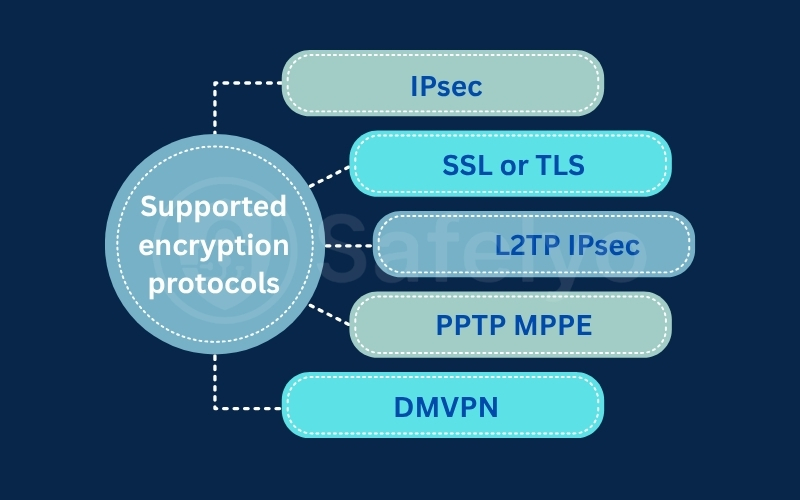
These devices do not just establish tunnels; they actively manage the protocols that dictate how data travels and gets encrypted. Most enterprise concentrators support several protocols simultaneously, allowing administrators to select the optimal method for each specific business use case.
- IPsec: The most widely used standard for enterprise networks, operating at the network layer to encrypt entire IP packets. It is particularly well suited for stable remote access and permanent site-to-site tunnels.
- SSL/TLS: Browser-based protocols that allow users to connect securely through a standard web browser without installing separate software. This is highly useful for organizations where deploying client software is restricted.
- L2TP/IPsec: Layer 2 Tunneling Protocol combined with IPsec for encryption. This serves as a legacy fallback option useful for connecting older corporate hardware that does not support newer standards.
- PPTP/MPPE: An older tunneling protocol with known security vulnerabilities that is now considered obsolete. Modern enterprise environments have completely moved away from this standard due to security risks.
- DMVPN: Dynamic Multipoint VPN simplifies the configuration of massive networks. It allows the hardware to build secure tunnels dynamically between remote branches without requiring manual pre-configuration for every single connection.
3.3. Scalability and load-balancing capabilities
What truly separates this hardware from consumer tech is its ability to handle immense network stress. High-end concentrators are designed to manage thousands of concurrent connections simultaneously without crashing or dropping active user sessions.
Furthermore, modern enterprise models feature advanced load balancing capabilities. If one internal server becomes overwhelmed by remote traffic, the concentrator intelligently distributes the user load across multiple backup servers to prevent network bottlenecks and ensure uninterrupted productivity.
4. Key benefits of using a VPN concentrator for businesses
Why do major corporations invest tens of thousands of dollars into specialized security hardware instead of using standard commercial routers? Our Safelyo security experts have analyzed these enterprise deployments to reveal the precise operational advantages they deliver.
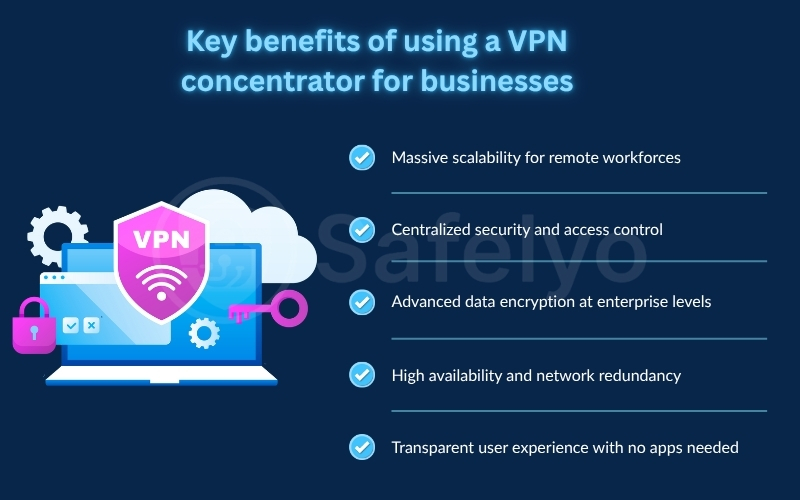
- Massive scalability for remote workforces
When a company transitions to a global remote model, a standard office router will instantly crash under the heavy data load. This specialized hardware effortlessly generates thousands of parallel encrypted tunnels, allowing a massive workforce to connect without experiencing network latency.
- Centralized security and access control
Managing individual software configurations for thousands of remote employees across the globe is a logistical nightmare. This hardware centralizes your entire network architecture so your IT department can enforce strict security policies from a single command post.
Through this unified dashboard, administrators can implement fine-grained access controls. This creates powerful network segmentation, which ensures that unauthorized users cannot move freely through your sensitive corporate databases if a single endpoint is compromised.
- Advanced data encryption at enterprise levels
Remote employees frequently access company servers from highly vulnerable public networks at airports or local cafes. This hardware ensures every piece of data is protected by military-grade encryption protocols before it ever leaves the employee device to prevent unauthorized interception.
- High availability and network redundancy
Enterprise networks cannot afford sudden downtime if a single piece of hardware fails during business hours. Administrators can configure these powerful devices in a primary-secondary failover arrangement so that a backup unit kicks in instantly if the main system fails.
Furthermore, these devices utilize intelligent load balancing to distribute incoming traffic evenly across multiple corporate servers. This prevents any single connection point from becoming a bottleneck, ensuring your staff experiences uninterrupted operational continuity during peak hours.
- Transparent user experience with no apps needed
One major benefit of this network security solution is that it does not rely on a standard client-server model. Employees do not need to install complex software or remember to log into a privacy application before starting their daily remote work.
Because the physical gateway hardware handles all the encryption automatically in the background, the entire process is completely invisible. This seamless integration drastically reduces onboarding friction and lowers the daily technical support workload for your IT team.
5. The limitations of VPN concentrators
Despite their immense security benefits, these powerful devices are not a universal remedy for every corporate network. You must carefully weigh the significant financial and administrative trade-offs before committing your business to a large-scale hardware deployment.
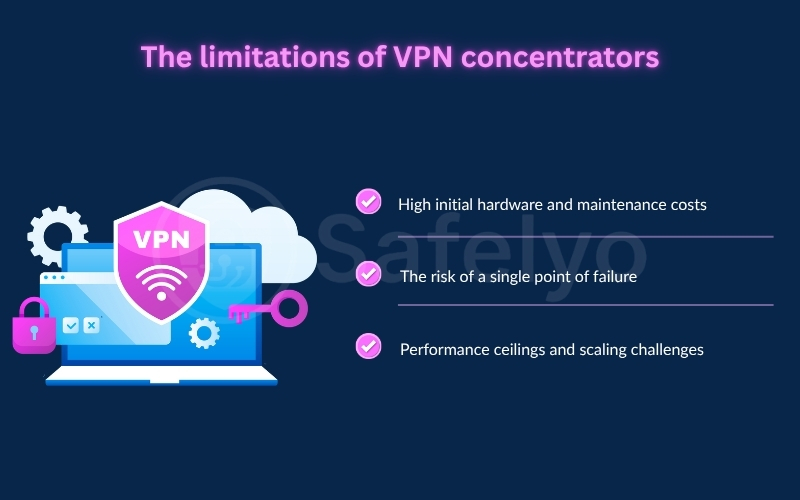
- High initial hardware and maintenance costs
Deploying an enterprise-grade security appliance requires a massive upfront financial investment. Depending on your required data throughput and user capacity, purchasing the physical hardware from top vendors can cost tens of thousands of dollars before installation even begins.
Furthermore, configuring and managing these complex devices demands specialized network engineering expertise. Most organizations must hire dedicated IT professionals or external contractors to maintain the system properly, which adds a massive ongoing expense to the total cost of ownership.
- The risk of a single point of failure
Centralization is the biggest administrative strength of this architecture, but it is also its most significant vulnerability. Because all remote traffic funnels directly through one specific hardware device, it creates a massive structural risk for your entire global workforce.
If the concentrator hardware experiences a catastrophic failure or loses power, every single remote employee is instantly disconnected. Unless your company invests heavily in redundant backup systems, a single hardware glitch will completely halt your business operations worldwide.
- Performance ceilings and scaling challenges
Every physical security appliance has a strict maximum limit on how much encrypted traffic it can process simultaneously. When your user base scales rapidly, the available bandwidth may become insufficient, leading to severe network latency and poor application performance.
Scaling up your services to fix these bottlenecks is incredibly challenging with physical hardware. Expansion often requires purchasing and installing additional hardware concentrators, which significantly increase your structural complexity and demand further massive capital investments.
6. VPN concentrator vs other networking solutions
Many business owners struggle to choose between different secure network setups because the technical terminology sounds so similar. Each of these technologies is designed for a very specific operational scale, deployment scenario, or protocol level.
The quick comparison table below outlines how these solutions differ in their primary roles and capabilities.
| Solution | Primary Use | Deployment Type | Target Scale |
|---|---|---|---|
| VPN Router | Secures local office Wi Fi | Hardware at a single site | Tens of users |
| Site-to-Site VPN | Links to permanent office locations | Gateway to gateway tunnels | Entire office networks |
| VPN Client | Secures a single remote user device | Software app on PC or phone | One device at a time |
| IPsec Encryption | Encrypts and secures IP packets | Cryptographic protocol suite | Applied to data packets |
| VPN Concentrator | Manages massive remote workforces | Central gateway command post | Thousands of users |
6.1. VPN concentrator vs VPN router
A VPN router is essentially a general-purpose device that secures all network traffic within a single physical office location, making it ideal for small businesses. Conversely, a VPN concentrator is a highly specialized enterprise gateway built exclusively to manage and encrypt thousands of remote tunnels simultaneously.
6.2. VPN concentrator vs site-to-site VPN
A site-to-site VPN is a permanent virtual bridge designed to link entire separate office networks together as if they were situated in the same building. Conversely, a VPN concentrator acts as a secure front gate, allowing a highly distributed mobile workforce to connect to the central headquarters on the fly.
6.3. VPN concentrator vs VPN client
A VPN client is the software application installed on an individual laptop or smartphone to establish a single secure connection to a server. Comparing them is like contrasting a personal taxi to a massive transit hub; both secure your data transit, but they operate on completely different structural scales.
6.4. VPN concentrator vs IPsec encryption
These two concepts are not mutually exclusive. IPsec is a network layer protocol suite designed to physically encrypt and authenticate individual data packets, whereas a VPN concentrator is the server-side gateway device that utilizes IPsec protocols to establish and manage those secure tunnels.
7. Are hardware VPN concentrators becoming obsolete?
In the enterprise networking landscape of 2026, the traditional model of routing massive remote traffic through a physical box is facing a massive paradigm shift. The rapid transition to decentralized cloud environments has led many organizations to question whether physical concentrator hardware is still a necessary long-term investment.
As corporate resources migrate from local on-premises servers to SaaS applications and public clouds, the role of the security gateway is evolving. Modern network architectures are shifting toward cloud-native models that prioritize agility, security, and lower maintenance overhead.
- The rise of Cloud VPNs and VPN as a Service
Rather than maintaining expensive physical server racks, modern businesses are rapidly transitioning to VPN as a Service (VPNaaS) models. These cloud-delivered solutions shift the entire cryptographic workload from local gateways to globally distributed virtual cloud networks.
This transition eliminates the high upfront cost of purchasing enterprise hardware and provides seamless scalability for growing teams. If your remote workforce suddenly doubles, you can instantly allocate more cloud processing power with a single click, completely bypassing physical hardware capacity ceilings.
- Zero Trust Network Access as the modern alternative
The most significant technological threat to traditional tunnels is the rapid corporate adoption of Zero Trust Network Access (ZTNA) frameworks. Traditional networks grant broad internal access once a user is verified, creating a massive security vulnerability if an endpoint is compromised.
ZTNA operates on a strict security policy of “never trust, always verify” regardless of the user’s network location. Instead of bridging entire local networks together, these modern architectures grant access to specific authorized applications only, preventing malicious lateral movement and securing remote access effectively.
8. FAQs about VPN concentrator
Do I need a VPN concentrator for my home network?
No, this enterprise hardware is far too expensive, loud, and complex for household use. For standard home privacy or bypassing streaming geo blocks, you only need a premium personal VPN application or a basic VPN enabled home router.
Where is a VPN concentrator placed on a network?
In standard corporate architectures, the device is deployed at the network edge, positioned directly behind the main firewall. It typically resides within a Demilitarized Zone (DMZ) to safely screen all inbound remote traffic before it can access your internal local servers.
What are some popular VPN concentrator brands?
The enterprise network security market is dominated by several major hardware and software vendors. The most trusted physical and virtual appliances are manufactured by industry leaders such as Cisco, Palo Alto Networks, Fortinet, and Aruba.
Can a VPN concentrator slow down internet speed?
While encryption introduces some computational overhead, modern hardware is designed to prevent performance drops. Slowdowns are usually caused by insufficient internet bandwidth at your corporate office or an undersized device that is struggling to handle too many simultaneous tunnels.
Can a VPN concentrator connect to cloud networks like AWS or Azure?
Yes, modern businesses frequently deploy virtual concentrators directly within cloud environments. This allows your physical office networks to establish secure tunnels to virtual private clouds hosted on platforms like Amazon Web Services (AWS) or Microsoft Azure seamlessly.
What is the main purpose of a VPN tunnel?
The primary purpose of a VPN tunnel is to establish a secure, private, and encrypted communication channel over an untrusted public network. It safely shields your business data from interception as it travels between a remote employee and the corporate private network.
9. Conclusion
Understanding exactly what is a VPN concentrator is essential for any business transitioning to a permanent hybrid work model. While the physical hardware requires significant financial investment, its unique ability to secure thousands of simultaneous connections centrally remains unmatched by standard office routers.
Making the right decision for your corporate infrastructure is critical for long-term data protection and scalability. To explore more advanced configurations, hardware deployment options, and expert security tutorials, visit our comprehensive VPN Guides at Safelyo to secure your enterprise network with absolute confidence.